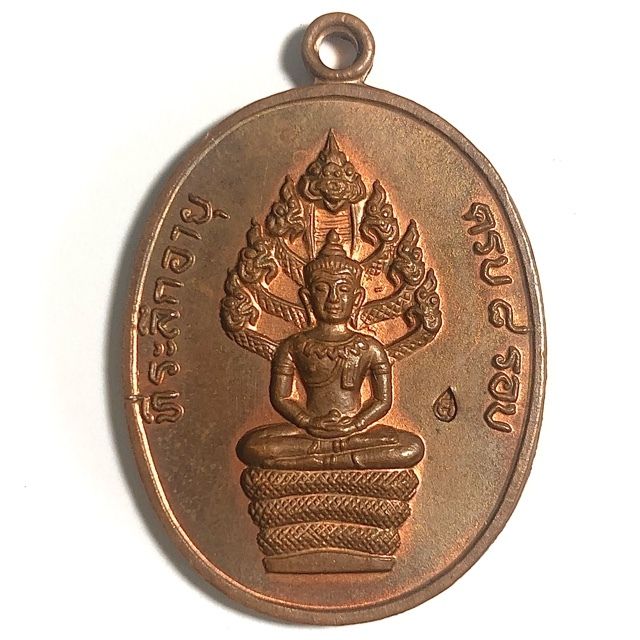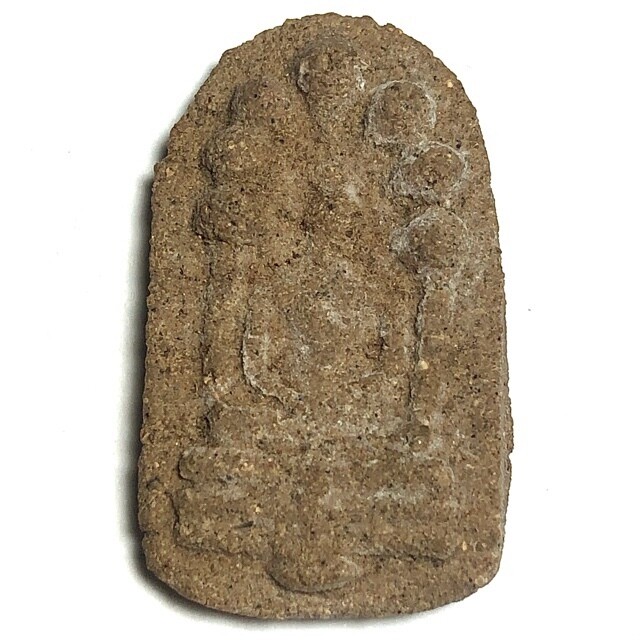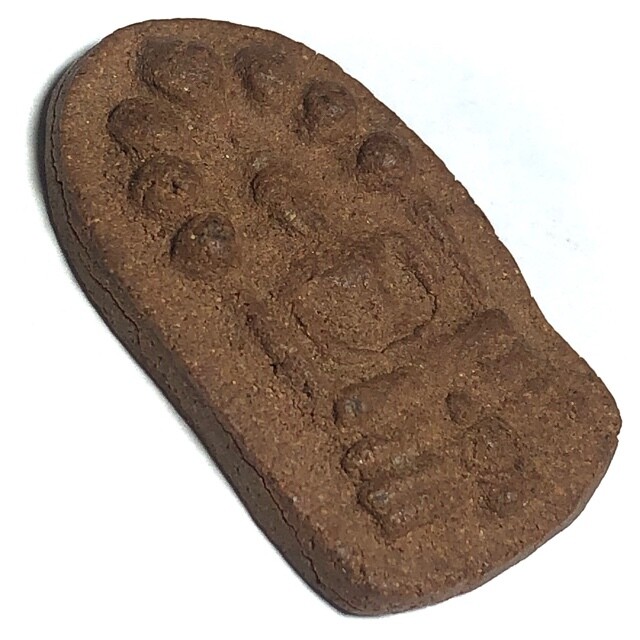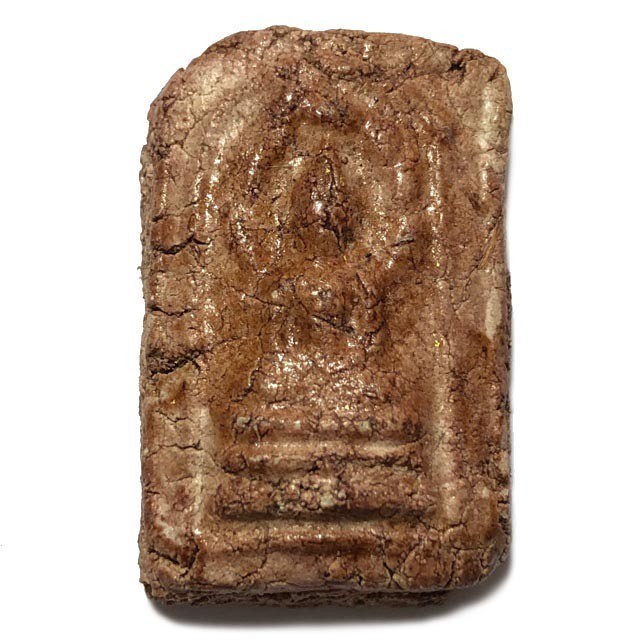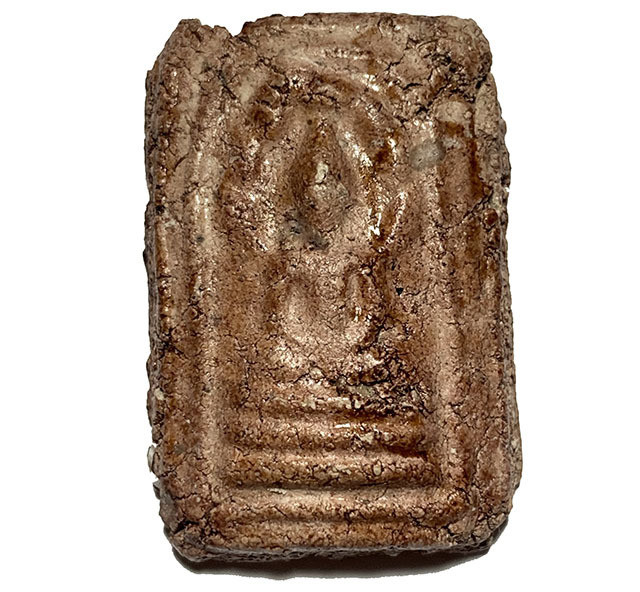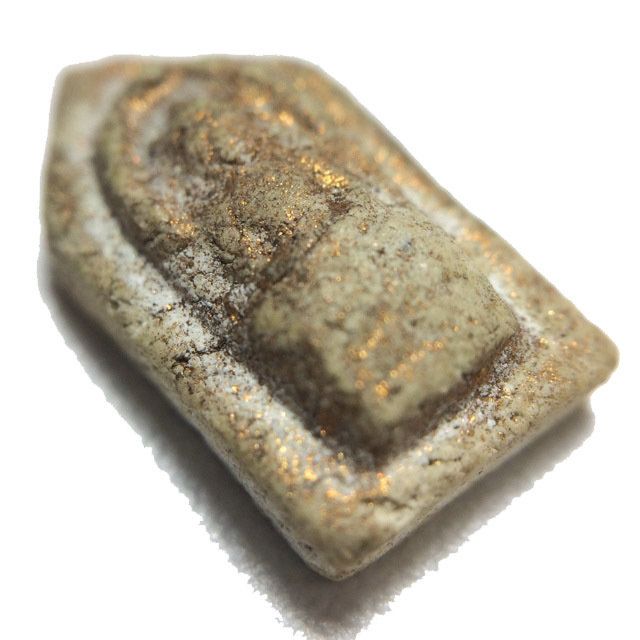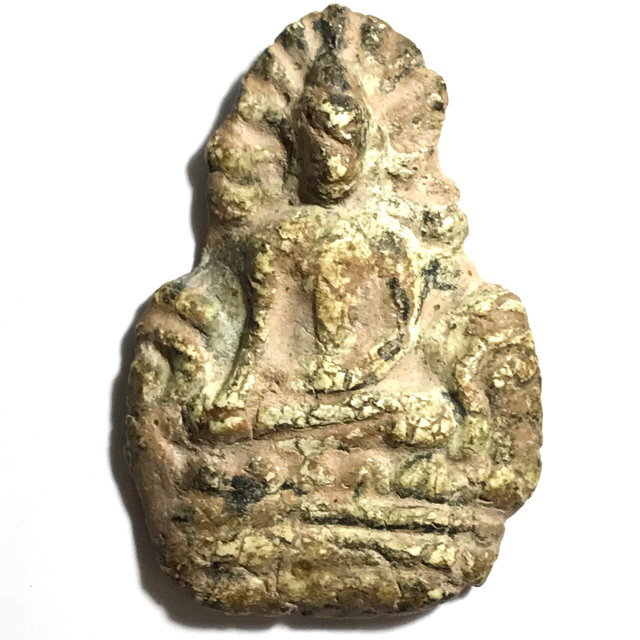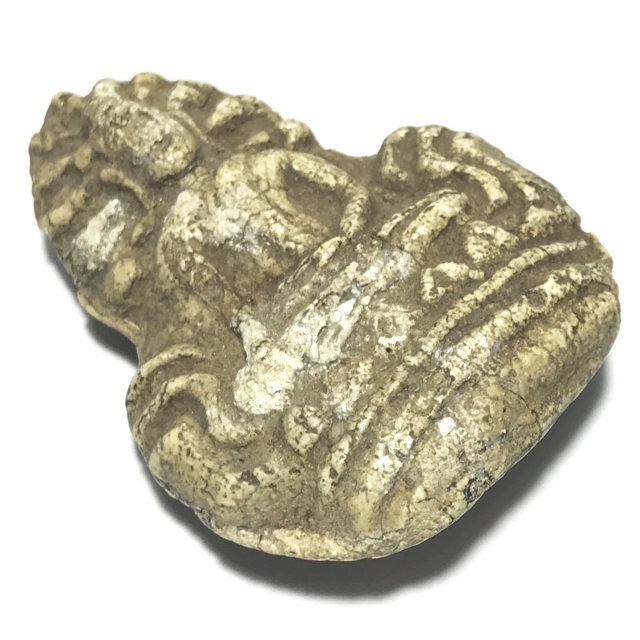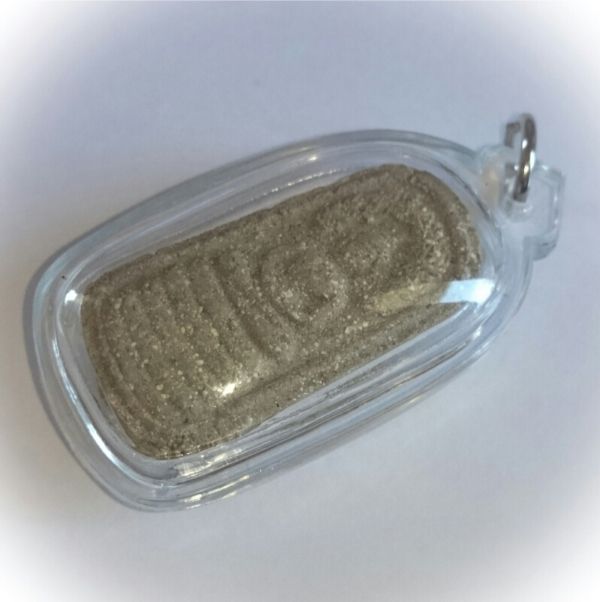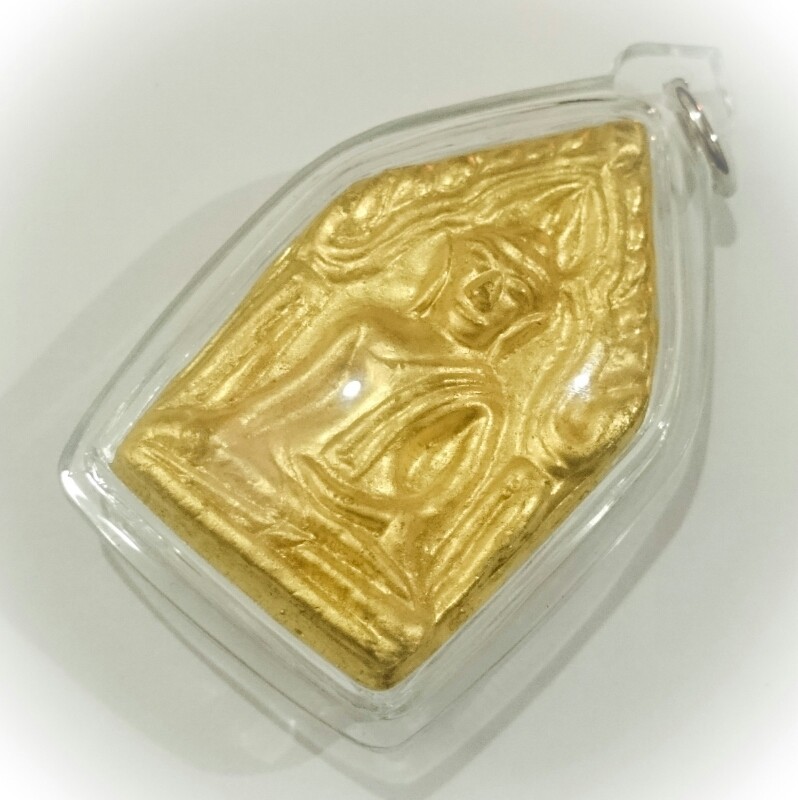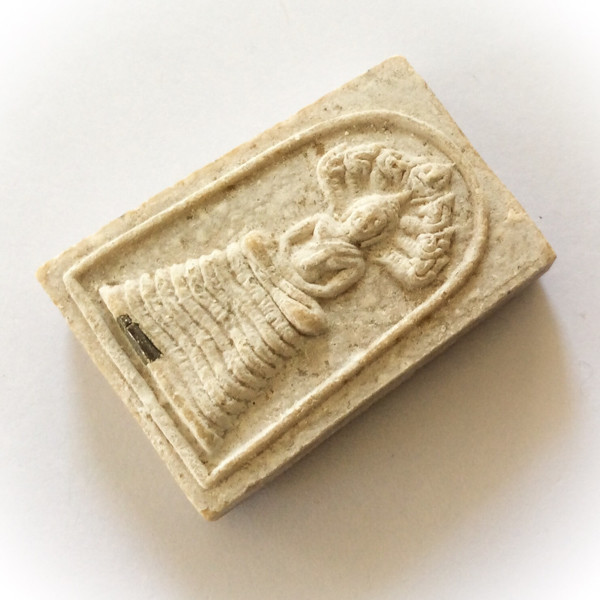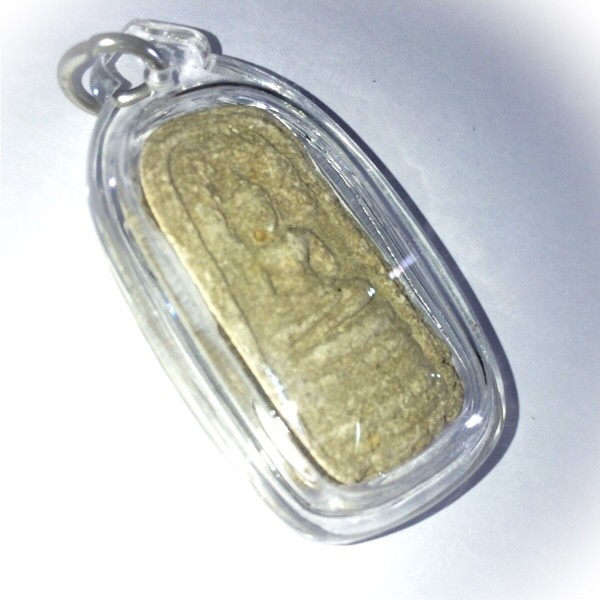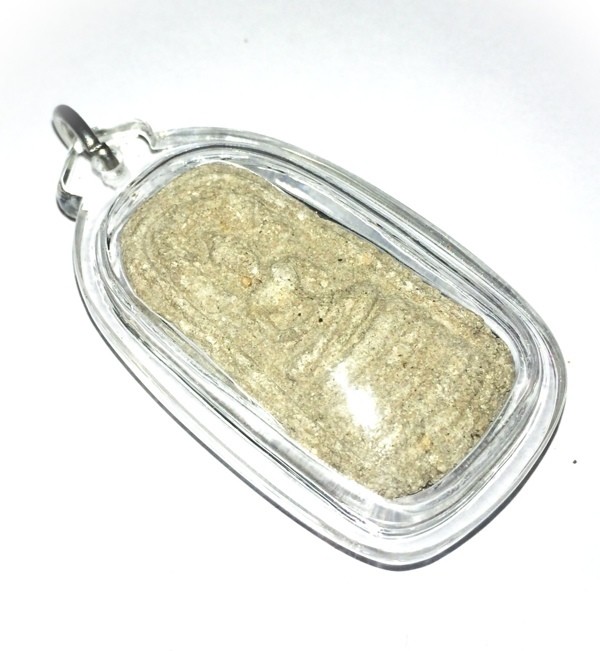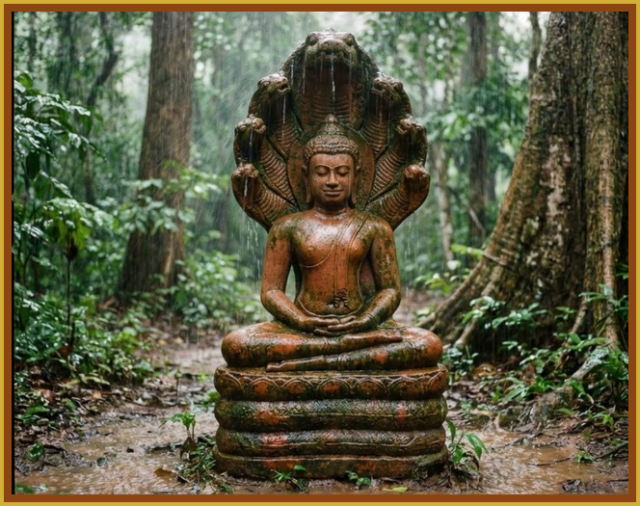
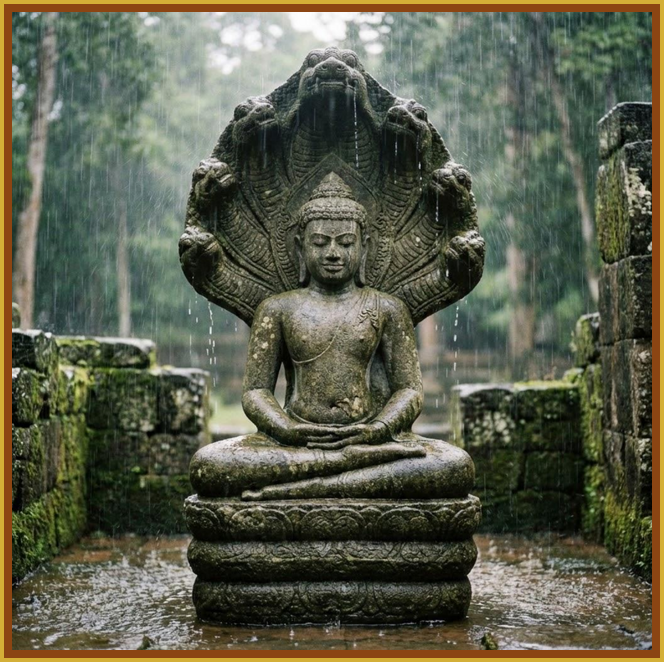
After his Enlightenment, the Buddha went to meditate under the Mucalinda tree (a jackfruit tree) during the sixth week of his ascetic practice. During this period, a heavy storm raged continuously for seven days. The Nāga king Muchalin emerged from the underground, coiling its body seven times around the Buddha. It then spread out its seven-headed hood over him, forming an umbrella that protected him from both the rain and malevolent creatures, according to Buddhist tradition.
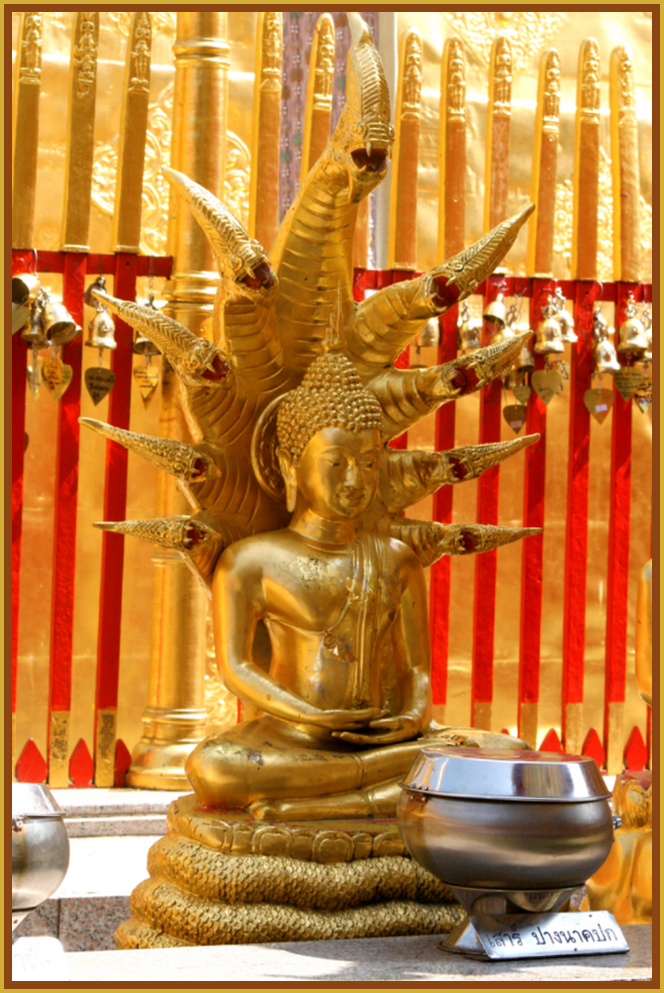
The Pali Tipiṭaka records that one week after his Enlightenment, the Buddha sat in meditation beneath the Mucalinda (jackfruit) tree at Prachin (or the Bodhgaya area), when a heavy rain fell. The nāga king named Muchalin emerged from the underworld, coiling its body into seven coils to support the Buddha’s seat, and then spread out its seven-headed hood to shelter the Buddha from the rain and demonic disturbances. When the rain stopped, the nāga transformed into a young Brahmin, bowed before the Buddha, and asked to give up his mortal life. The English Pali text (Udāna) describes this event clearly: “Muchalin, the nāga-king, left his dwelling place…encircled the Lord’s body seven times…and stood with his great hood over the Lord’s head…in order to prevent wind and rain from harming the Lord.”. Similarly, in the Vinaya (monastic code) there is evidence that Muchalin also revealed his Brahmin form at the end of the episode. Later Buddhist commentaries explain that the nāga’s act symbolizes the merit of steadfast faith: “Those who are full of unshakable truth, if they honor these deities, they will bring protection to us” (Udāna Commentary). Ancient Chinese and Sanskrit Buddhist texts (e.g. the Mahāvastu and the Mahāyāna Lalitavistara) contain similar stories, noting that the nāga-king Muchalin was a great nāga who revered the Buddha and once used his nāga-parasol to shield the Buddha from a great storm during meditation (Lalitavistara 19.15). The notion of the “Nākatanāmāna Muchalin” (the nāga-King Muchalin) even appears in Emperor Ashoka’s inscriptions, corroborating this episode.
Classification of Nagas and Mythical Beings in Tradition
Nagas (nāga; Thai naak) in original Indian belief are serpent-like semi-divine beings associated with water, treasures, and fertility. In the Buddhist cosmos, they are regarded as second-tier deities (a class of subterranean gods) inhabiting the “Naga realm.” Some dwell in rivers, streams, or the ocean (water is the element of the Nāga); others live in underground cave chambers. Nagas are attendants of Viroopaksha (the guardian of the West) and have the role of protecting Mount Meru from assaults by asuras. In Indian cosmology there are also asuras, an ancient tribe of powerful deities often said to dwell in the lower worlds; they are depicted as fierce and hostile toward Brahma and Indra. Likewise there are yakṣas, spirit beings of forests, rivers, and gold; originally sometimes malicious ghosts, in Buddhism they were elevated into guardian deities of wealth, sacred objects, and protection for local people.
| Group/Rank | Role/Characteristics | Habitat/Origin |
|---|---|---|
| Nak (Nāga) | Semi-divine, serpent-like beings dwelling in water and floods; revered as protective deities (guardians of the Buddha, preservers of sacred relics) | Inhabit the Naga-world (caves, rivers, ocean); retinue of Viroopaksha (guardian of the West) |
| Yak (Yakṣa) | Nature spirits of forests and treasures; often guardians of land and wealth (legends sometimes portray them as malign, but Buddhist tradition envisions them as Dharma-protectors) | Found everywhere (forests, lakes, mountains); normally attendants of Kubera (Vishnu), the north-direction deity |
| Gandharva | Semi-divine celestial musicians (males sing or play the lute, females are dancers) | Inhabit Indra’s heaven (Trāyastriṃśa, often as celestial guests of the gods); serve Indra (providing musical ambience) |
| Asura (Asura) | Powerful and mighty deities; in some legends of the same lineage as the gods but are aggressive and resentful toward the higher deities | Cast down into the lower worlds (hellish realms); sometimes described as descendants of Avīci or the 33rd hell (in opposition to higher gods like Indra) |
Origins of Pra Nakprok Iconography
Belief in the Pra Nakprok is attested in Buddhist art as early as India’s Gupta period. It appears as low-relief stucco decorations on temple spires and gateways. Later, free-standing Buddha statues in the Pra Nakprok posture are found: beginning around the late 2nd century CE in southern India (in regions such as Champa and Nalanda), and by the 11th–12th Buddhist centuries in Sri Lanka (Anuradhapura period). In Southeast Asia, Pra Nakprok reliefs and statues appear in the Dvaravati civilization (Central Thailand) during the 12th–15th Buddhist centuries, and in ancient Khmer art of the 16th–19th Buddhist centuries (e.g. Bayon temple at Angkor).
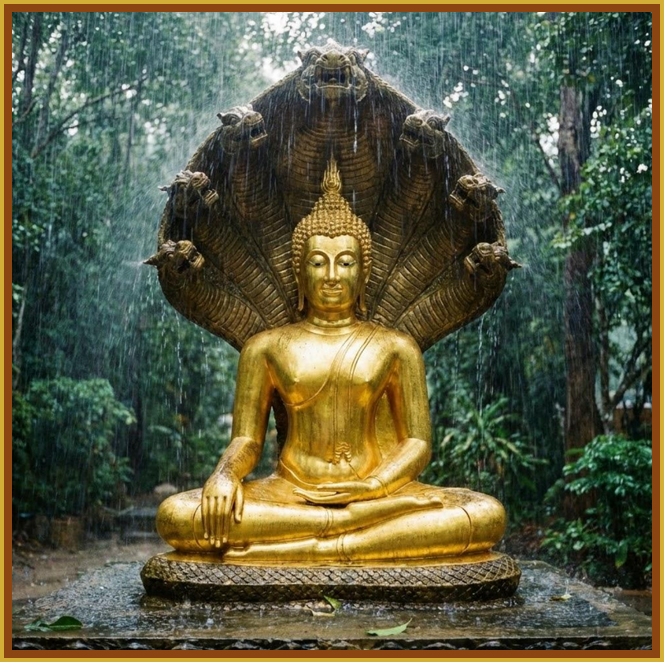
Above; Statue of the golden Pra Nakprok Buddha at Wat Phra That Doi Suthep, Chiang Mai (an eight-headed Naga canopy covering the Buddha’s head).
Development of Pra Nakprok Veneration in Thailand
In Thailand, veneration of the Pra Nakprok Buddha has a long history. It began with constructing large Pra Nakprok Buddha images enshrined in temples. For example, traces of a Dvaravati-period Pra Nakprok (found at Suphanburi) have been discovered. In the Sukhothai–Ayutthaya period, Khmer- and Lopburi-style Pra Nakprok statues were produced; for instance, a Pra Nakprok Buddha was found at Wat Mahathat, Ayutthaya (dating to the Lopburi period, around the 20th Buddhist century). In the late Ayutthaya and Thonburi eras, many Pra Nakprok amulets were buried in the ground for protection. Entering the Rattanakosin era, early Rattanakosin craftsmen made small terracotta and metal Pra Nakprok figures (for household worship), while in the later Rattanakosin period several major temples cast large principal Buddha images in the Pra Nakprok pose.
For example, the principal statue at Wat Benchamabophit in Bangkok (an 8-headed Pra Nakprok image, cast in 1973 CE). Regarding amulets, the Pra Nakprok design became extremely popular.
Beyond antique sets, many Pra Nakprok amulets were created by famous monks, such as Luang Pu Suk of Wat Pak Khlong Makham Thao (a Pra Nakprok image with decorative regalia) and Luang Pu Toh of Wat Pradoochimplee (1980 CE).
Types of Pra Nakprok amulets include yantra-inscribed coins, small metal plates, and tiny cast Buddha images. It is said in Thai astrology that the Pra Nakprok is the personal Buddha image of those born on Saturday, so Saturday-born devotees receive special auspicious protection from it.
| Example Pra Nakprok Amulets / Characteristics | Period/Origin | Material/Style | Powers & Inscriptions |
|---|---|---|---|
| Pra Nakprok of Wat Nuwa (Ayutthaya) | Late Sukhothai – Early Ayutthaya (recast during Thonburi) | Silver/china-metal with light gold leaf; leaf-shaped form | Great invulnerability (ancient accounts say it was especially effective for Saturday-born people) |
| Mango Leaf Pra Nakprok (Luang Pu Suk) | Rattanakosin (Dvaravati Revival) | Dark bronze or gold-plated; special thin patina | Wealth, great charm; commonly used for protection |
| Pra Nakprok (Luang Pu Toh, 1980) | Rattanakosin (1980) | Mixed alloy, lacquered and partly blackened finish | Augments prestige and invulnerability (large cast for temple veneration) |
| General Pra Nakprok Amulets | Rattanakosin | Powdered clay or small metal casts (neck pendants) | Protection from harm; auspicious for Saturdays (most have no inscriptions) |
Symbolism and Powers of the Pra Nakprok Image
In Thai belief, the Pra Nakprok is a symbol of protection and inner peace. It represents the Buddha calmly meditating amid crisis, since he is sheltered by the Naga from wind and rain. Thus it is believed to help ward off disasters, accidents, and evil magic, and to strengthen the stability of the devotee (both in destiny and mind). The sacred power of the Pra Nakprok image is thought to emphasize invulnerability (especially against black magic) and great popularity; in particular, people born on Saturday receive special blessings from it (since it is the Buddha image for Saturday). Historical chronicles note that the Pra Nakprok amulet of Wat Mahathat “has no mercury plating” (the highest standard among Ayutthaya amulets) because it provides the utmost protection.
Rituals of Chanting and Offerings
Thai tradition often honors the Pra Nakprok Buddha with special mantras, especially by those born on Saturday, accompanied by devotional offerings of flowers, incense, candles, and clean water. A commonly chanted Pali invocation for the Pra Nakprok is:
“… Yato haṃ thakini ariya sattha, yo nāpichā nāmaṃ sanjijjhati pāṇāṃ cittā, voraṃ petā tena satthī, sotaṭhī kopā vora (sic)….”.
Traditional masters say this has protective power, and Thai astrologers often advise reciting it ten times during meditation or before sleep to enhance auspiciousness. Other chants include “Nakaporokkā parittaṃ mahātejaṃ…” or the protective verses of Angulimala (chanted for safe childbirth). Offerings to a Pra Nakprok statue follow standard Buddhist custom: lotus flowers, jasmine garlands, three incense sticks, two candles, and pure water, in remembrance of the Buddha’s serenity and to beseech the removal of obstacles as per the legend.
Scholarly Analysis
Scholars suggest that the Pra Nakprok legend reflects a blending of folk beliefs with Buddhism. In ancient homiletics, the powerful Nāga was symbolized as a guardian of the Buddha, similar to how a divine prince governs the earthly realm (as in Jambudvīpa mythology). This led even some Mahayana (and Tibetan) traditions to venerate the “Naga” as a star or serpent deity, aligning with the doctrine of shared merit (e.g. the Mahākathina pañcaviha records).
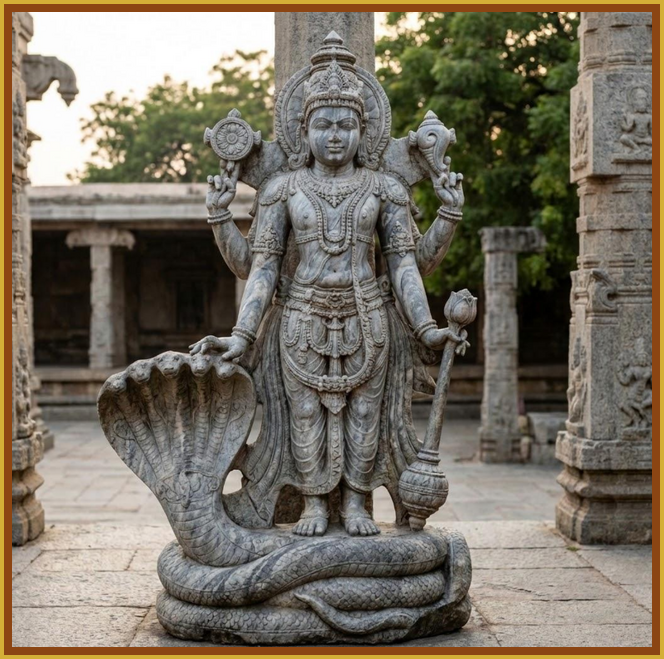
However, art historians debate whether some Sukhothai – Ayutthaya Pra Nakprok images (13th–14th centuries) were influenced by Brahmanical iconography (e.g. Vishnu standing on a nāga) or Hindu Naga motifs.
This confusion caused earlier observers to misinterpret certain figures: for example, a figure seated on a seven-headed nāga might actually represent Indra or a local spirit rather than the Buddhist Pra Nakprok.
Some scholars note that belief in the supernatural power of Pra Nakprok amulets grew with popular faith, but archaeological or textual evidence confirming their alleged powers is lacking.
Such beliefs may instead stem from Brahmanical traditions relating to water and agricultural fertility combined with people’s desire for protection. In summary, the Pra Nakprok legend is a syncretic symbol merging Buddhist and Brahmanical elements, grounded in scripture and folk tales.
Today, Pra Nakprok amulets in Thailand have become media of contemporary protective rituals. Academics view this belief as a social phenomenon, studied in the context of cultural disaster management and popular faith.
Ajarn Spencer Littlewood & Sovereign Amulet Agent (SAA) for ancientamulet.com
All rights reserved.
Pra Nakprok