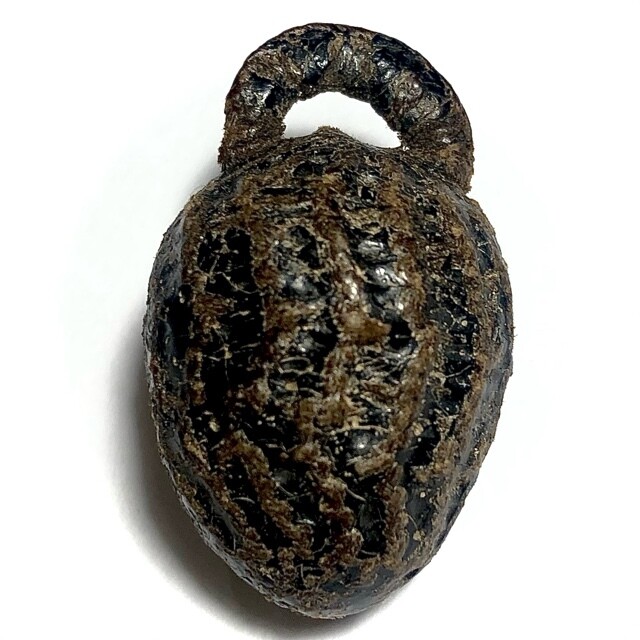
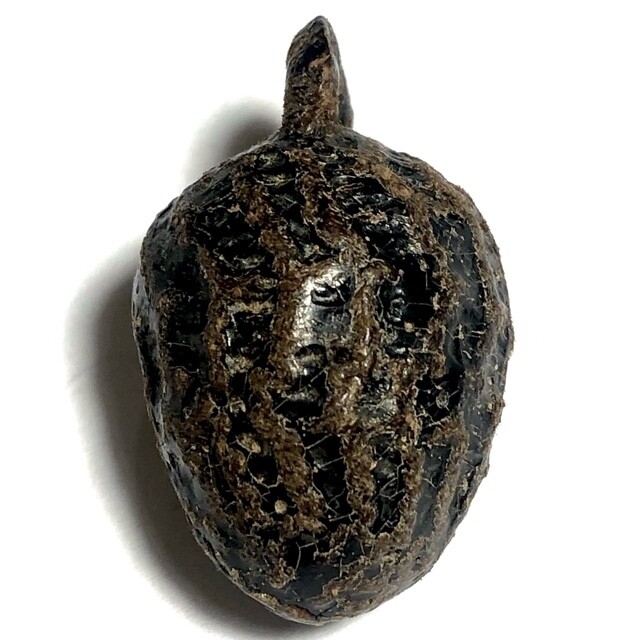
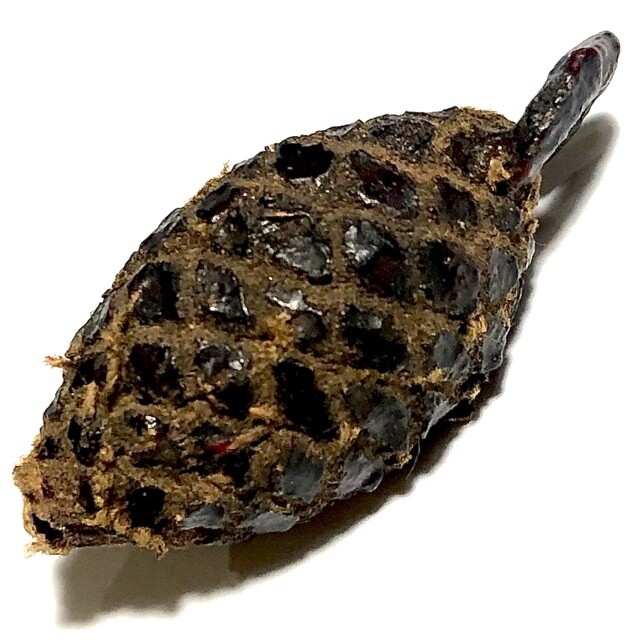
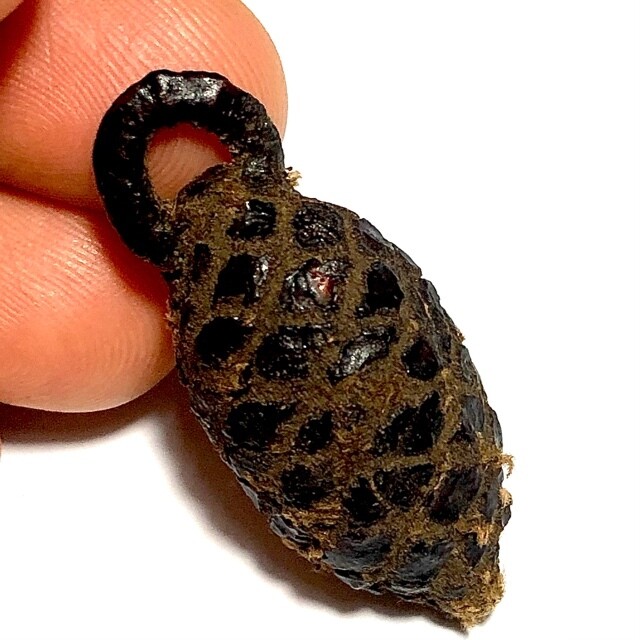
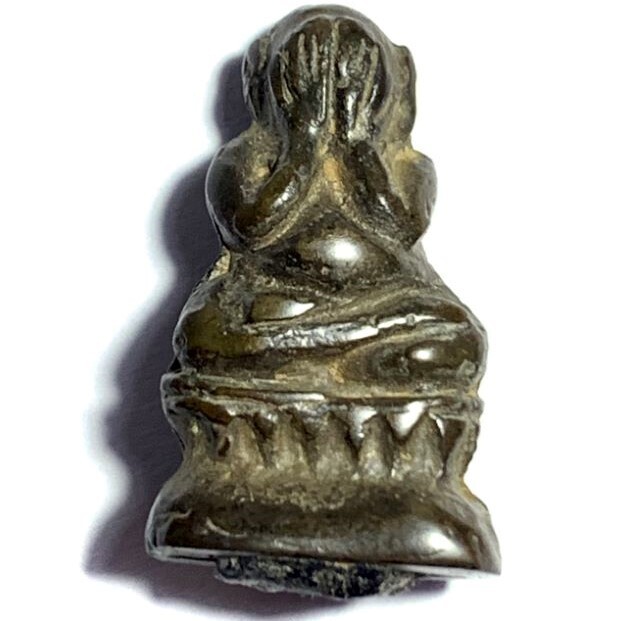
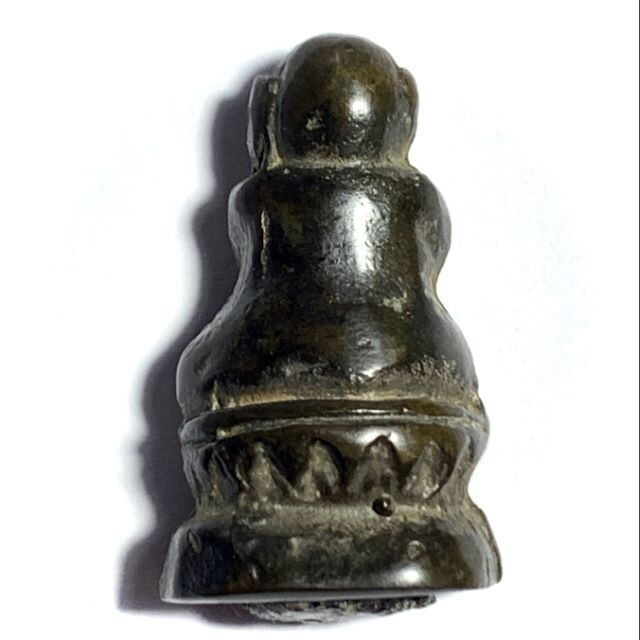
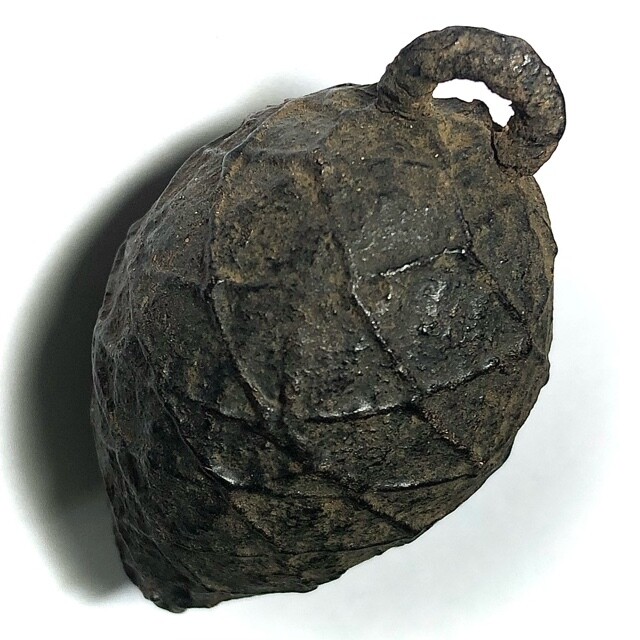
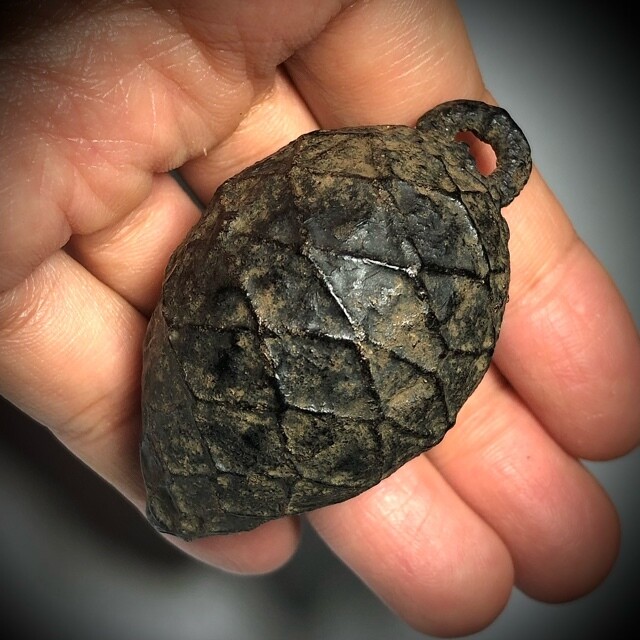
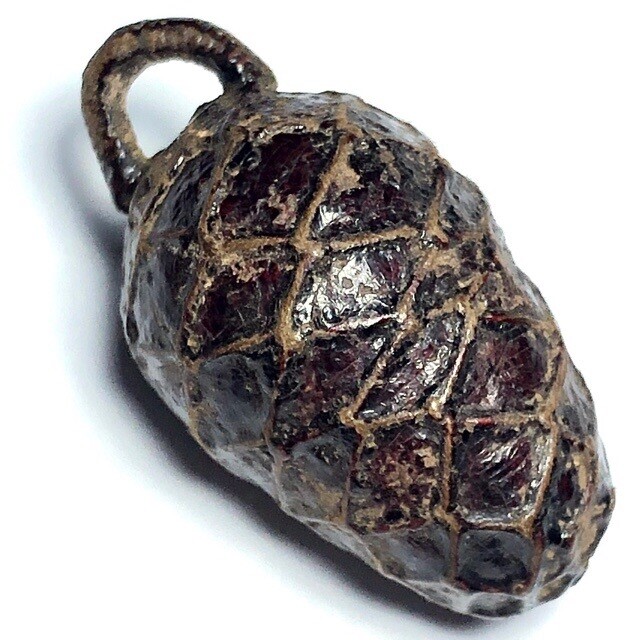
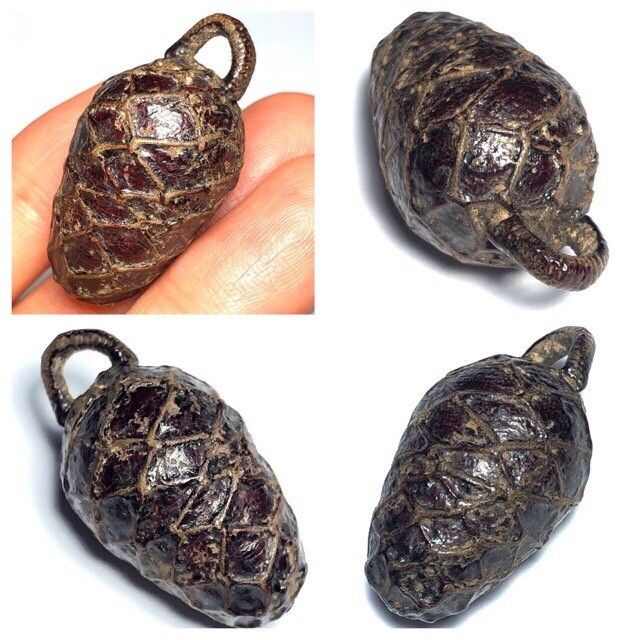
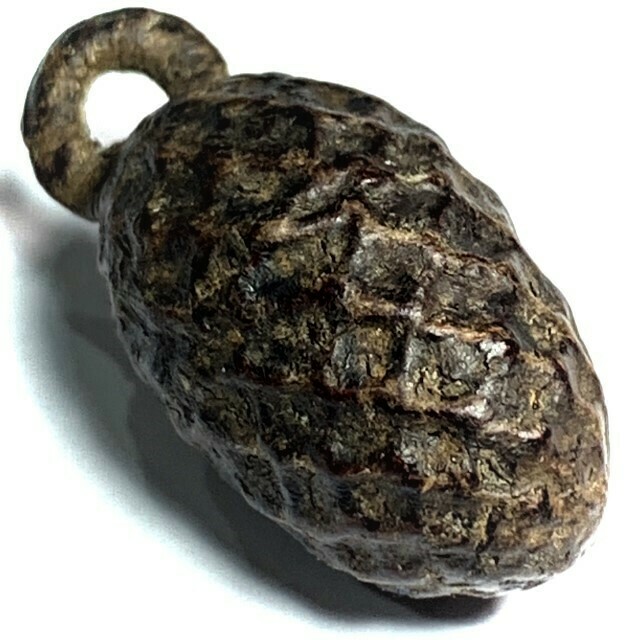
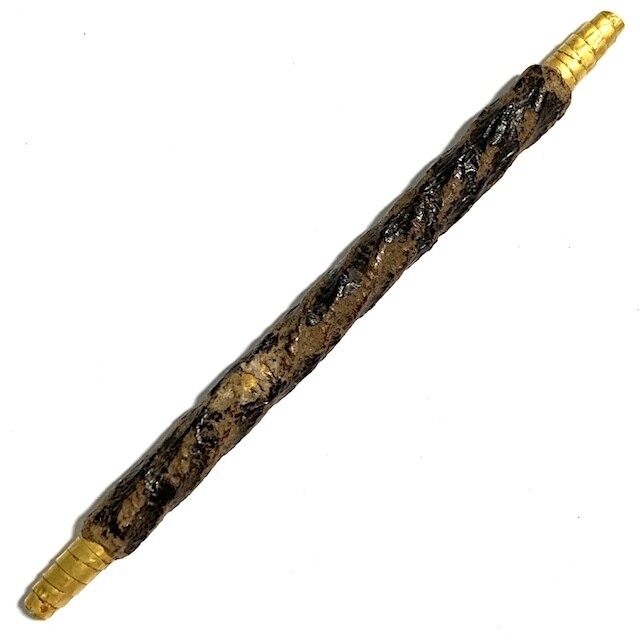
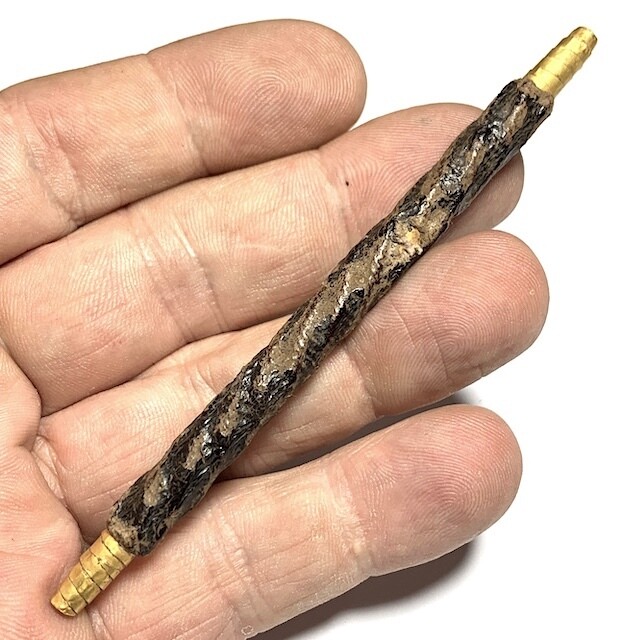
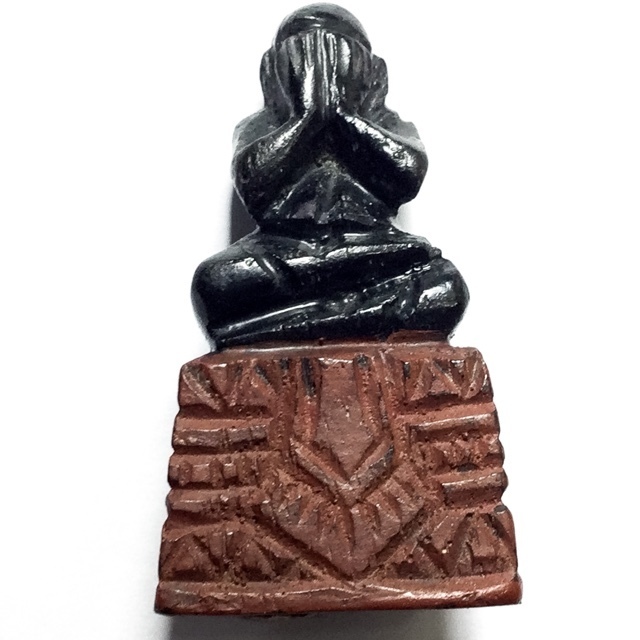
An early-mid era example of Luang Por Pina’s most Sacred and Powerful Daw Nai Pan Nai Pon Star Amulet – Sacred Karma Improving Lucky Star for Protection, Wealthy Fortunes, Status Increase, Promotion, and Auspicious Fate. This exhibit is a Pim Lek (small size) measuring 2.5 x 2 Cm. The five sided star face is painted red, and the eight sided star side is painted silver. This exhibit is especially desirable to collectors for the fact that this exhibit has almost a full set of Ploi Sek Gemstones on both sides, which is rare to see in this early-mid era model, for most examples of this Pim, are found without gemstones.
This is the two sided 5 and 8 Pointed Pentacle version, in red/silver painted Muan Sarn Sacred Powders wth Ploi Sek Maha Pokasap Gem inserts. This particular example has special Necromantic Powders stuffed into the edge of the amulet, and, as a Pim lek model, is not only suitable for men, but also a very recommendable model for lady devotees due to the smaller size.

It is very hard to find Daw Nai Pan Nai Pon amulets in a suitable size for ladies to wear.. It is in any case extremely difficult to find one of these amulets in any circumstances, but to find one with an almost complete set of gemstones is doubly lucky.
This exhibit is a Pim Lek (small size) measuring 2.5 x 2 Cm, and is a very early era model in pure muan sarn, made from a very highly concentrated admixture of sacred Necromantic and Magical powders.
The Daw Aathan Hnun Duang has different stars on each side, one as a 5 pointed star similar to the Military Star, and one in 8 pointed Pentacle similar to the Police Force star. Despite their importance for the meaning which is attributed for the Military and Police force, which was of course intentional, there are deep spiritual meanings imbued within the symbolism of each star design.

This amulet is commonly know for its Wealth Increasing Maha Lap Magick, but in truth, the amulet possesses an massive repository of attributed Buddhist Blessings of very sacred and Auspicious Influences on the Forces of Karma.

The amulet is recommended to be encased with,with the pendant ring at an angle, which is a tradition with the Dao Nai Pan Nai Pon, as was originally decreed with the first edition Mae Nuea Horm (Perfumed Mother) Lucky Star (‘Mae Nuea Horm’ 1st edition, was differentiated being somewhat Larger with a crescent moon below the star).

The base of the amulet has a special code stamp embossed into it by Luang Por Pina. The powers of the Daw Nai Pan Nai Pon are manyfold, but has a special ability given by Luang Por Pina which Luang Por Pina would say goes like this; ‘whoever is not straight with you and cannot be trusted, will be spotted and exposed by the Dao Nai Pan or the Mae Nuea Horm, if you wear it at an angle like this’

When understood, the meanings within the sacred Lucky Star Pentacle amulets of Luang Por Pina, are very extensive and comprehensive, and aligned to the focal points of Advanced Buddhist Vipassana Kammathana Practices, with the accompanyiing Miraculous Power of transformation that comes with the 40 Kammathanas.

Luang Por Pina is the deceased Abbot of Wat Sanom Lao in Sra Buri and was said to have possessed Abhinya Powers, and to have Mastered the 10 Kasina Powers of Elemental Magical Dominion.

It is said that he was able to read the minds and intentions of other Humans, and bring amulets to life with is Empowerment Methods, and that his amulets were able to give signs and also can be beseeched and prayed to for wish fulfilment (Sarapat Neuk). There are many stories of Miraculous Events occurring through his amulets.

The Daw Nai Pan Lucky Star is made from a mixture of Highly Sorcerous Ingredients, Herbal and Prai Necromantic Powders, which are both incredibly difficult to find and obtain, and also very easy to recognise their presence within the sacred Muan Sarn Powder mixture.

Those who have had an authentic Daw Aathan before their eyes, will be able to see instantly that this amulet is a very recognisable and distinguished exhibit with the clear to see presence of Luang Por Pina’s Sorcerous Muan Sarn Sarn Powders.

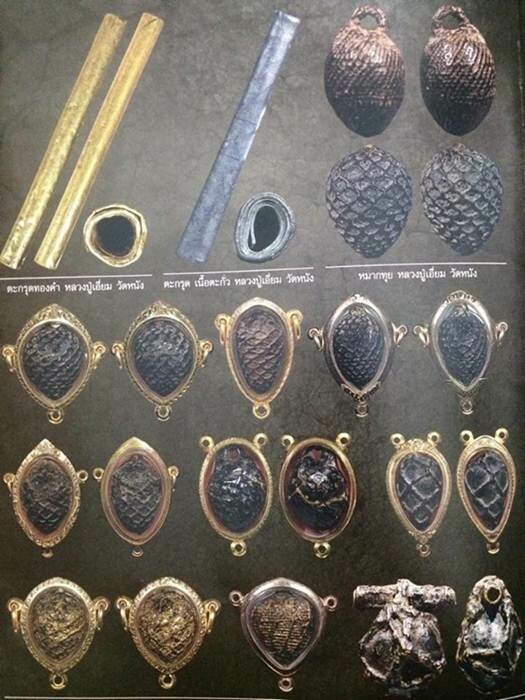
Below is a different model (Namely the Mae Nuea Horm First Edition Amulet), for you to enjoy looking at and for study.
The holes in the amulet also have meaning, some of the daw Nai Pan Nai Pon can be found to have gemstones (Ploi Sek) embedded within the indentations, which are even rarer to find.
This particular exhibit is a Classic Pim from the Early period of Making (Circa 2500), and also one of the highly Preferred ‘Pim Niyom’ Master Models and can be considered ‘Ongk Kroo’ (Teacher Reference Model) for a perfect reference comparison of authenticating other less recognisable Star amulets of lesser preference.

‘Ud Mai Gon Fa Pa’ (Wood from a tree that was truck by Lightning), and many Sacred Relics within its Sacred Powder Muan Sarn. Luang Por Pina’s Daw Nai Pan, exspecially this model above others, is now extremely rare and sought after.
Its price is constantly rising, because only a few hundred Daw Nai Pan are assumed to have been made in the early Era, and they are mostly all already in the possession of the Devotees, many of whom are high ranking Policemen, Army Officers and Top Doctors and Medics.
This model is an early edition which is evidend by its extreme dryness and the texture of the Muan Sarn Sacred Powders which reveal its age, and the authenticity of the amulet
The title of ‘Ongk kroo’ is fitting for this amulet, is for its easily recognisable features and Muan Sarn Powders allow one to easily distinguish the authenticity of any other exhibit when held side by side for comparison, making it a Master Key for teaching the eyes to recognise Luang Por’s famous Sacred Powders, as well as the effects of aging over the years, as to how discoloration and surface mildews should appear in a true authentic example of the Daw Nai Pan. Despite being a painted model, the edges of the amulet are highly visible to reveal the Muan Sarn Sacred Powders content and aging characteristics, and the true appearance of the Muan Sarn used by Luang Por Pina for these inimitable and famously powerful amulets

Luang Por Pina is known to have performed strange Magical feats in front of the eyes of his disciples many times, especially when devotees would ask him for an amulet. He would ask the devotee to lay down and open their eyes, and would take a handful of sand and pour it over their face, as they would hold the amulet in the hand.
But the sand would bounce back before it hit their eyes, and no matter how much was poured on the face, not a single grain of sand would be able to enter the eyes of the devotee, becoming repelled as if by a force field before it touched the eyes.

Kata Luang Por Pina
Light 5 sticks of Incense, and chant the Maha Namasakara 3 times before chanting the special Kata for Luang Por Pina Bpiyataro
Namo Dtassa Pakawadto Arahadto Sammaa Samputtassa
Namo Dtassa Pakawadto Arahadto Sammaa Samputtassa
Namo Dtassa Pakawadto Arahadto Sammaa Samputtassa
Then chant the Kata for Luang Por Pina (3 times);
Ahang Sukhadto Pina Bpiyataro Naamadtae Aajaariyo Ma Pandtae Hohi
Kata Pluk Khong (Call the power within the amulet)
Puttang Gandtang Saranang Haa
Puttang Gandtang Saranang Hae
Puttaaa Namo Ya

Kata Pra Som Hwang (Fulfilment of Wishes)
Chant the following for as many repetitions as your age (for example, if you are 35 years old, then chant the Kata, repeatedly for 35 times)
Nadtae Sudtae
The last repetition, change the words to
Mahaa Sudtae Nachaa
As an example, let us pretend a four year old were to recite the mantra, which would result in four lines like this;
Nadtae Sudtae, Nadtae Sudtae, Nadtae Sudtae, Mahaa Sudtae Nachaa

We invite you to listen to the podcast below, and be amazed at the depth of meanings within the Star Amulet.
Below; The remains of Luang Por Pina in the Sussaan Pina, as he requested to be unpreserved Unmummified, and left to rot naturally according to the laws of Nature, without a grand funeral ceremony or chanting, and forbidden to be cremated.


Luang Phu Iam (Wat Hnang)
Luang Phu Iam was a World Famous Master Monk of the previous Century, and maker of the Number 2 Amulet of the Top 5 'Benjapakee' of Pra Pid Ta of all Thai Buddhist History, the Pra Pid Ta Yant Yung. Luang Phu Iam is the No.2 Master of all History, renowned for Pra Pid Ta Amulets, and his Rare and Powerful First Edition Monk Coin, which fetches extremely high prices in auctions.

Pra Pāwanā Gosol Thēra (Luang Phu Iam Suwannasarõ)
Luang Phu Iam was a born on Friday the 7th October 2375 BE. Luang Phu Iam was born a Citizen of Bang Khun Tian, whose household lived on the banks of the Klong Bang Hwa Canal, behind the temple of Wat Hnang. Luang Phu Iam was born during the reign of His Majesty Prabat Somdej Pra Nang Glao Jao Yuu Hua King Rama 3. Luang Phu Iam was given the birthname of ‘Iam’ and his surname was ‘Tong U’. The devotees of Wat Hnang temple did not call him Luang Phu Iam, rather, preferred to call him ‘Luang Por Phu Tao’.
People in General, and the collectors of the amulet appreciation societies like to refer to Luang Phu Iam as ‘Luang Por Wat Hnang’. His father and mother’s names were Mr. Tong, and Mrs. U, with the surname ‘Tong U’. Luang Phu Iam’s family were market gardners, and were relatively prosperous. At the age of 9 years old, Luang Phu Iam was taken to the temple of Wat Hnang, to learn to read and write, and practice Khom Agkhara, under the tutelage of his first mentor, Luang Phu Rod, then Vice Abbot of Wat Hnang.

In the year 2387 BE, Luang Phu Rod then began to teach him Wicha Akom Buddha Magic and also to teach him in the Pali Sanskrit scripts, and the Khom Agkhara used for Magical Inscriptions. At the age of 11, in the year 2386 BE, Luang Phu Iam also went to study Pali Sanskrit with Pra Maha Yim at Wat Bovornives Voraviharn.
After he finished his studies with Pra Maha Yim, Luang Phu Rod then went to practice under the tutelage of Pra Pidok Gosol (Luang Por Chim), at Wat Liab.
Thereafter, he returned to Wat Hnang, and ordained as a Samanera Novice Monk, and studied the Dhamma in his original place of learning at Wat Hnang. Luang Phu spent many years focused on study and practice, for about one decade, until the year 2394 BE.
Luang Phu was now coming of age where he should ordain from Samanera to become full status of an adult Bhikkhu, and had to go to the Royal Sanam Luang to take his Pali Sanskrit exams, which were at that time, done orally, answering in front of the teacher without any written questions to answer. Luang Phu did not pass the test. Because of failing his Pali exam, Luang Phu decided to disrobe and go to help his parents and relatives at home.
But Luang Phu only managed to remain a layman for three years, and his true calling became evident, and Luang Phu returned in the year 2397 BE to Re-Ordain as a Bhikkhu in the Buddha Sasanā at Wat Jom Tong, at the age of 22 years old.
Luang Por Gerd was his Upachaya Ordaining Officer, and gave Luang Phu Iam the Ordained Name of ‘Suwannasaro’
His Pra Gammawājājārn was Pra Tamma Chedi (Luang Por Jeen), with Pra Pawanā Gosol Thēra (Luang Phu Rod) as his Prompting Officer.
Once he had Re-Ordained again, Luang Phu Tao (Luang Phu Iam) went to stay at Wat Nang Nong, which was across the other side of the path to Wat Nang Nong. Here he continued his written studies of the Dhamma and Sorcery Grimoires, and Mastery of various Wicha, in the Samnak of Luang Por Jeen, with supplementary tuition from Pra Sangworn Wimol (Luang Por Hmen).
This time Luang Phu Iam went to finish his exams once more at Sanam Luang, and passed with flying colours. The ordained professor of Pali who was examining him, then said he had given very good translations, and invited Luang Phu Iam to come and practice at the same Samnak.
Luang Phu Iam however, refused, and continued with his usual trajectory. He then focused deeper on his practice of Vipassana Mindfulness Practice, and Puttakom (Buddha Magic) with Luang Phu Rod (who was abbot of Wat Nang Nong).
It can be seen from historical documentation, that Luang Phu Iam followed the footsteps of of Luang Phu Rod, in the same way that Somdej Pra Puttajarn (Dto) Prohmrangsri of Wat Rakang Kositaram had followed in the footsteps of his Mentor Pra Sangkarach (Sukh Gai Thuean). Luang Phu Iam hence mastered the various Wicha of Luang Phu Rod, with his diligence and unquestioning service to Luang Phu Rod as his Mentor.
Sometime around 2440, Luang Phu Rod had his Royal Pat Yos fan confiscated and was stipped of Royal status, and moved from Wat Nang Nong to gp stay at Wat Ko Non. This was because Luang Phu Rod refused to use the official terminology of respect towards King Rama 4, because he was angry about the splitting of the Sangha into Dhammayut, and Maha Nikaya sects, which he considered the King to have caused a schism in the Sangha. Luang Phu Iam and his devotees followed Luang Phu Rod to Wat Ko Non, and Luang Phu Iam continued to practice and continue to practice his Wicha with Luang Phu Rod, for many years.
This comparison is also extendible to the amulets of both Masters, just as Somdej Pra Puttajarn (Dto) Prohmrangsri learned the Wicha Pra Somdej from Somdej pra Sangkarach Sukh (maker of the Pra Somdej Arahang Benjapakee Amulet), so, in turn, did Luang Phu Iam make powerful Pra Pid Ta and Pra Pid Tawarn amulets, in the same Dtamra (formula) of his Mentor Luang Phu Rod.
The third Comparison between the two Monks, reveals that both Somdej Pra Puttajarn (Dto) Prohmrangsri and Luang Phu Iam managed to attain the same fame and reverence as their Mentors, and their amulets became equally reputed for their magical power.
Luang Phu Iam created the same style of imagery as Luang Phu Rod for both kinds of Pid Ta amulets, and his Wicha is so equal in power to that of Luang Phu Rod, that one will often seen devotees collecting the amulets of both masters with equal fervency. It is not uncommon to see a high-end collector wearing a Pra Pid Ta Luang Phu Iam alongside a Pra Pid Ta Luang Phu Rod on the same necklaceใ
Some time after the passing of his Mentor Luang Phu Rod, in the year 2441 BE, Luang Phu Iam was called upon by his Majesty King Prabat Somdej Pra Julajom Glao Jao Yu Hua (Rama 5), to become the abbot of Wat Hnang, and perform the duty of its maintenance and further development.
Luang Phu Iam proved to be a Great Abbot, and diligently restored and developed the temple and its facilities. Luang Phu Iam was a highly favoured Monk of His Majesty King Rama 5, and was more often than not always requested to attend the most important Blessing Ceremonies, and Buddhist Rituals of the Royal Palace. His name 'Pra Pawana Gosol' was bestowed upon him by his Majesty the King, at the time he was given the charge of Wat Hnang temple.
Luang Phu Iam then spent 27 Years working selflessly for the temple and devotees of Wat Hnang, for another 27 years, until his passing on the 26th April 2469 BE, at the age of 94. His Pid Ta Yant Yung metallic amulet is equally highly regarded for its Klaew Klaad Kong Grapan Chadtri Maha Ud power, as the famous Pra Pid Ta Rae Bang Phai, and the Pra Pid Ta Wat Tong, and the Pra Pid Ta Pim Tapap of Wat Sapan Sung.