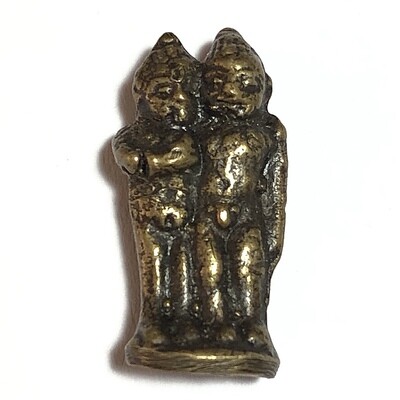
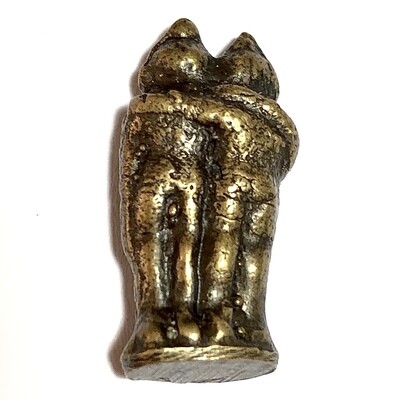
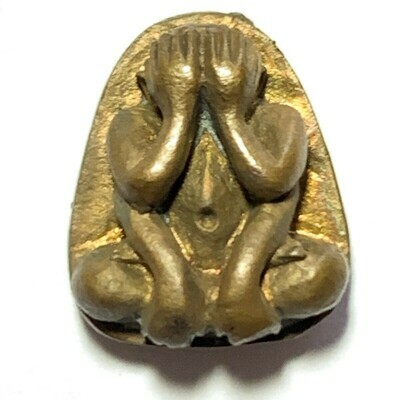
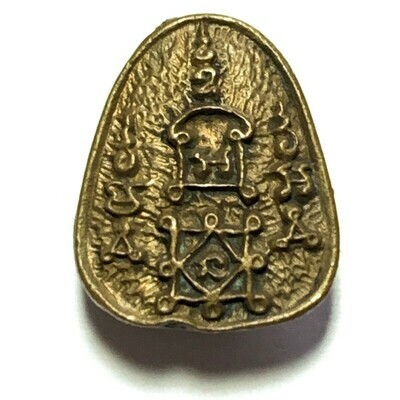
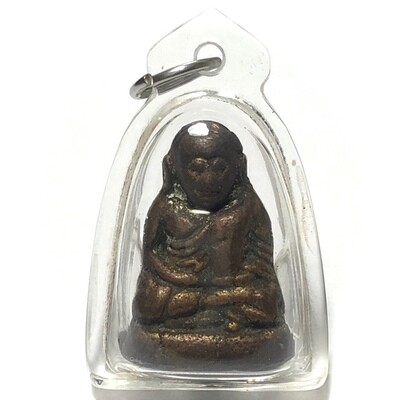
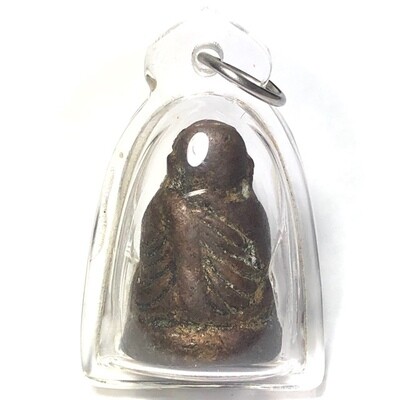
An early-mid era example of Luang Por Pina’s most Sacred and Powerful Daw Nai Pan Nai Pon Star Amulet – Sacred Karma Improving Lucky Star for Protection, Wealthy Fortunes, Status Increase, Promotion, and Auspicious Fate. This exhibit is a Pim Lek (small size) measuring 2.5 x 2 Cm. The five sided star face is painted red, and the eight sided star side is painted silver. This exhibit is especially desirable to collectors for the fact that this exhibit has almost a full set of Ploi Sek Gemstones on both sides, which is rare to see in this early-mid era model, for most examples of this Pim, are found without gemstones.
This is the two sided 5 and 8 Pointed Pentacle version, in red/silver painted Muan Sarn Sacred Powders wth Ploi Sek Maha Pokasap Gem inserts. This particular example has special Necromantic Powders stuffed into the edge of the amulet, and, as a Pim lek model, is not only suitable for men, but also a very recommendable model for lady devotees due to the smaller size.

It is very hard to find Daw Nai Pan Nai Pon amulets in a suitable size for ladies to wear.. It is in any case extremely difficult to find one of these amulets in any circumstances, but to find one with an almost complete set of gemstones is doubly lucky.
This exhibit is a Pim Lek (small size) measuring 2.5 x 2 Cm, and is a very early era model in pure muan sarn, made from a very highly concentrated admixture of sacred Necromantic and Magical powders.
The Daw Aathan Hnun Duang has different stars on each side, one as a 5 pointed star similar to the Military Star, and one in 8 pointed Pentacle similar to the Police Force star. Despite their importance for the meaning which is attributed for the Military and Police force, which was of course intentional, there are deep spiritual meanings imbued within the symbolism of each star design.

This amulet is commonly know for its Wealth Increasing Maha Lap Magick, but in truth, the amulet possesses an massive repository of attributed Buddhist Blessings of very sacred and Auspicious Influences on the Forces of Karma.

The amulet is recommended to be encased with,with the pendant ring at an angle, which is a tradition with the Dao Nai Pan Nai Pon, as was originally decreed with the first edition Mae Nuea Horm (Perfumed Mother) Lucky Star (‘Mae Nuea Horm’ 1st edition, was differentiated being somewhat Larger with a crescent moon below the star).

The base of the amulet has a special code stamp embossed into it by Luang Por Pina. The powers of the Daw Nai Pan Nai Pon are manyfold, but has a special ability given by Luang Por Pina which Luang Por Pina would say goes like this; ‘whoever is not straight with you and cannot be trusted, will be spotted and exposed by the Dao Nai Pan or the Mae Nuea Horm, if you wear it at an angle like this’

When understood, the meanings within the sacred Lucky Star Pentacle amulets of Luang Por Pina, are very extensive and comprehensive, and aligned to the focal points of Advanced Buddhist Vipassana Kammathana Practices, with the accompanyiing Miraculous Power of transformation that comes with the 40 Kammathanas.

Luang Por Pina is the deceased Abbot of Wat Sanom Lao in Sra Buri and was said to have possessed Abhinya Powers, and to have Mastered the 10 Kasina Powers of Elemental Magical Dominion.

It is said that he was able to read the minds and intentions of other Humans, and bring amulets to life with is Empowerment Methods, and that his amulets were able to give signs and also can be beseeched and prayed to for wish fulfilment (Sarapat Neuk). There are many stories of Miraculous Events occurring through his amulets.

The Daw Nai Pan Lucky Star is made from a mixture of Highly Sorcerous Ingredients, Herbal and Prai Necromantic Powders, which are both incredibly difficult to find and obtain, and also very easy to recognise their presence within the sacred Muan Sarn Powder mixture.

Those who have had an authentic Daw Aathan before their eyes, will be able to see instantly that this amulet is a very recognisable and distinguished exhibit with the clear to see presence of Luang Por Pina’s Sorcerous Muan Sarn Sarn Powders.

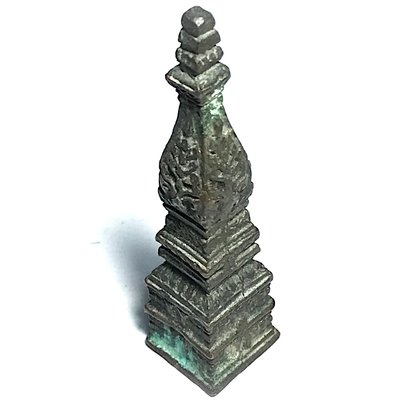
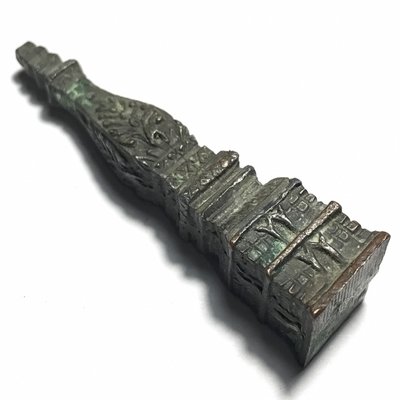
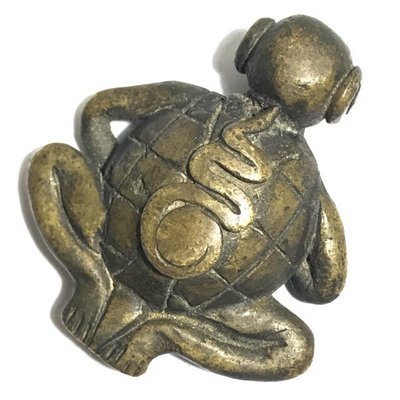
Below is a different model (Namely the Mae Nuea Horm First Edition Amulet), for you to enjoy looking at and for study.
The holes in the amulet also have meaning, some of the daw Nai Pan Nai Pon can be found to have gemstones (Ploi Sek) embedded within the indentations, which are even rarer to find.
This particular exhibit is a Classic Pim from the Early period of Making (Circa 2500), and also one of the highly Preferred ‘Pim Niyom’ Master Models and can be considered ‘Ongk Kroo’ (Teacher Reference Model) for a perfect reference comparison of authenticating other less recognisable Star amulets of lesser preference.

‘Ud Mai Gon Fa Pa’ (Wood from a tree that was truck by Lightning), and many Sacred Relics within its Sacred Powder Muan Sarn. Luang Por Pina’s Daw Nai Pan, exspecially this model above others, is now extremely rare and sought after.
Its price is constantly rising, because only a few hundred Daw Nai Pan are assumed to have been made in the early Era, and they are mostly all already in the possession of the Devotees, many of whom are high ranking Policemen, Army Officers and Top Doctors and Medics.
This model is an early edition which is evidend by its extreme dryness and the texture of the Muan Sarn Sacred Powders which reveal its age, and the authenticity of the amulet
The title of ‘Ongk kroo’ is fitting for this amulet, is for its easily recognisable features and Muan Sarn Powders allow one to easily distinguish the authenticity of any other exhibit when held side by side for comparison, making it a Master Key for teaching the eyes to recognise Luang Por’s famous Sacred Powders, as well as the effects of aging over the years, as to how discoloration and surface mildews should appear in a true authentic example of the Daw Nai Pan. Despite being a painted model, the edges of the amulet are highly visible to reveal the Muan Sarn Sacred Powders content and aging characteristics, and the true appearance of the Muan Sarn used by Luang Por Pina for these inimitable and famously powerful amulets

Luang Por Pina is known to have performed strange Magical feats in front of the eyes of his disciples many times, especially when devotees would ask him for an amulet. He would ask the devotee to lay down and open their eyes, and would take a handful of sand and pour it over their face, as they would hold the amulet in the hand.
But the sand would bounce back before it hit their eyes, and no matter how much was poured on the face, not a single grain of sand would be able to enter the eyes of the devotee, becoming repelled as if by a force field before it touched the eyes.

Kata Luang Por Pina
Light 5 sticks of Incense, and chant the Maha Namasakara 3 times before chanting the special Kata for Luang Por Pina Bpiyataro
Namo Dtassa Pakawadto Arahadto Sammaa Samputtassa
Namo Dtassa Pakawadto Arahadto Sammaa Samputtassa
Namo Dtassa Pakawadto Arahadto Sammaa Samputtassa
Then chant the Kata for Luang Por Pina (3 times);
Ahang Sukhadto Pina Bpiyataro Naamadtae Aajaariyo Ma Pandtae Hohi
Kata Pluk Khong (Call the power within the amulet)
Puttang Gandtang Saranang Haa
Puttang Gandtang Saranang Hae
Puttaaa Namo Ya

Kata Pra Som Hwang (Fulfilment of Wishes)
Chant the following for as many repetitions as your age (for example, if you are 35 years old, then chant the Kata, repeatedly for 35 times)
Nadtae Sudtae
The last repetition, change the words to
Mahaa Sudtae Nachaa
As an example, let us pretend a four year old were to recite the mantra, which would result in four lines like this;
Nadtae Sudtae, Nadtae Sudtae, Nadtae Sudtae, Mahaa Sudtae Nachaa

We invite you to listen to the podcast below, and be amazed at the depth of meanings within the Star Amulet.
Below; The remains of Luang Por Pina in the Sussaan Pina, as he requested to be unpreserved Unmummified, and left to rot naturally according to the laws of Nature, without a grand funeral ceremony or chanting, and forbidden to be cremated.


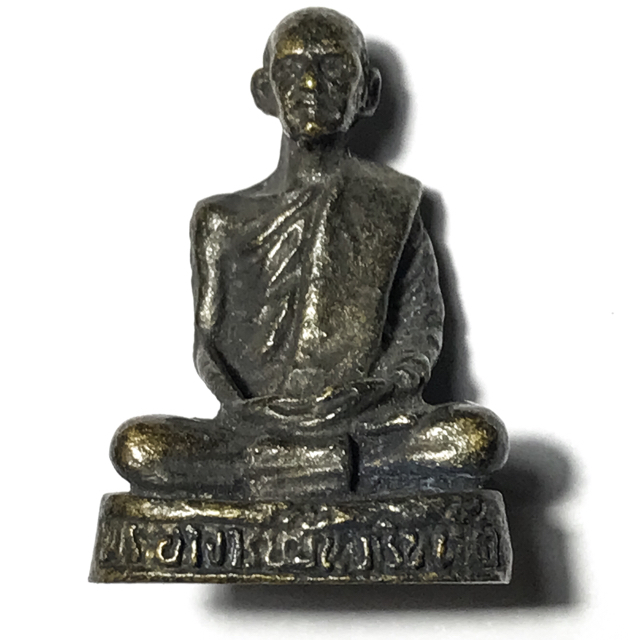
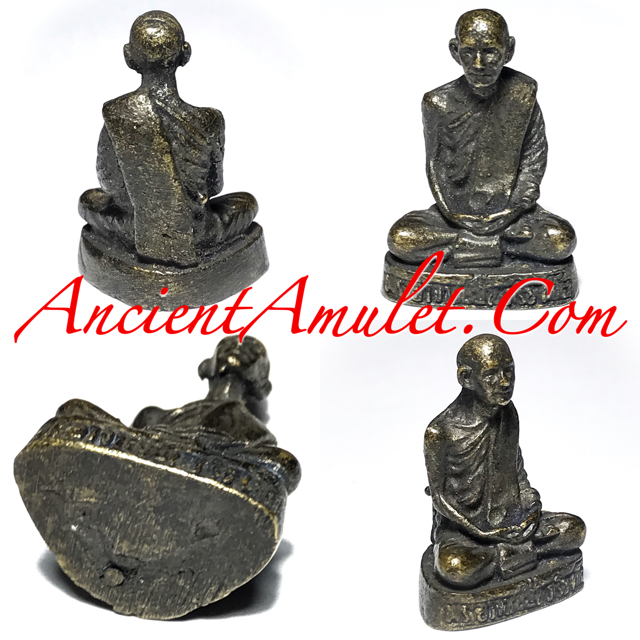
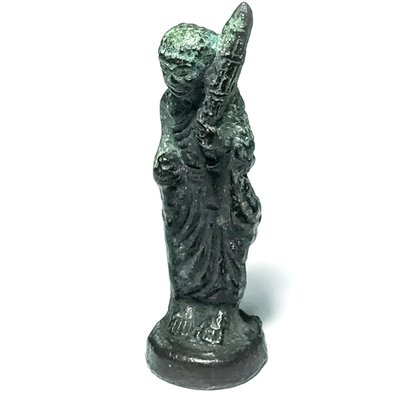
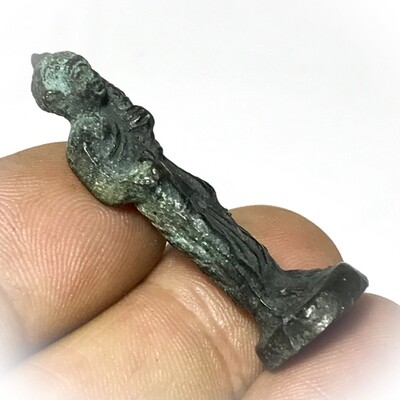
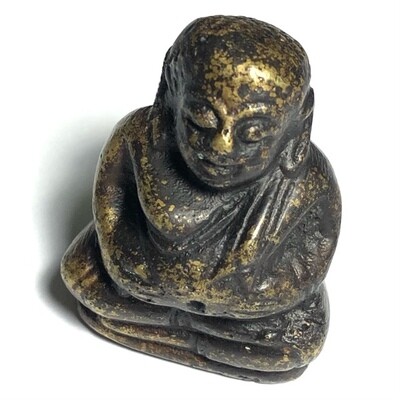
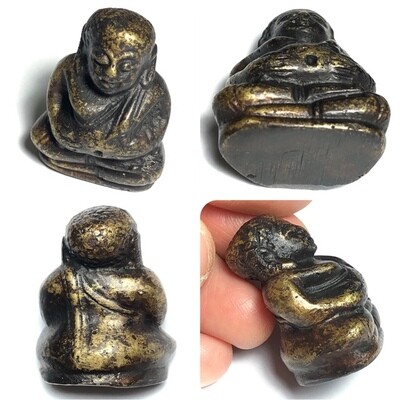
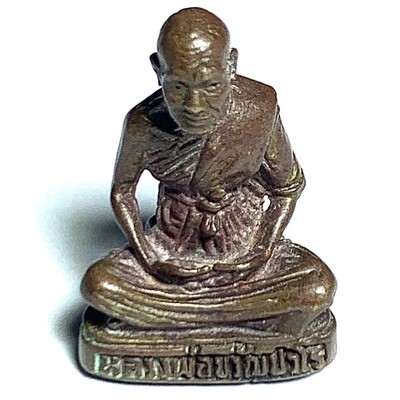
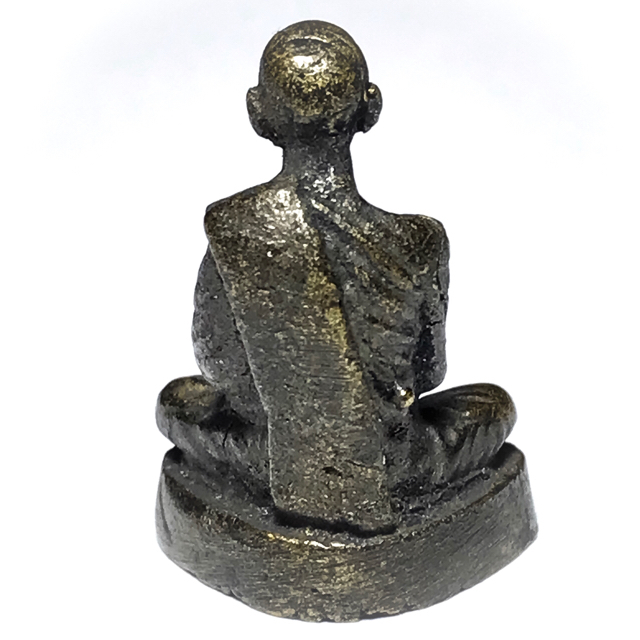
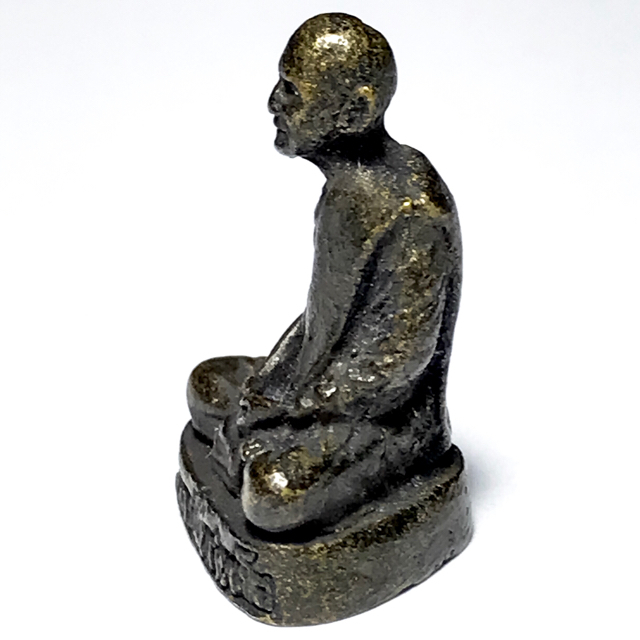
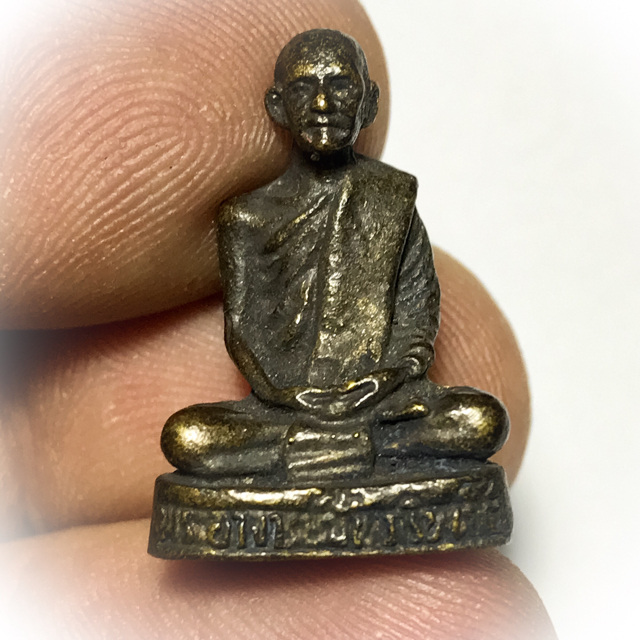
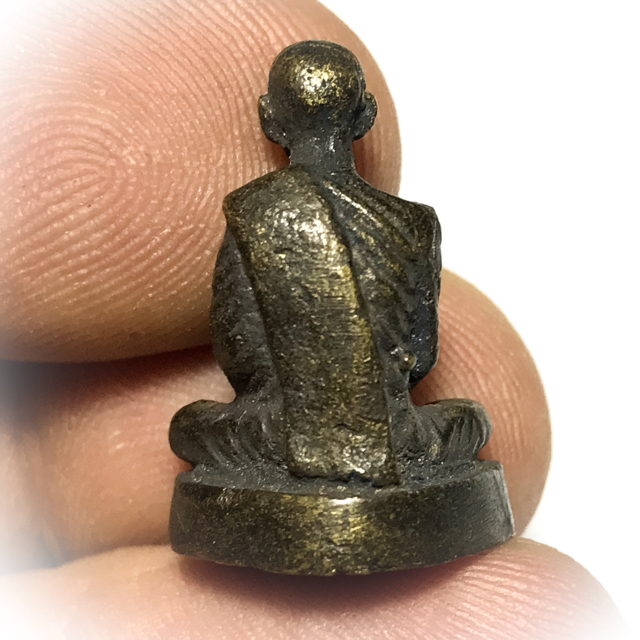
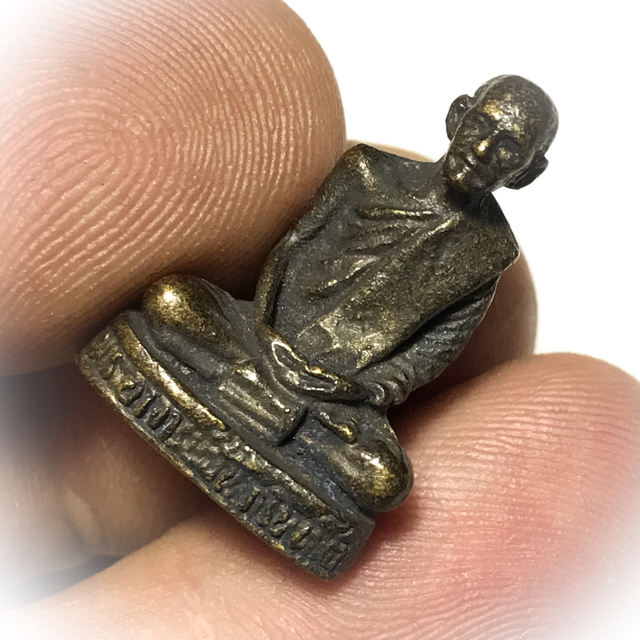
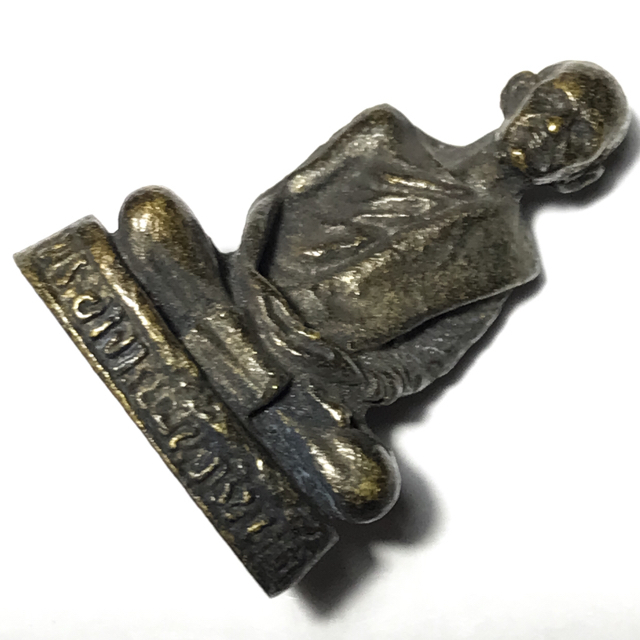
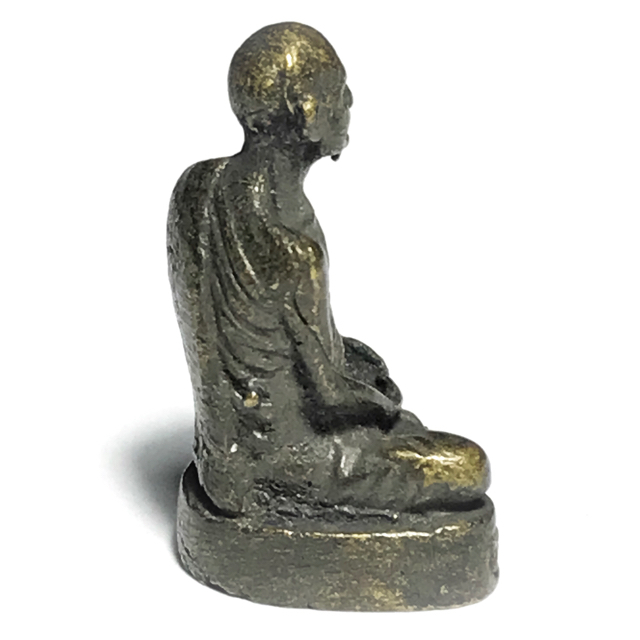
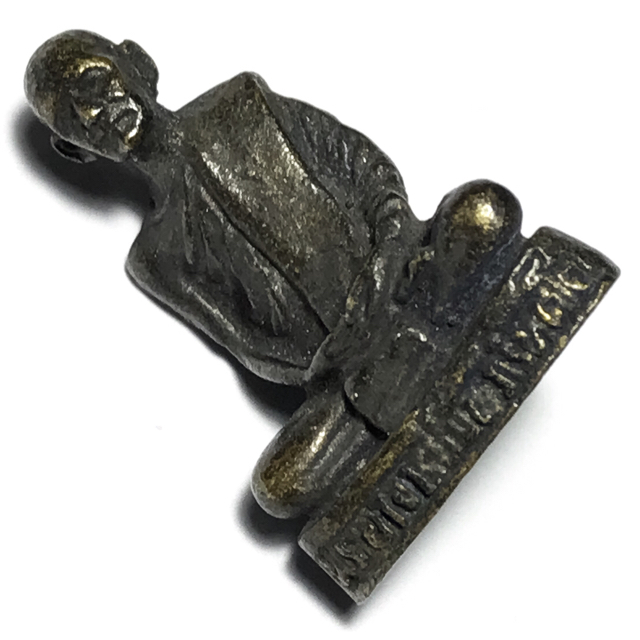
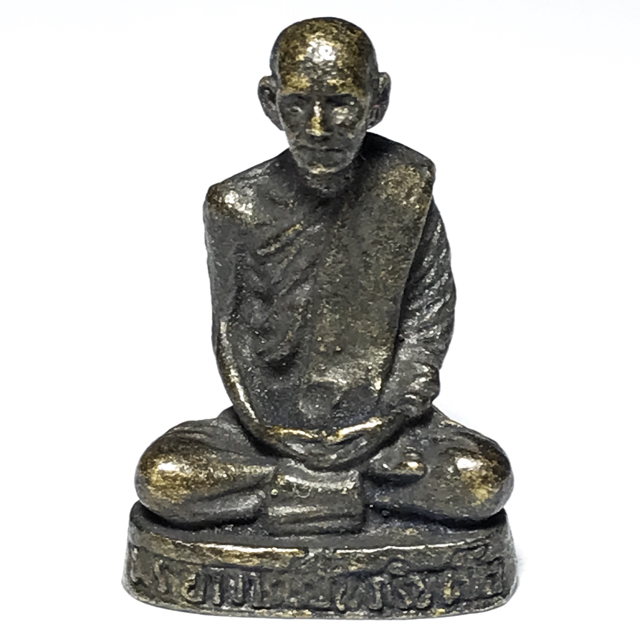
Sacred Guru Monk statuette, The Roop Lor Nuea Rakang Gao Image of Luang Phu Mun Puritadto of Wat Pha Sutawas was released in the same edition and ceremony as the famed Rian Luang Phu Mun 2513 BE Guru Monk Coin Amulet, which is so highly sought after as a highly sacred amulet, blessed by some of the greatest Masters of the time in Mass Buddha Abhiseka.
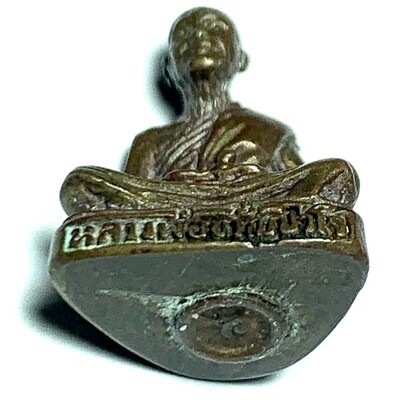
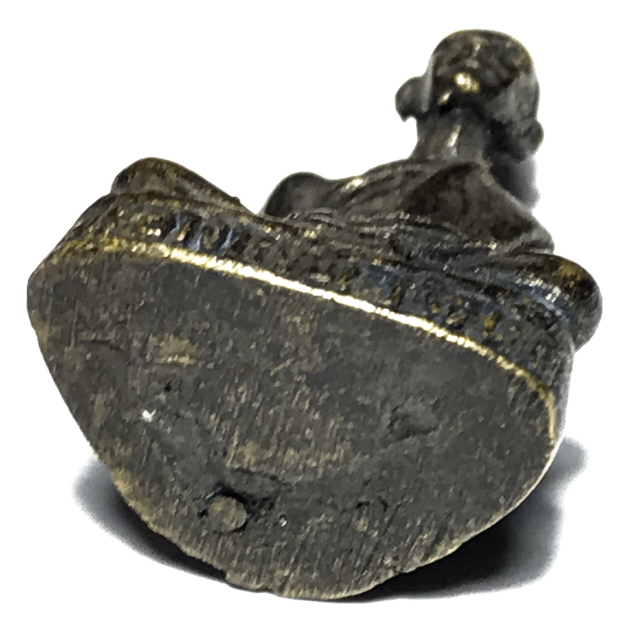
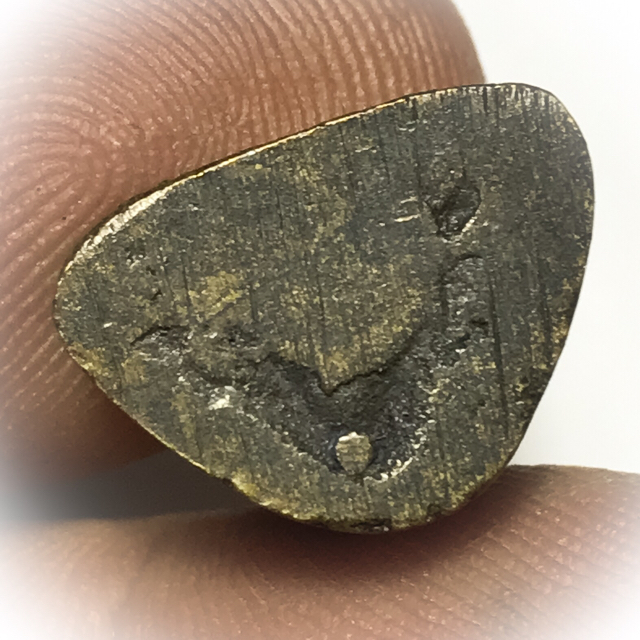
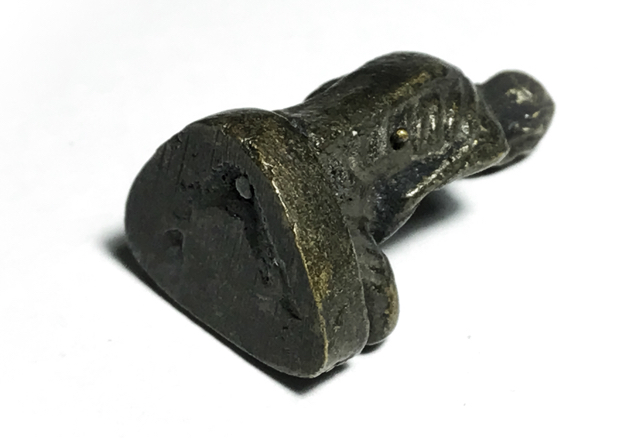
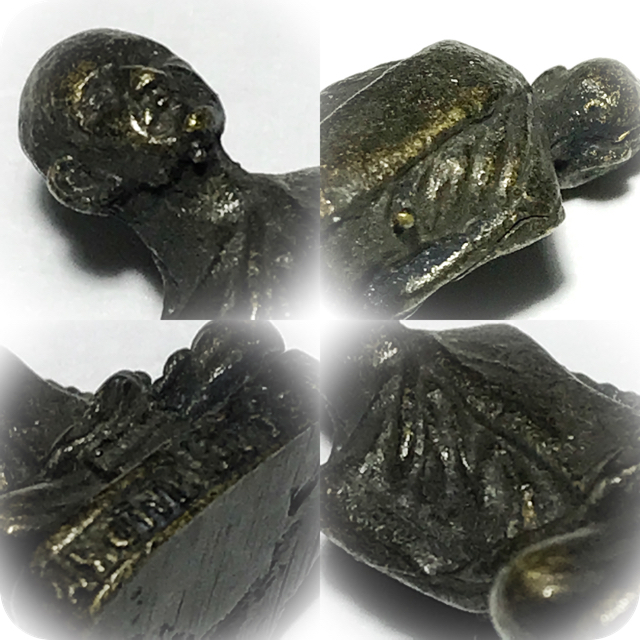
The statuette is forged from Nuea Rakang Gao smelted from an ancient Brass Temple Bell. Temple Bells are seen to be sacred artifacts, and to possess powerful vibrations from the ritual ringing of the bell by monks. The statuette has the words 'Pra Ajarn Mun Puritadto' on the front of the base of the amulet, with Luang Phu Mun seated in meditation above.

The amulets were released in the year 2513-2514 BE in a very special Buddha Abhiseka, at the temple of Wat Sum Namai in Khon Gaen, with a large number of some of the greatest Guru Masters of the time present to empower, including; Luang Phu Doon Udtalo (Wat Burapharam, Surin), Luang Phu Khaw Analayo (Wat Tham Gong Plae, Udorn Thani), Luang Phu Fan Ajaro, Luang Phu Tet, Taesrangsri, Luang Phu Hwaen (Wat Doi Mae Pang), Luang Phu Phang Jidtakudto, Luang Phu Pra Maha So Kassapo, and Luang Phu Nin Mahandtabanyo.
Ajarn Mun Bhuridatta Thera (Thai: มั่น ภูริทตฺโต, rtgs: Ajarn Man Phurithatto; Lao: ຫຼວງປູ່ມັ່ນ ພູຣິທັຕໂຕ), 1870–1949, was a Thai bhikkhu of Lao descent who is credited, along with his mentor, Ajarn Sao Kantasīlo, with establishing the Thai Forest Tradition or "Kammaṭṭhāna tradition" that subsequently spread throughout Thailand and to several countries abroad. Ajarn Mun was born in Baan Kham Bong, a farming village in Ubon Ratchathani Province, Isan. Ordained as a monk in 1893, he spent the remainder of his life wandering through Thailand, Burma, and Laos, dwelling for the most part in the forest, engaged in the practice of meditation. He attracted an enormous following of students and, together with his teacher, Sao Kantasīlo (1861–1941), established the Thai Forest Tradition (the kammaṭṭhāna tradition) that subsequently spread throughout Thailand and to several countries abroad. He died at Wat Suddhavasa, Sakon Nakhon Province.
Ajarn Mun was born in Baan Kham Bong, a farming village in Ubon Ratchathani Province, Isan. Ordained as a monk in 1893, he spent the remainder of his life wandering through Thailand, Burma, and Laos, dwelling for the most part in the forest, engaged in the practice of meditation. He attracted an enormous following of students and, together with his teacher, Sao Kantasīlo (1861–1941), established the Thai Forest Tradition (the kammaṭṭhāna tradition) that subsequently spread throughout Thailand and to several countries abroad. He died at Wat Suddhavasa, Sakon Nakhon Province. (Wikipedia)
We would like to share a passage written by Luang Por Thanissaro Bhikkhu (Ajarn Geoffrey de-Graaf), who wrote a most explanatory essay of the role of the Great Ajarn Mun in the revival of the true Buddhist Practice and the Rise of the Thai Tudong Kammathana Forest tradition;
"Throughout its history, Buddhism has worked as a civilizing force. Its teachings on karma, for instance — the principle that all intentional actions have consequences — have taught morality and compassion to many societies. But on a deeper level, Buddhism has always straddled the line between civilization and wilderness. The Buddha himself gained Awakening in a forest, gave his first sermon in a forest, and passed away in a forest. The qualities of mind he needed in order to survive physically and mentally as he went, unarmed, into the wilds, were key to his discovery of the Dhamma. They included resilience, resolve, and alertness; self-honesty and circumspection; steadfastness in the face of loneliness; courage and ingenuity in the face of external dangers; compassion and respect for the other inhabitants of the forest.
These qualities formed the "home culture" of the Dhamma. Periodically, as Buddhism spread and adapted to different societies, some practitioners felt that the original message of the Dhamma had become diluted. So they returned to the wilderness in order to revive its home culture. Many wilderness traditions are still alive today, especially in the Theravada countries of Sri Lanka and Southeast Asia. There, mendicant ascetic monks continue to wander through the remaining rainforests, in search of Awakening in the same environment where the Buddha found Awakening himself. Among these wilderness traditions, the one that has attracted the largest number of Western students, and is beginning to take root in the West, is the Kammatthana (Meditation) Forest tradition of Thailand. The Kammatthana tradition was founded by Ajarn Mun Bhuridatto in the early decades of this century. Ajarn Mun's mode of practice was solitary and strict. He followed the Vinaya (monastic discipline) faithfully, and also observed many of what are known as the thirteen classic dhutanga (ascetic) practices, such as living off almsfood, wearing robes made of cast-off rags, dwelling in the forest, eating only one meal a day.
Searching out secluded places in the wilds of Thailand and Laos, he avoided the responsibilities of settled monastic life and spent long hours of the day and night in meditation. In spite of his reclusive nature, he attracted a large following of students willing to put up with the hardships of forest life in order to study with him. He also had his detractors, who accused him of not following traditional Thai Buddhist customs. He usually responded by saying that he wasn't interested in bending to the customs of any particular society — as they were, by definition, the customs of people with greed, anger, and delusion in their minds. He was more interested in finding and following the Dhamma's home culture, or what he called the customs of the noble ones: the practices that had enabled the Buddha and his disciples to achieve Awakening in the first place.
This phrase — the customs of the noble ones — comes from an incident in the Buddha's life: not long after his Awakening, he returned to his home town in order to teach the Dhamma to the family he had left six years earlier. After spending the night in a forest, he went for alms in town at daybreak. His father the king learned of this and immediately went to upbraid him. "This is shameful," the king said. "No one in the lineage of our family has ever gone begging. It's against our family customs." "Your majesty," the Buddha replied, "I now belong, not to the lineage of my family, but to the lineage of the noble ones. Theirs are the customs I follow." Ajarn Mun devoted many years of his life to tracking those customs down. Born in 1870, the son of rice farmers in the northeastern province of Ubon, he was ordained as a monk in the provincial capital in 1892. At the time of his ordination, there were two broad types of Buddhism available in Thailand.
The first can be called Customary Buddhism — the mores and rites handed down over the centuries from teacher to teacher with little, if any, reference to the Pali canon. For the most part, these customs taught monks to live a sedentary life in the village monastery, serving the local villagers as doctors or fortune tellers. Monastic discipline tended to be loose. Occasionally, monks would go on a pilgrimage they called "dhutanga" which bore little resemblance to the classic dhutanga practices. Instead, it was more an undisciplined escape valve for the pressures of sedentary life. Moreover, monks and lay people practiced forms of meditation that deviated from the path of tranquillity and insight outlined in the Pali canon. Their practices, called vichaa aakhom, or incantation knowledge, involved initiations and invocations used for shamanistic purposes, such as protective charms and magical powers. They rarely mentioned nirvana except as an entity to be invoked for shamanic rites. The second type of Buddhism available at the time was Reform Buddhism, based on the Pali canon and begun in the 1820's by Prince Mongkut, who later became King Rama IV (and still later was portrayed in the musical The King and I).
Prince Mongkut was ordained as a monk for twenty-seven years before ascending the throne. After studying the canon during his early years as a monk, he grew discouraged by the level of practice he saw around him in Thai monasteries. So he reordained among the Mons — an ethnic group that straddled the Thai-Burmese border and occupied a few villages across the river from Bangkok — and studied Vinaya and the classic dhutanga practices under the guidance of a Mon teacher. Later, his brother, King Rama III, complained that it was disgraceful for member of the royal family to join an ethnic minority, and so built a monastery for the Prince-Monk on the Bangkok side of the river. There, Mongkut attracted a small but strong following of like-minded monks and lay supporters, and in this way the Dhammayut (lit., In Accordance with the Dhamma) movement was born.
In its early years, the Dhammayut movement was an informal grouping devoted to Pali studies, focusing on Vinaya, the classic dhutanga practices, a rationalist interpretation of the Dhamma, and the revival of meditation techniques taught in the Pali canon, such as recollection of the Buddha and mindfulness of the body. None of the movement's members, however, could prove that the teachings of the Pali canon actually led to enlightenment. Mongkut himself was convinced that the path to nirvana was no longer open, but he felt that a great deal of merit could be made by reviving at least the outward forms of the earliest Buddhist traditions. Formally taking a bodhisattva vow, he dedicated the merit of his efforts to future Buddhahood. Many of his students also took vows, hoping to become disciples of that future Buddha.

Upon disrobing and ascending the throne after his brother's death in 1851, Rama IV was in a position to impose his reforms on the rest of the Thai Sangha, but chose not to. Instead, he quietly sponsored the building of new Dhammayut centers in the capital and the provinces, which was how — by the time of Ajarn Mun — there came to be a handful of Dhammayut monasteries in Ubon. Ajarn Mun felt that Customary Buddhism had little to offer and so he joined the Dhammayut order, taking a student of Prince Mongkut as his preceptor. Unlike many who joined the order at the time, he wasn't interested in the social advancement that would come with academic study and ecclesiastical appointments. Instead, his life on the farm had impressed on him the sufferings inherent in the cycle of life and death, and his single aim was to find a way out of the cycle. As a result, he soon left the scholarly environment of his preceptor's temple and went to live with a teacher named Ajarn Sao Kantasilo (1861-1941) in a small meditation monastery on the outskirts of town.
Ajarn Sao was unusual in the Dhammayut order in that he had no scholarly interests but was devoted to the practice of meditation. He trained Ajarn Mun in strict discipline and canonical meditation practices, set in the context of the dangers and solitude of the wilderness. He could not guarantee that this practice would lead to the noble attainments, but he believed that it headed in the right direction. After wandering for several years with Ajarn Sao, Ajarn Mun set off on his own in search of a teacher who could show him for sure the way to the noble attainments. His search took nearly two decades and involved countless hardships as he trekked through the jungles of Laos, central Thailand, and Burma, but he never found the teacher he sought. Gradually he realized that he would have to follow the Buddha's example and take the wilderness itself as his teacher, not simply to conform to the ways of nature — for nature is samsara itself — but to break through to truths transcending them entirely. If he wanted to find the way beyond aging, illness, and death, he would have to learn the lessons of an environment where aging, illness, and death are thrown into sharp relief. At the same time, his encounters with other monks in the forest convinced him that learning the lessons of the wilderness involved more than just mastering the skills of physical survival.

He would also have to develop the acuity not to be misled by dead-end sidetracks in his meditation. So, with a strong sense of the immensity of his task, he returned to a mountainous region in central Thailand and settled alone in a cave. In the long course of his wilderness training, Ajarn Mun learned that — contrary to Reform and Customary beliefs — the path to nirvana was not closed. The true Dhamma was to be found not in old customs or texts but in the well-trained heart and mind. The texts were pointers for training, nothing more or less. The rules of the Vinaya, instead of simply being external customs, played an important role in physical and mental survival. As for the Dhamma texts, practice was not just a matter of confirming what they said. Reading and thinking about the texts could not give an adequate understanding of what they meant — and did not count as showing them true respect. True respect for the texts meant taking them as a challenge: putting their teachings seriously to the test to see if, in fact, they are true. In the course of testing the teachings, the mind would come to many unexpected realizations that were not contained in the texts. These in turn had to be put to the test as well, so that one learned gradually by trial and error to the point of an actual noble attainment. Only then, Ajarn Mun would say, did one understand the Dhamma.
This attitude toward the Dhamma parallels what ancient cultures called "warrior knowledge" — the knowledge that comes from developing skills in difficult situations — as opposed to the "scribe knowledge" that people sitting in relative security and ease can write down in words. Of course, warriors need to use words in their training, but they view a text as authoritative only if its teachings are borne out in practice. The Canon itself encourages this attitude when it quotes the Buddha as teaching his aunt, "As for the teachings of which you may know, 'These teachings lead to dispassion, not to passion; to being unfettered, not to being fettered; to divesting, not to accumulating; to modesty, not to self-aggrandizement; to contentment, not to discontent; to seclusion, not to entanglement; to aroused persistence, not to laziness; to being unburdensome, not to being burdensome': You may definitely hold, 'This is the Dhamma, this is the Vinaya, this is the Teacher's instruction.'" Thus the ultimate authority in judging a teaching is not whether the teaching can be found in a text. It lies in each person's relentless honesty in putting the Dhamma to the test and carefully monitoring the results. When Ajarn Mun had reached the point where he could guarantee that the path to the noble attainments was still open, he returned to the northeast to inform Ajarn Sao and then to continue wandering.
Gradually he began to attract a grassroots following. People who met him were impressed by his demeanor and teachings, which were unlike those of any other monks they had known. They believed that he embodied the Dhamma and Vinaya in everything he did and said. As a teacher, he took a warrior's approach to training his students. Instead of simply imparting verbal knowledge, he put them into situations where they would have to develop the qualities of mind and character needed in surviving the battle with their own defilements. Instead of teaching a single meditation technique, he taught them a full panoply of skills — as one student said, "Everything from washing spittoons on up" — and then sent them into the wilds. It was after Ajarn Mun's return to the northeast that a third type of Buddhism emanating from Bangkok — State Buddhism — began to impinge on his life. In an effort to present a united front in the face of imperialist threats from Britain and France, Rama V (1868-1910) wanted to move the country from a loose feudal system to a centralized nation-state. As part of his program, he and his brothers — one of whom was ordained as a monk — enacted religious reforms to prevent the encroachment of Christian missionaries. Having received their education from British tutors, they created a new monastic curriculum that subjected the Dhamma and Vinaya to Victorian notions of reason and utility.
Their new version of the Vinaya, for instance, was a compromise between Customary and Reform Buddhism designed to counter Christian attacks that monks were unreliable and lazy. Monks were instructed to give up their wanderings, settle in established monasteries, and accept the new state curriculum. Because the Dhammayut monks were the best educated in Thailand at the time — and had the closest connections to the royal family — they were enlisted to do advance work for the government in outlying regions. In 1928, a Dhammayut authority unsympathetic to meditation and forest wanderers took charge of religious affairs in the northeast. Trying to domesticate Ajarn Mun's following, he ordered them to establish monasteries and help propagate the government's program. Ajarn Mun and a handful of his students left for the north, where they were still free to roam. In the early 1930's, Ajarn Mun was appointed the abbot of an important monastery in the city of Chieng Mai, but fled the place before dawn of the following day.
He returned to settle in the northeast only in the very last years of his life, after the local ecclesiastical authorities had grown more favorably disposed to his way of practice. He maintained many of his dhutanga practices up to his death in 1949. It wasn't until the 1950's that the movement he founded gained acceptance in Bangkok, and only in the 1970's did it come into prominence on a nationwide level. This coincided with a widespread loss of confidence in state monks, many of whom were little more than bureaucrats in robes. As a result, Kammatthana monks came to represent, in the eyes of many monastics and lay people, a solid and reliable expression of the Dhamma in a world of fast and furious modernization. Buddhist history has shown that wilderness traditions go through a very quick life cycle.
As one loses its momentum, another often grows up in its place. But with the wholesale destruction of Thailand's forests in the last few decades, the Kammatthana tradition may be the last great forest tradition that Thailand will produce. Fortunately, we in the West have learned of it in time to gather lessons that will be help in cultivating the customs of the noble ones on Western soil and establishing authentic wilderness traditions of our own. Perhaps the most important of those lessons concerns the role that the wilderness plays in testing and correcting trends that develop among Buddhists in cities and towns. The story of the Kammatthana tradition gives lie to the facile notion that Buddhism has survived simply by adapting to its host culture. The survival of Buddhism and the survival of the Dhamma are two different things. People like Ajarn Mun — willing to make whatever sacrifices are needed to discover and practice the Dhamma on its own terms — are the ones who have kept the Dhamma alive.
Of course, people have always been free to engage in Buddhist traditions in whatever way they like, but those who have benefited most from that engagement are those who, instead of reshaping Buddhism to fit their preferences, reshape themselves to fit in with the customs and traditions of the noble ones. To find these customs isn't easy, given the bewildering variety of traditions that Buddhists have spawned over the centuries. To test them, each individual is thrown back on his or her own powers of relentless honesty, integrity, and discernment. There are no easy guarantees. And perhaps this fact in itself is a measure of the Dhamma's true worth. Only people of real integrity can truly comprehend it. As Ajarn Lee, one of Ajarn Mun's students, once said, "If a person isn't true to the Buddha's teachings, the Buddha's teachings won't be true to that person — and that person won't be able to know what the Buddha's true teachings are. "
Source; The Customs of the Noble Ones", by Thanissaro Bhikkhu. Access to Insight (Legacy Edition), 7 June 2010, http://www.accesstoinsight.org/lib/authors/thaniss... ©1999 Thanissaro Bhikkhu