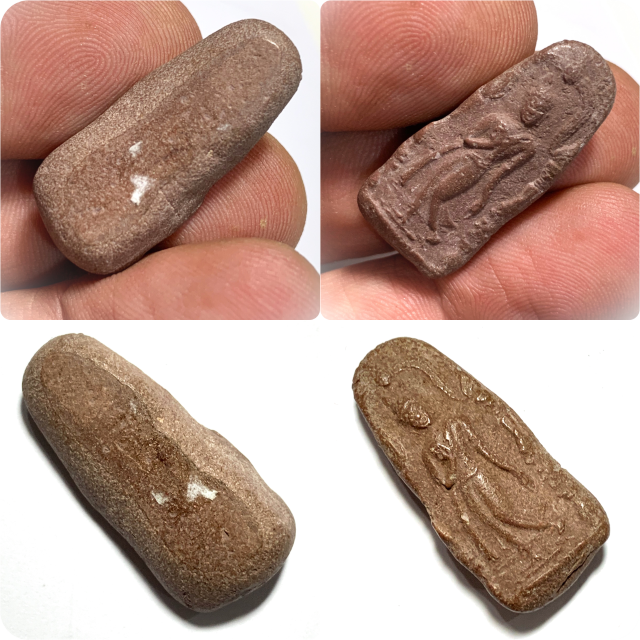
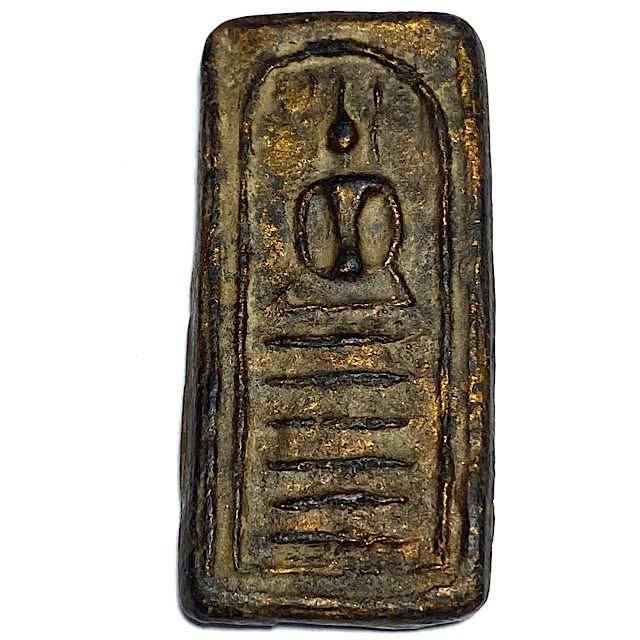
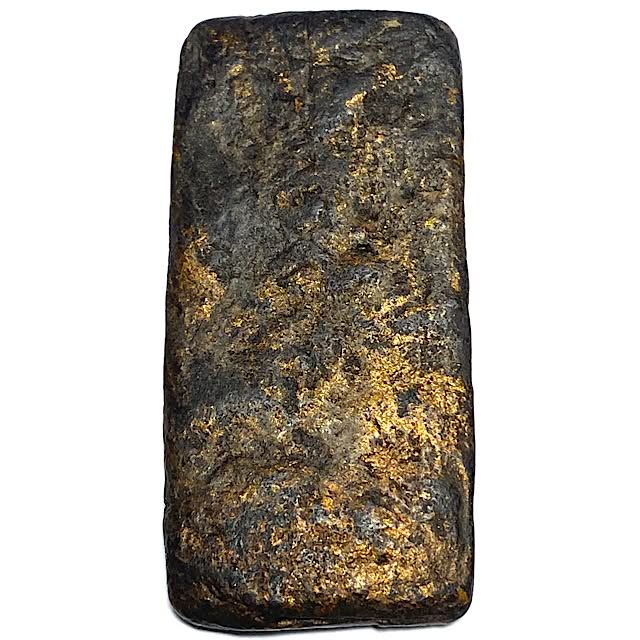
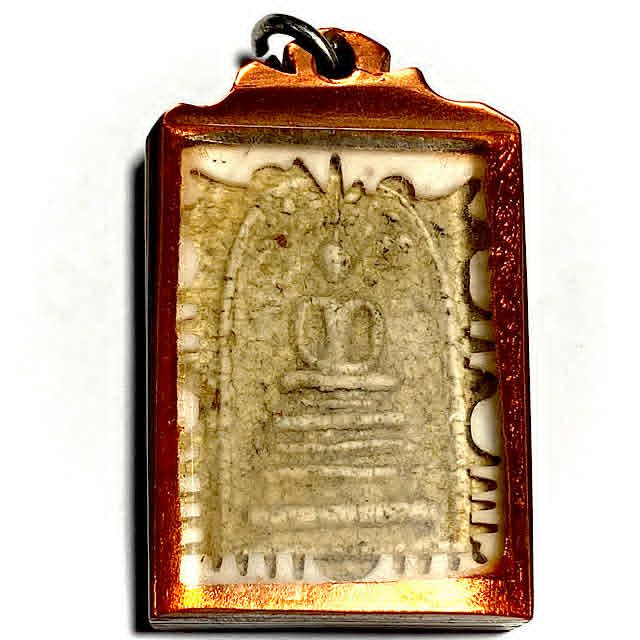
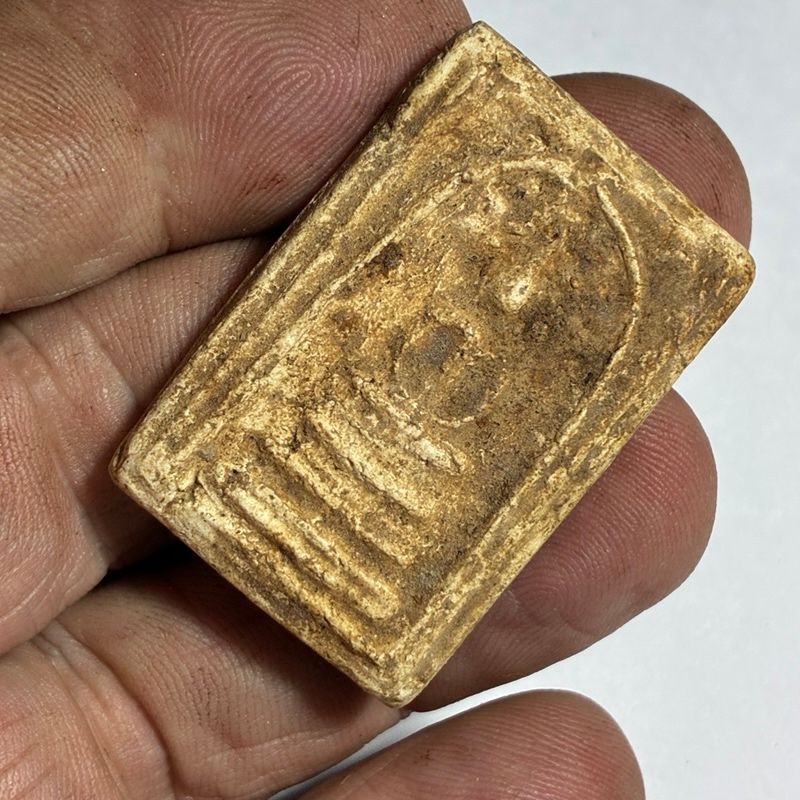
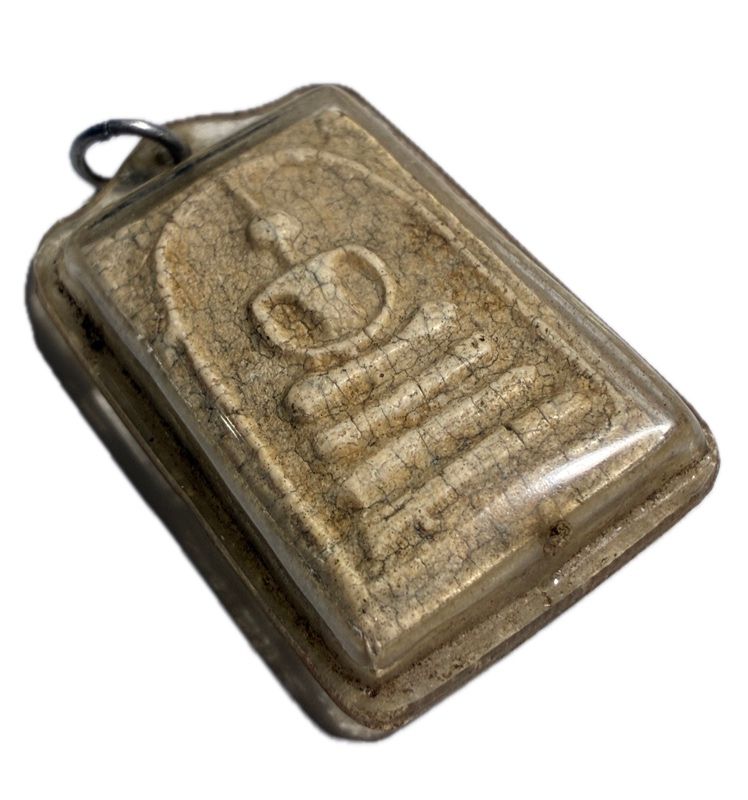
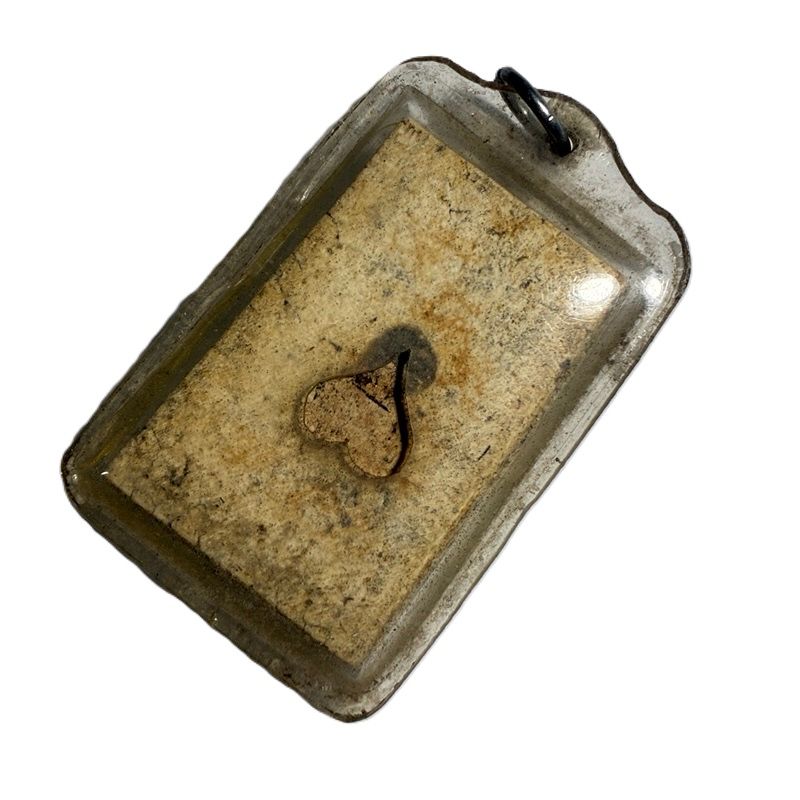
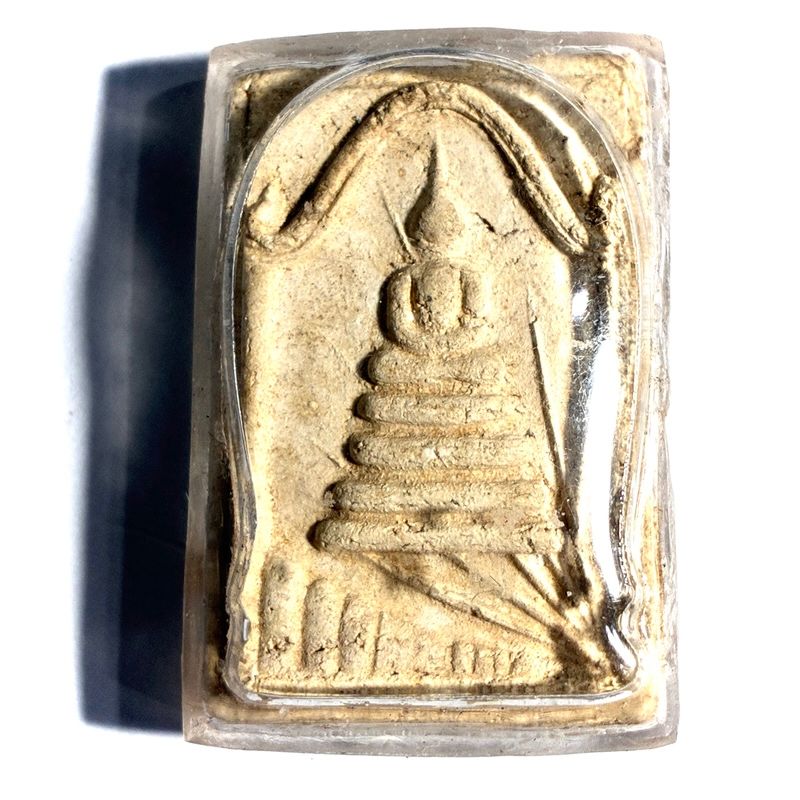
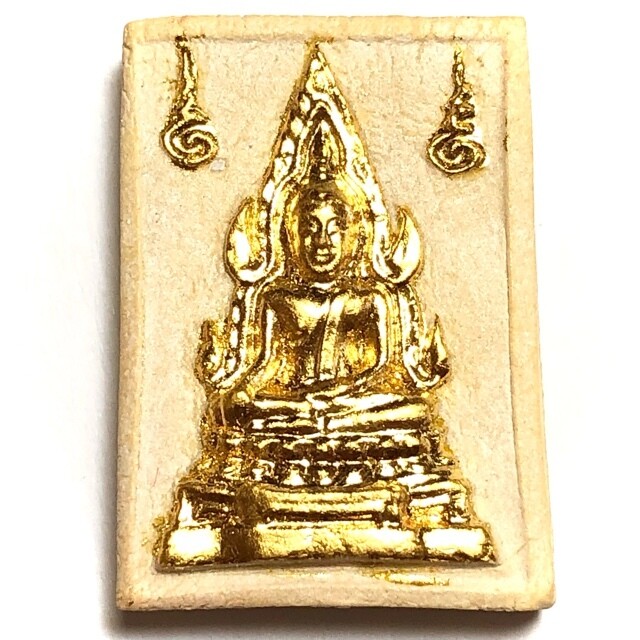
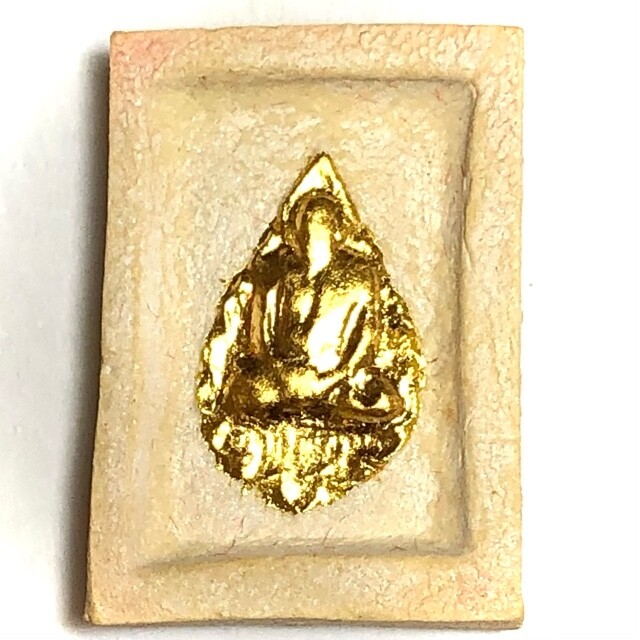
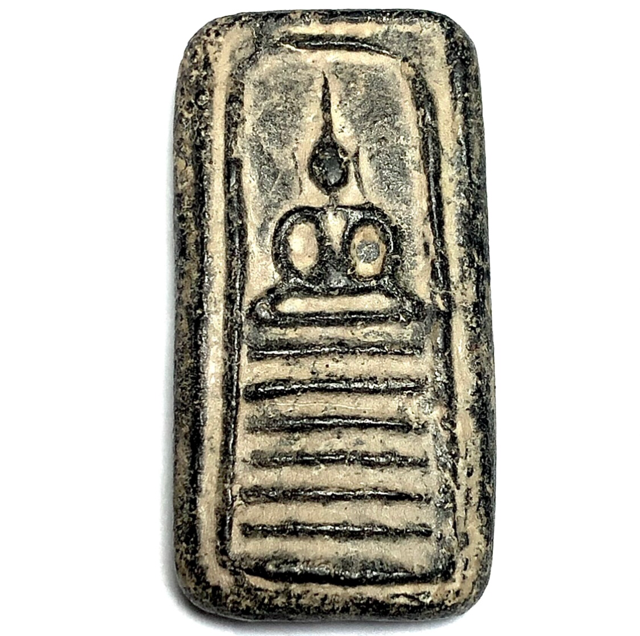
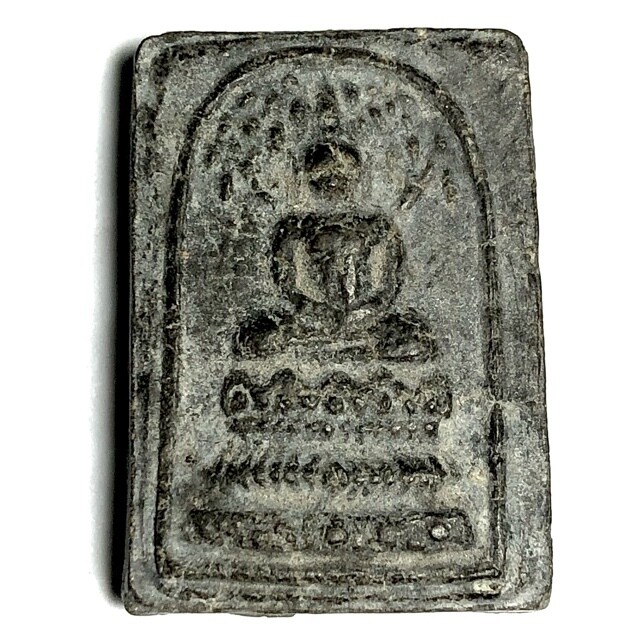
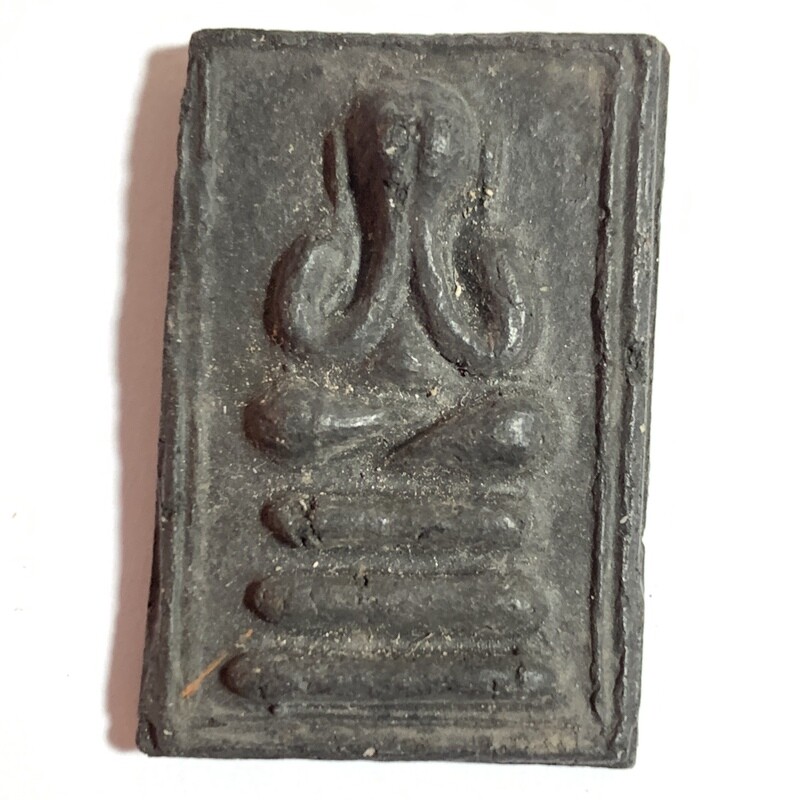
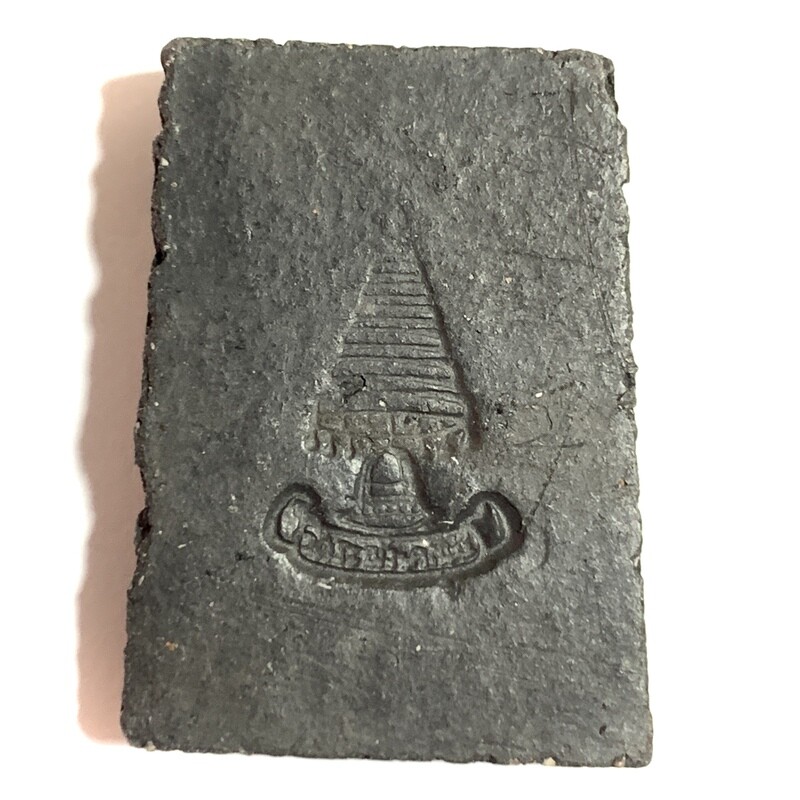
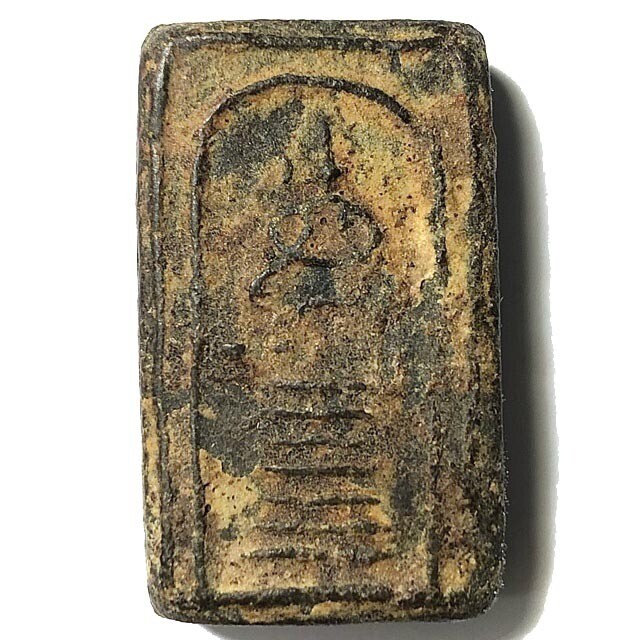
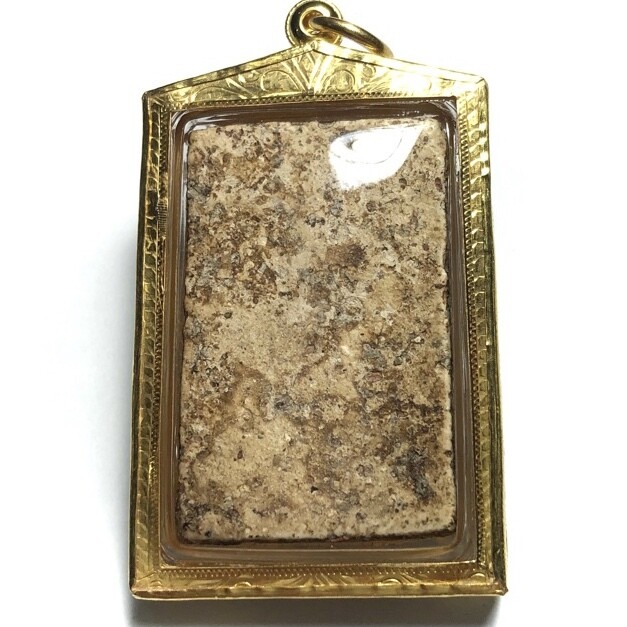
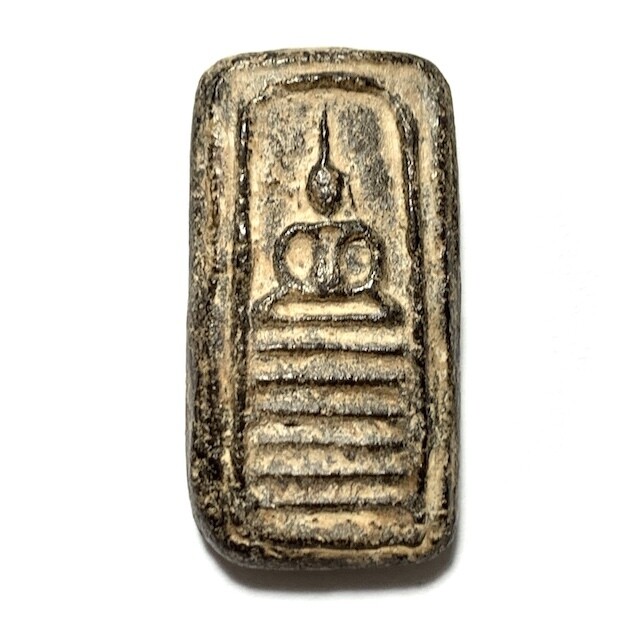
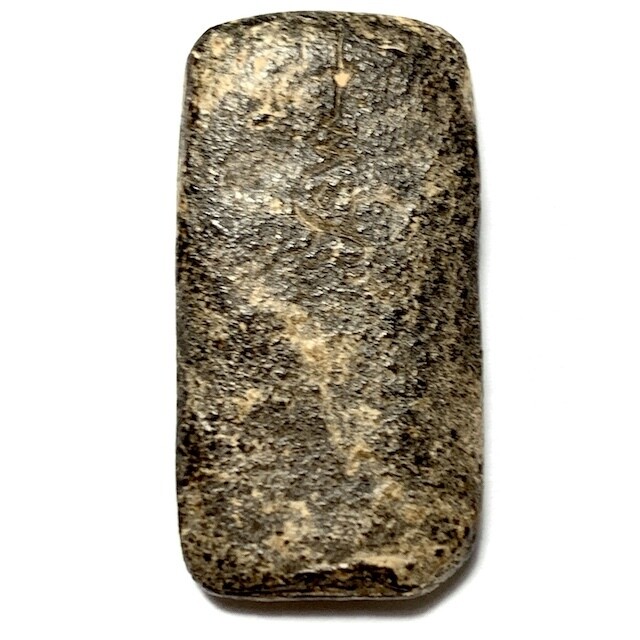
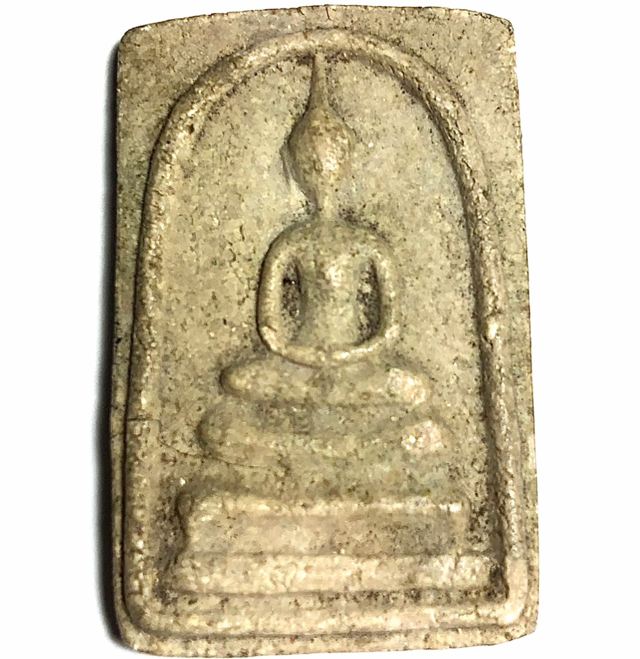
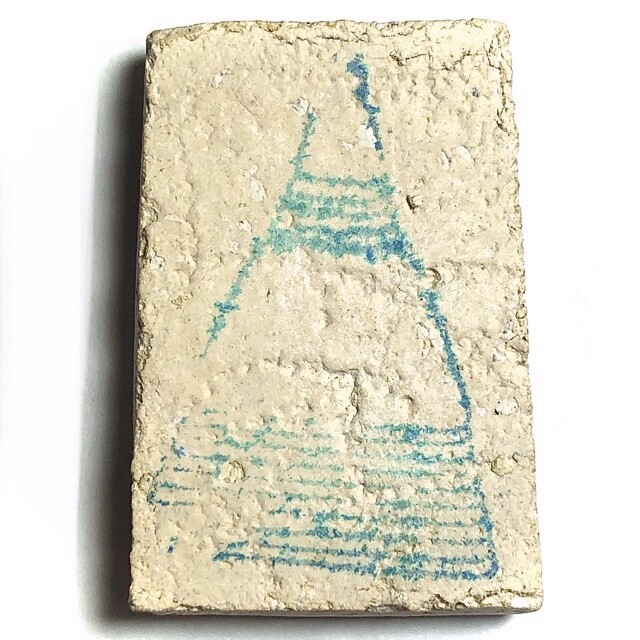
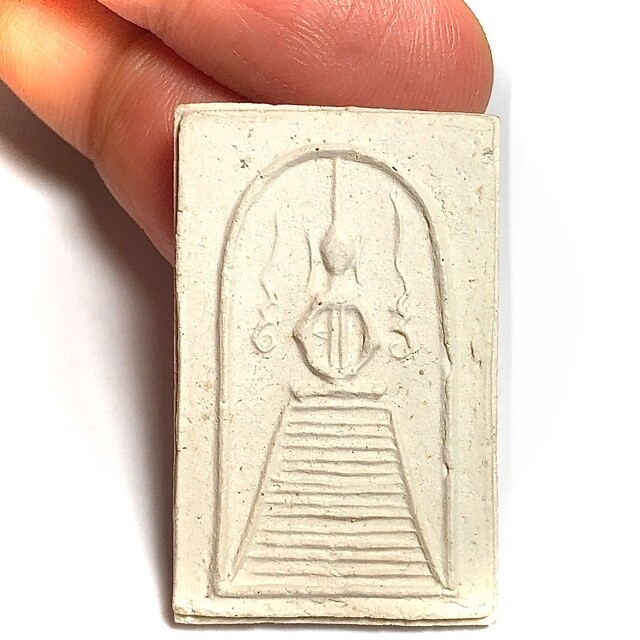
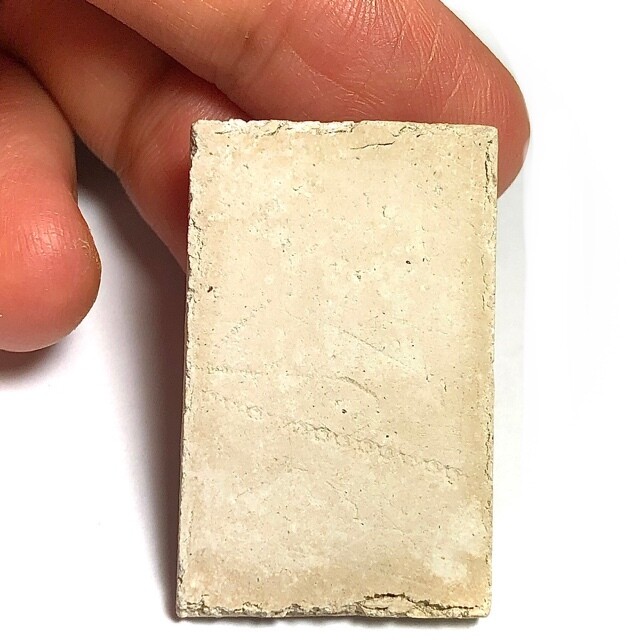
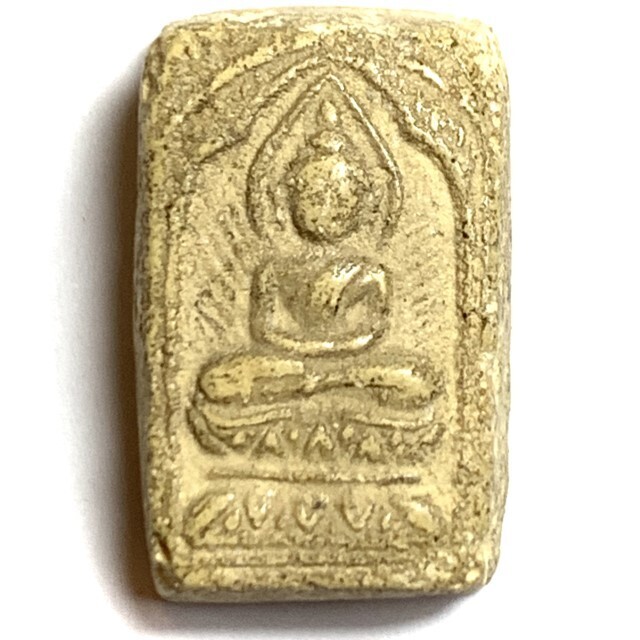
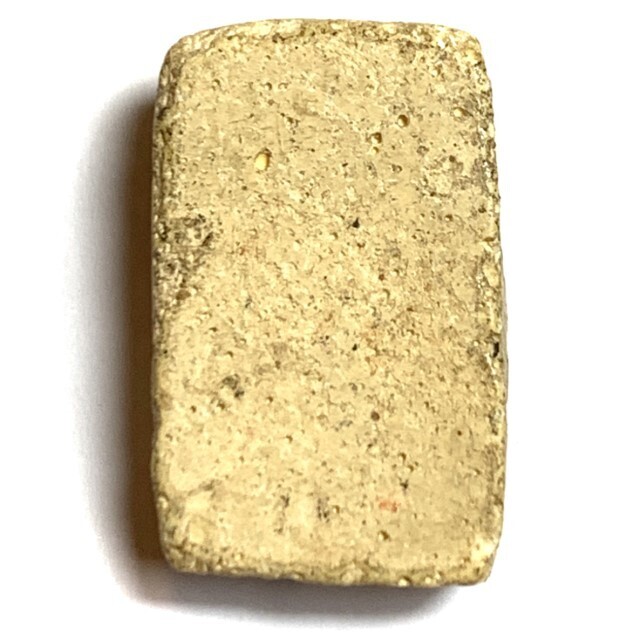
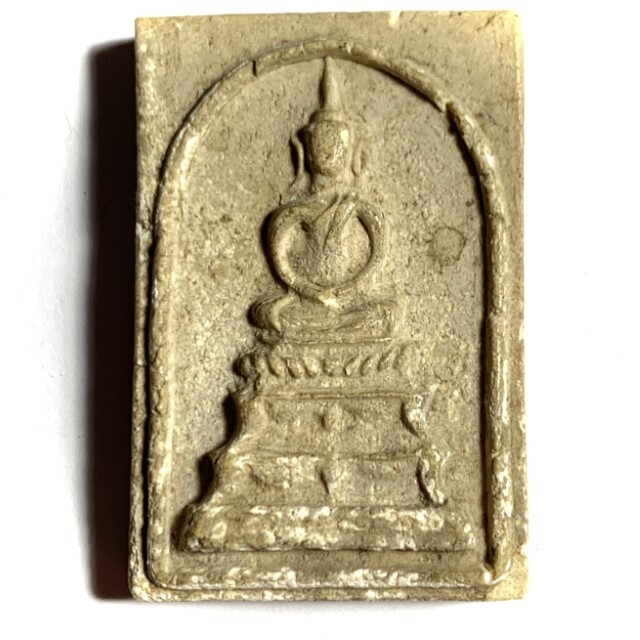
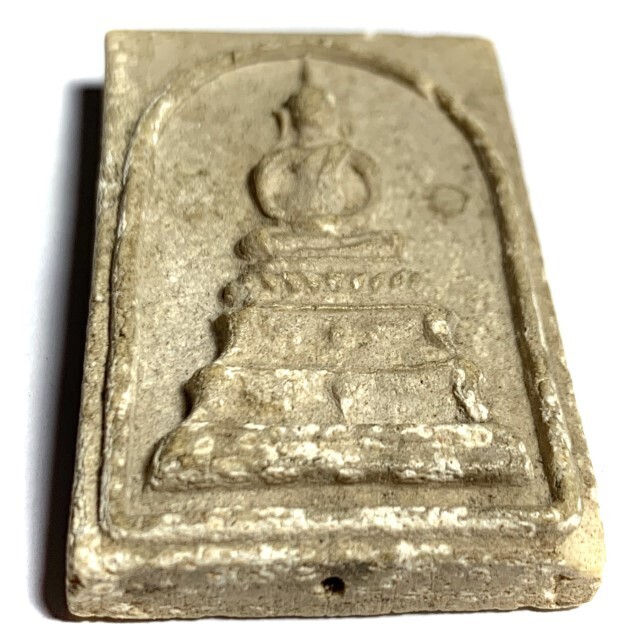
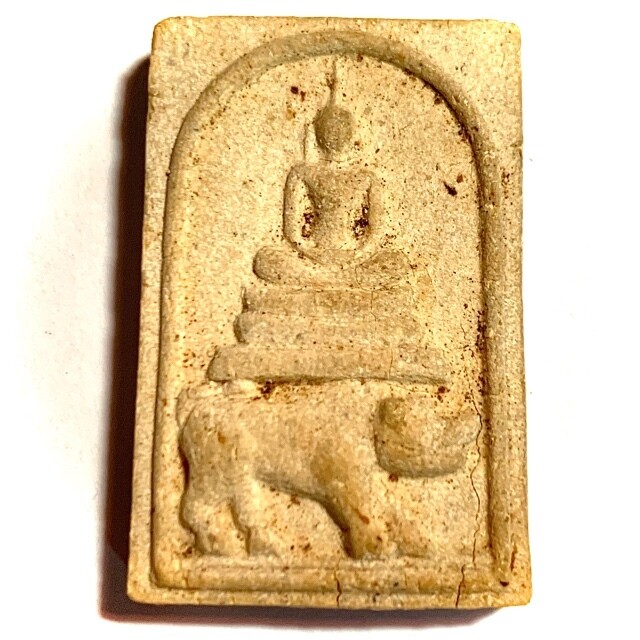
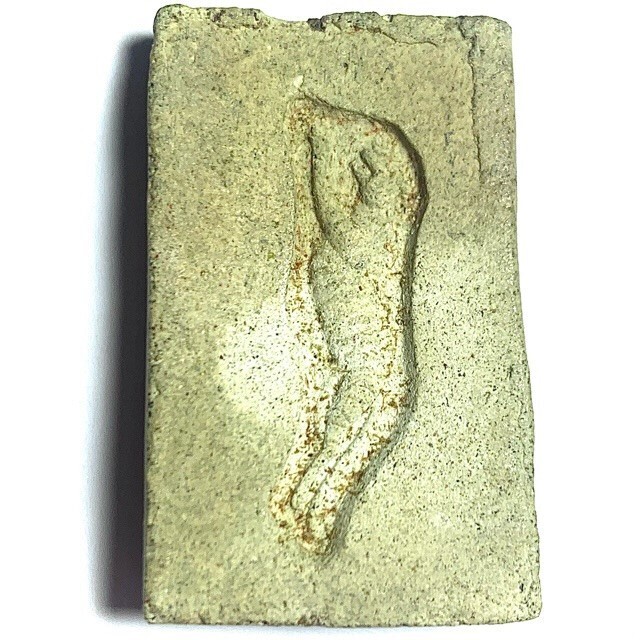
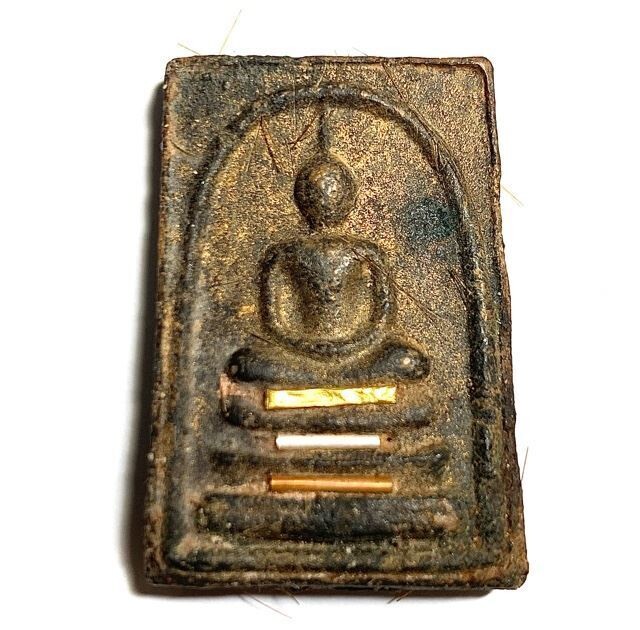
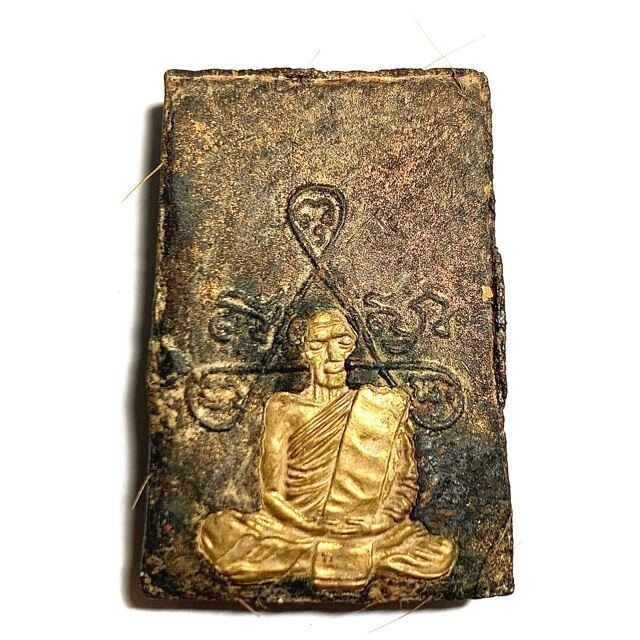
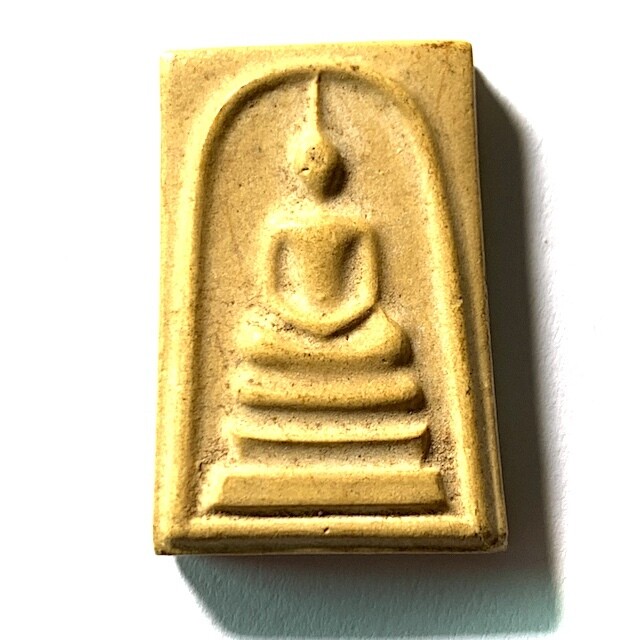
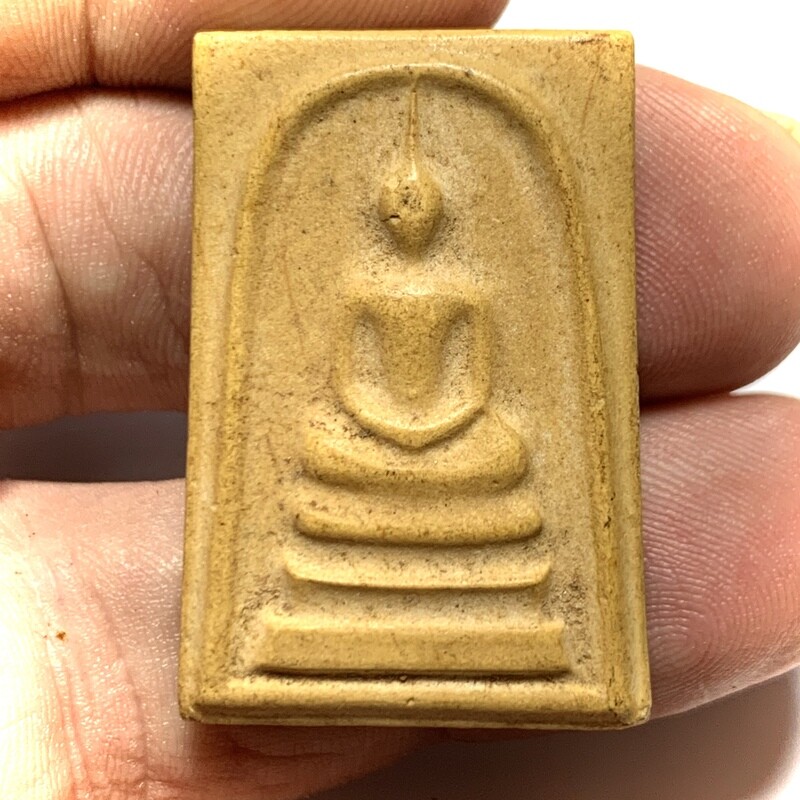
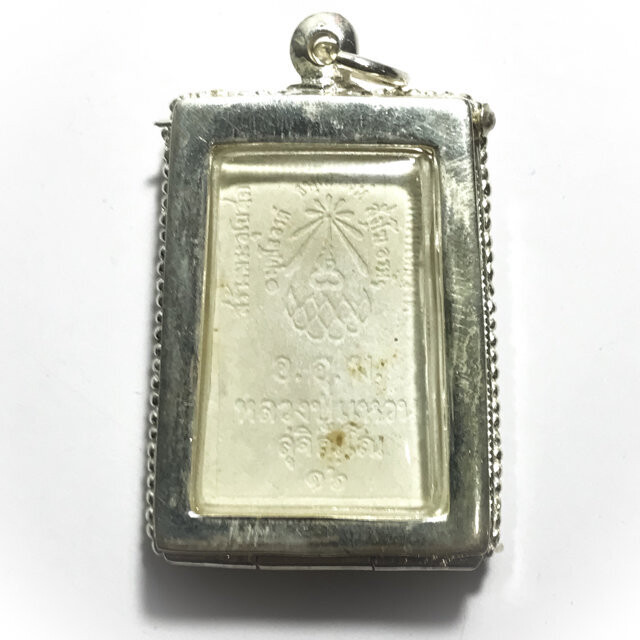
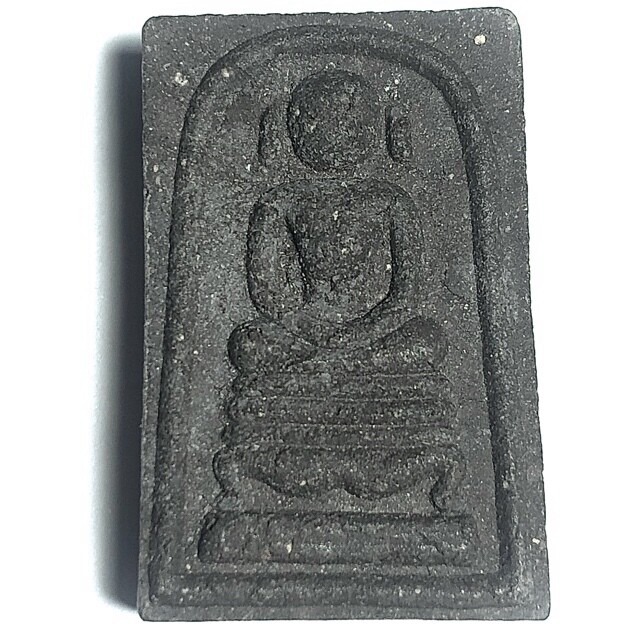
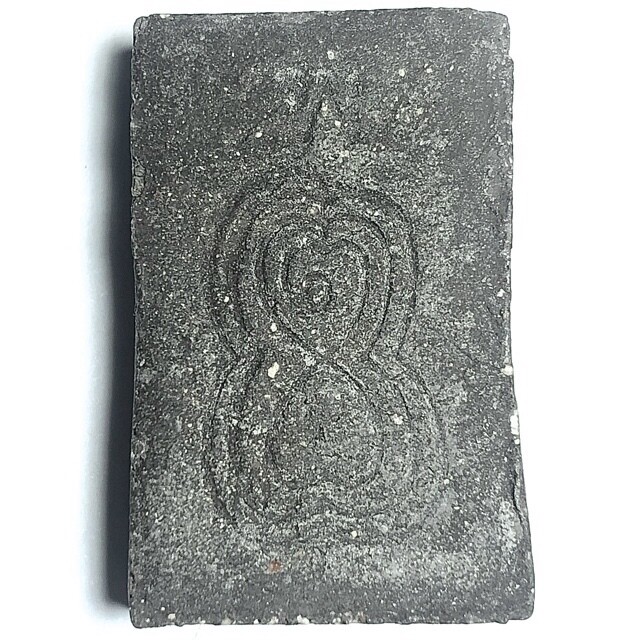
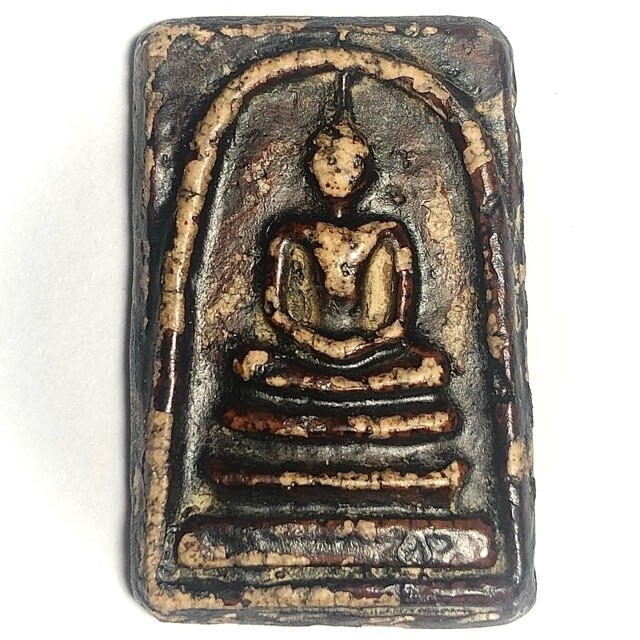
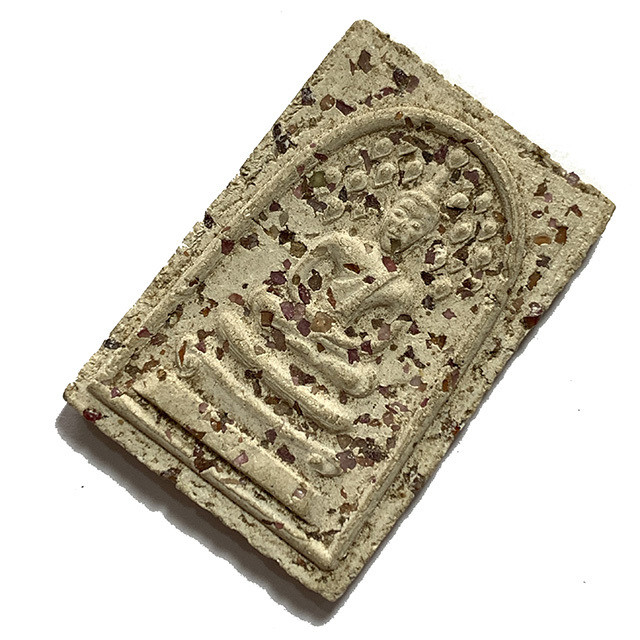
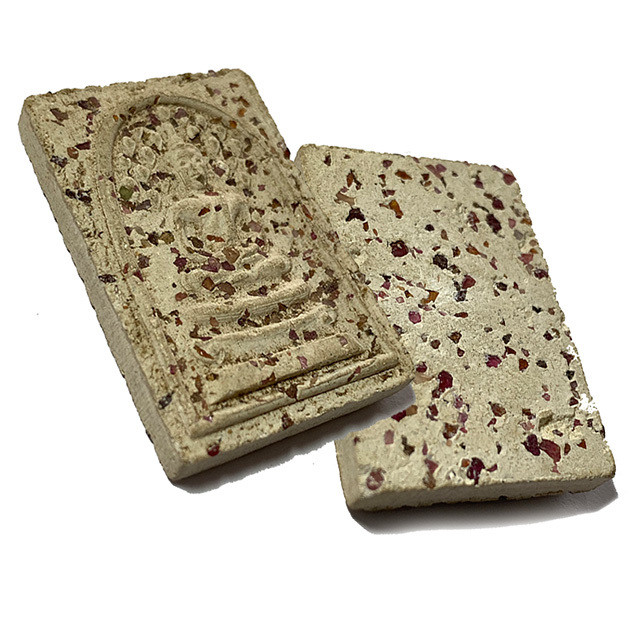
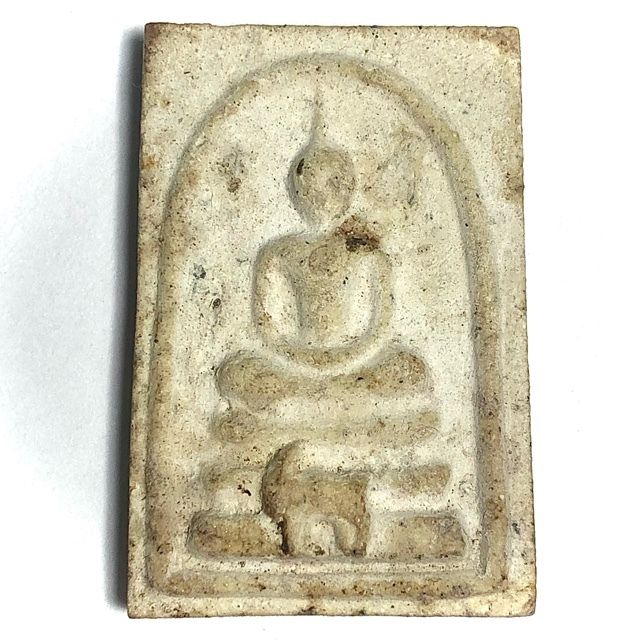
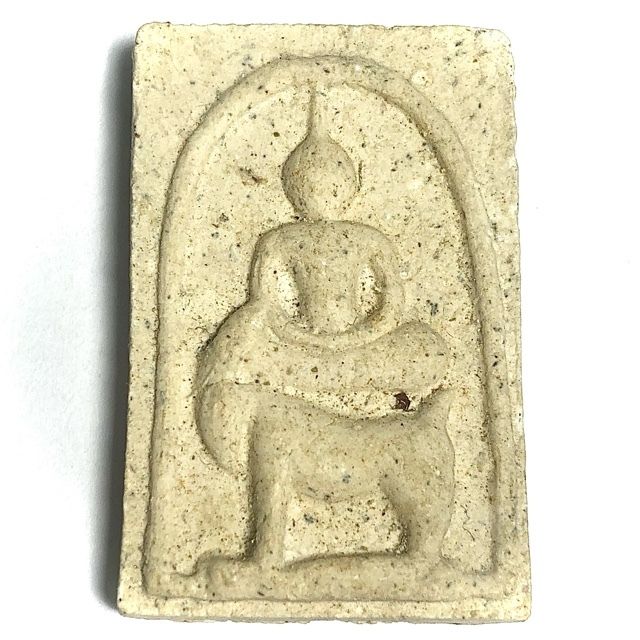
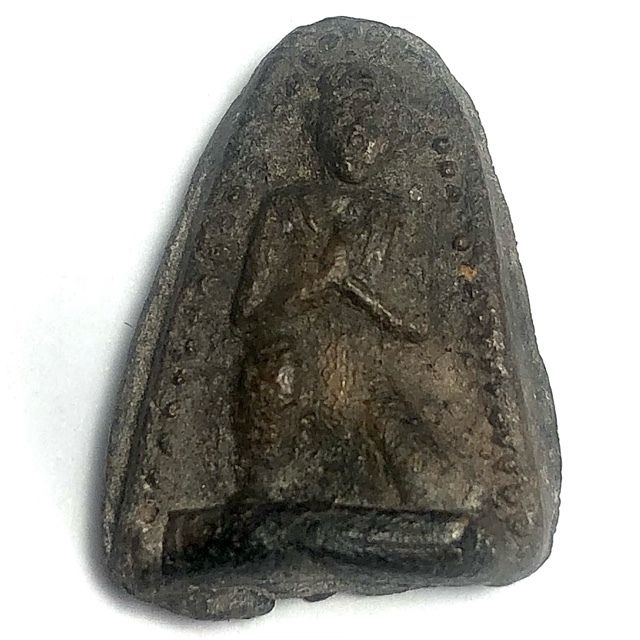
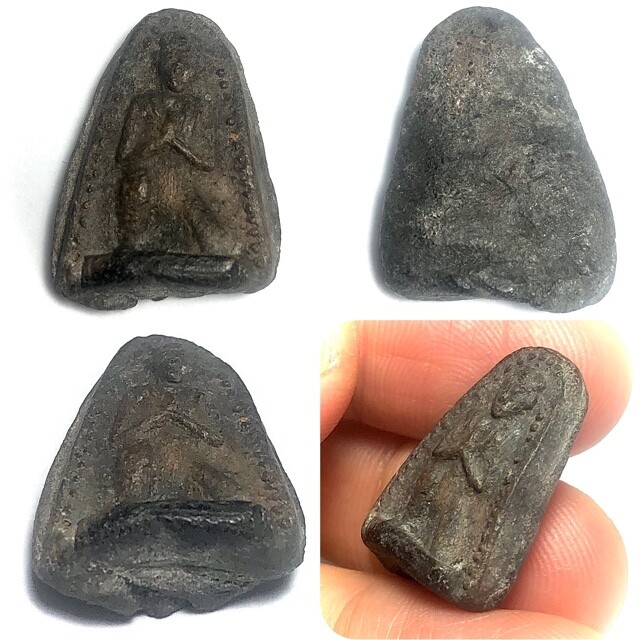
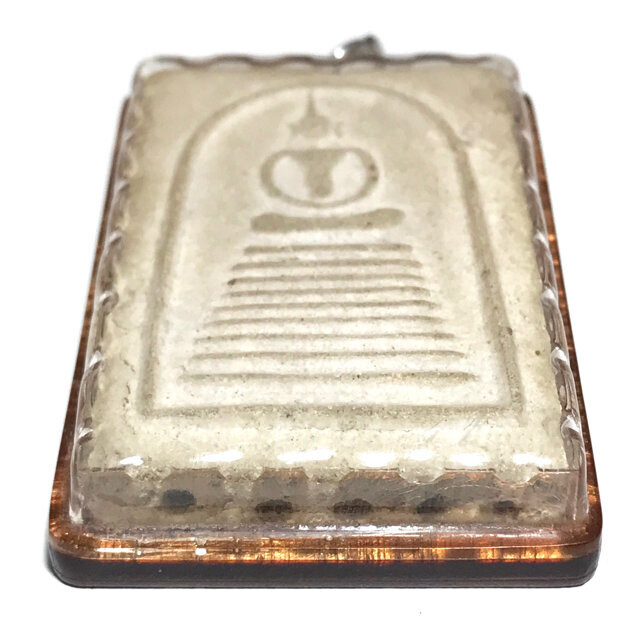
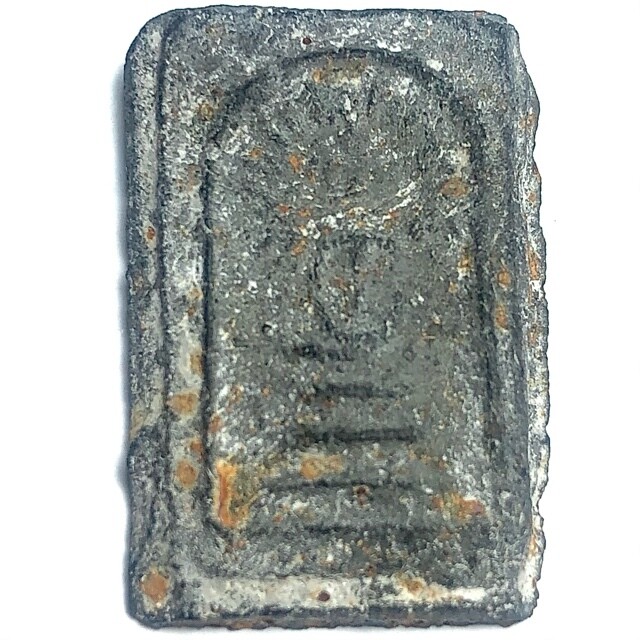
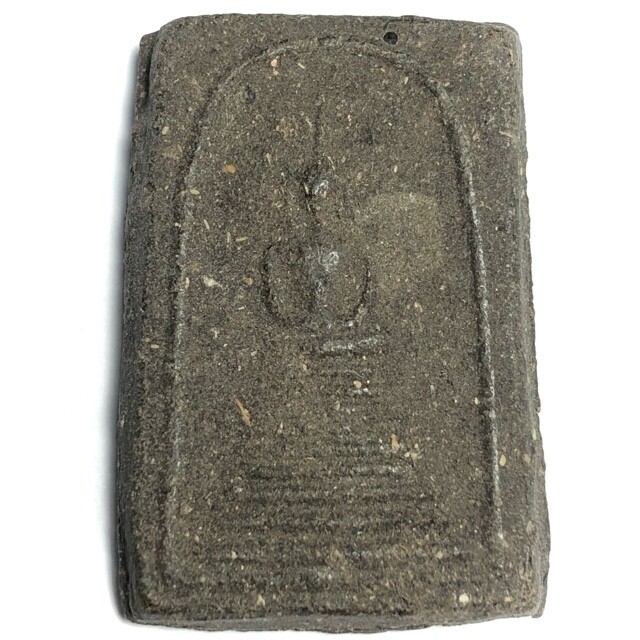
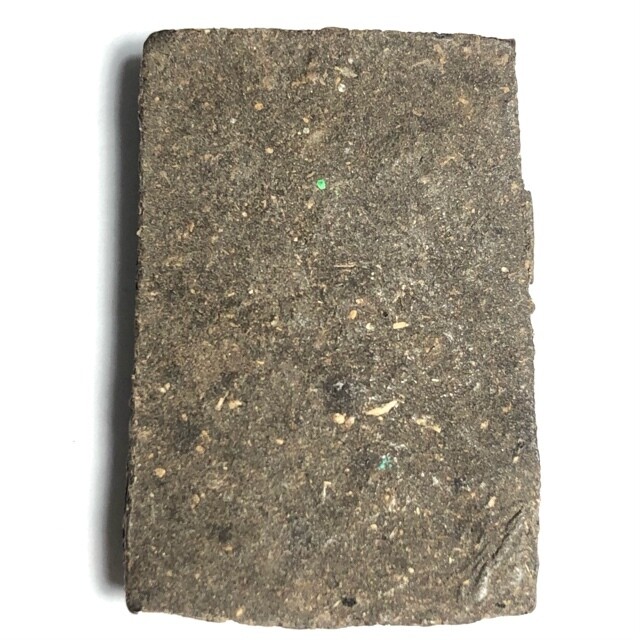
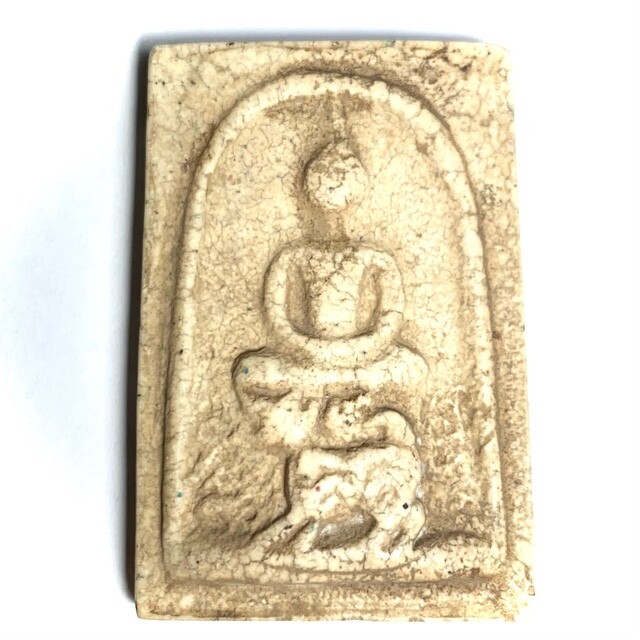
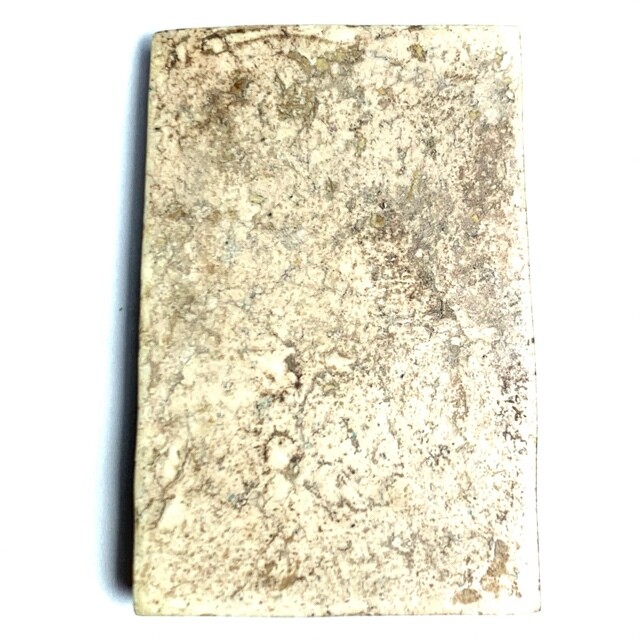
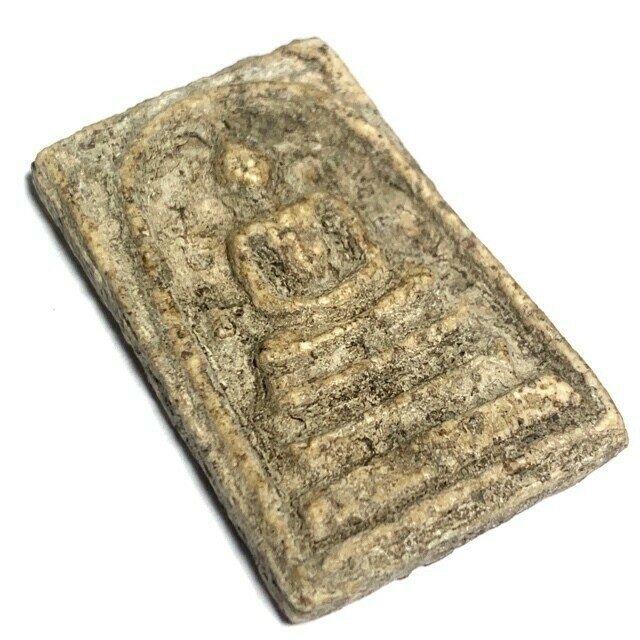
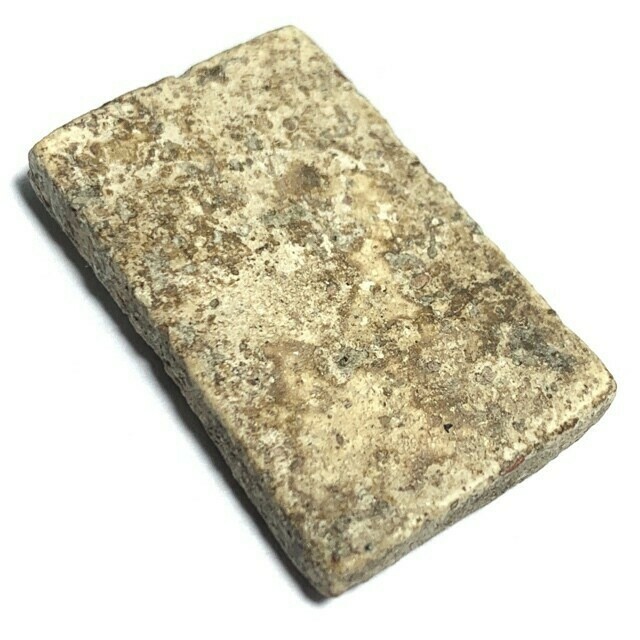
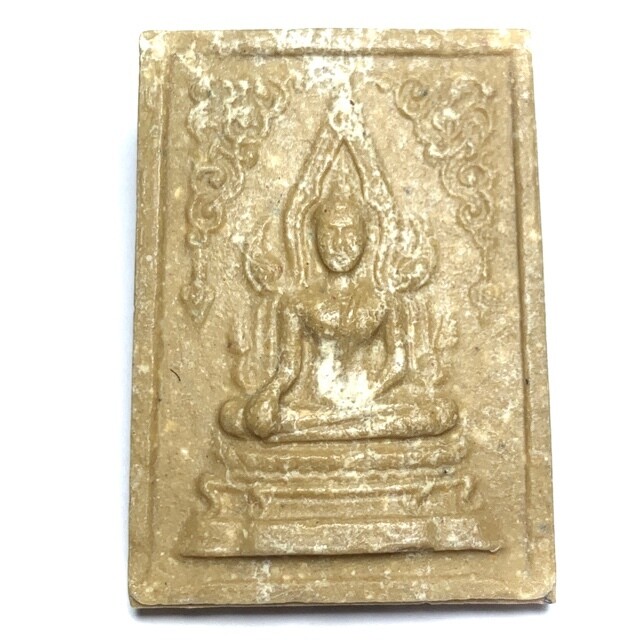
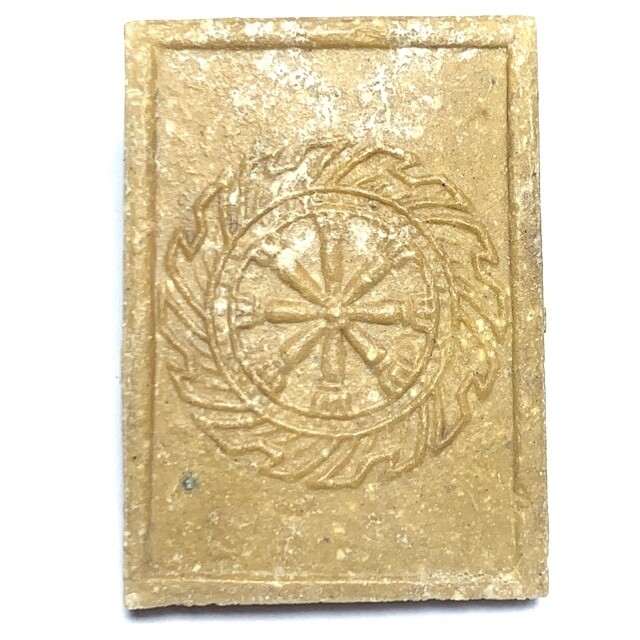
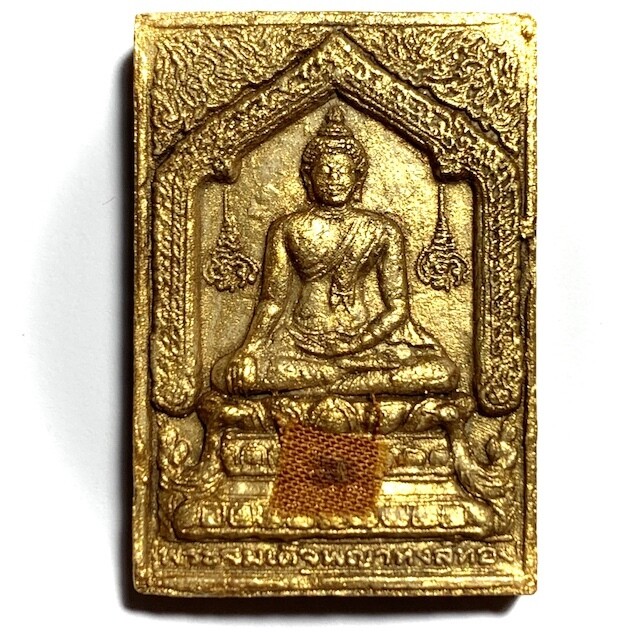
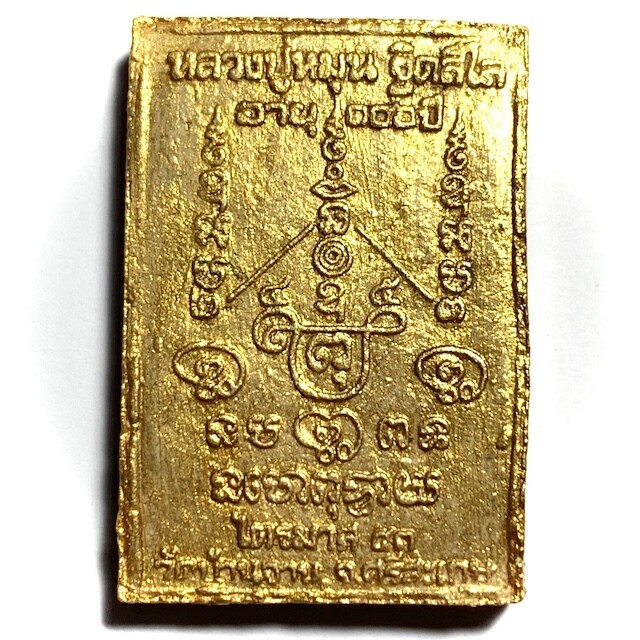
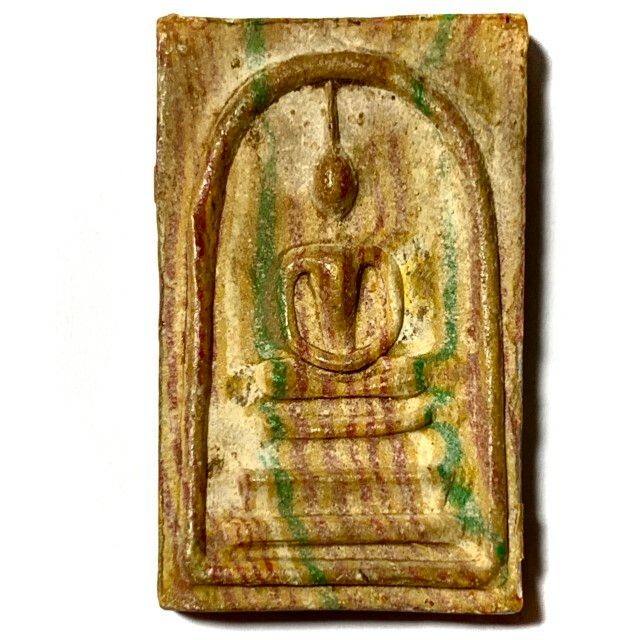
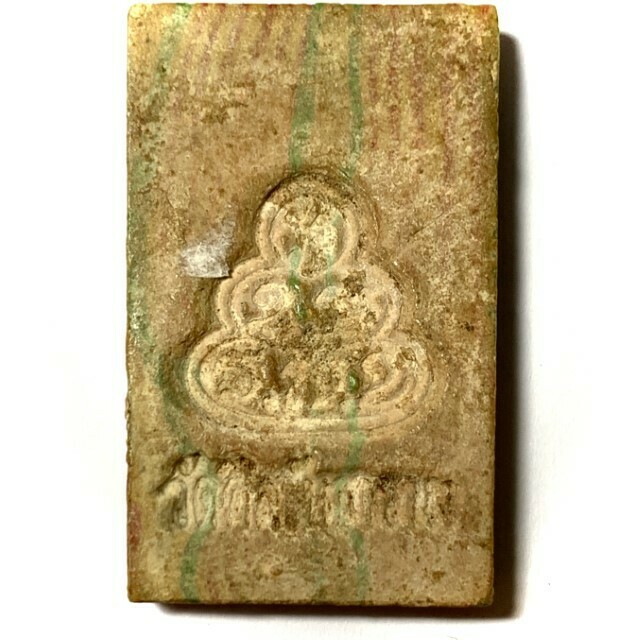
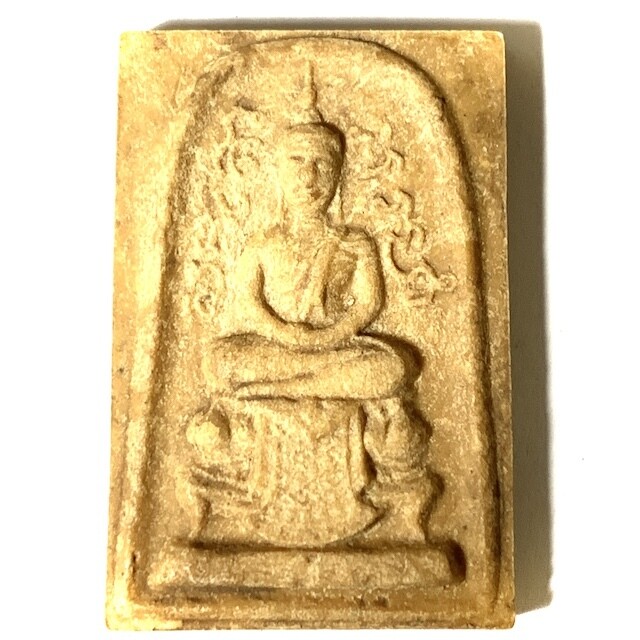
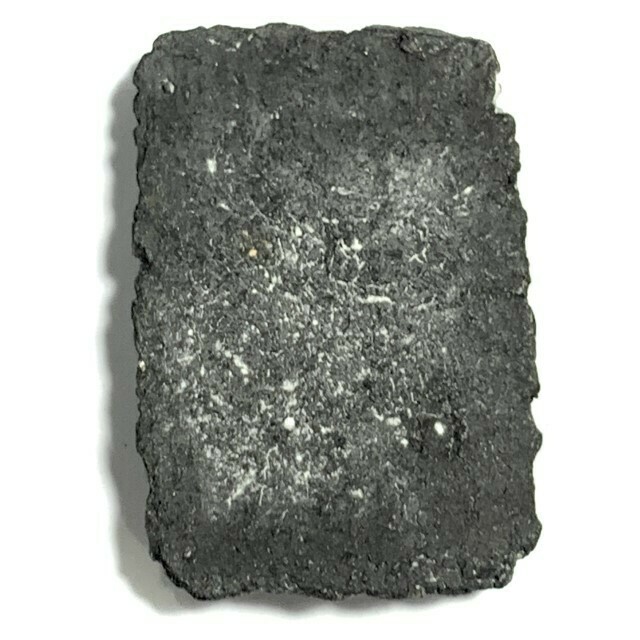
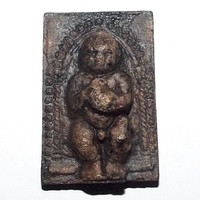
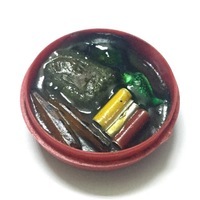
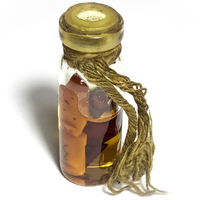
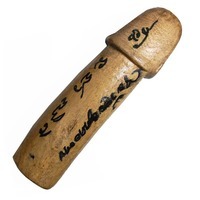
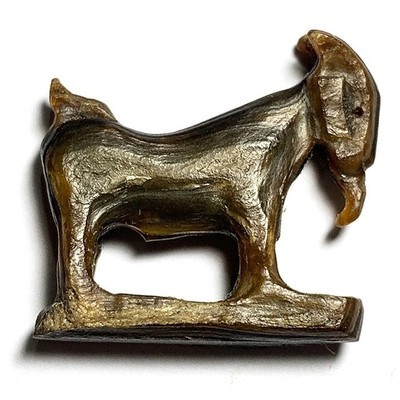
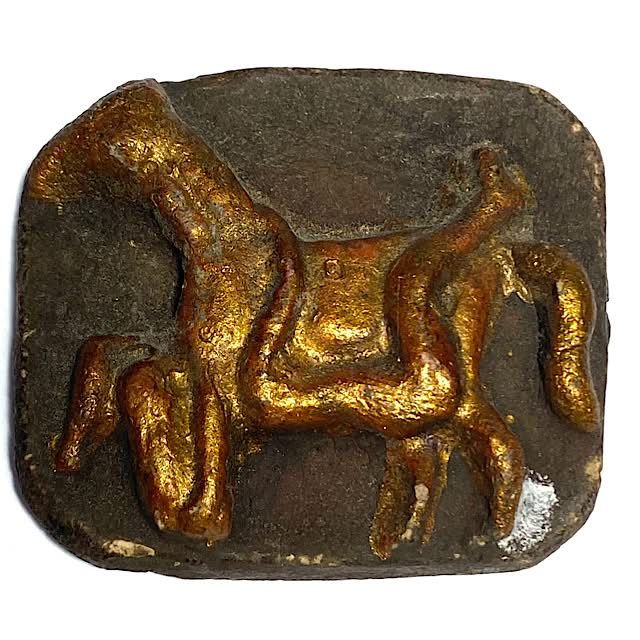
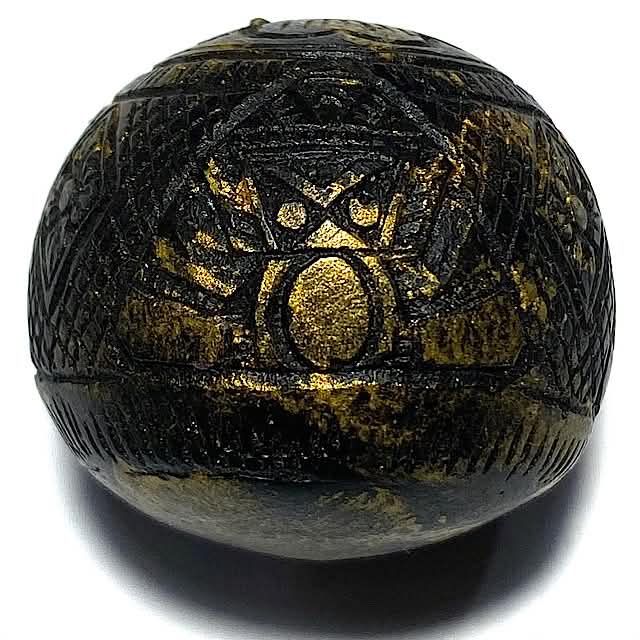
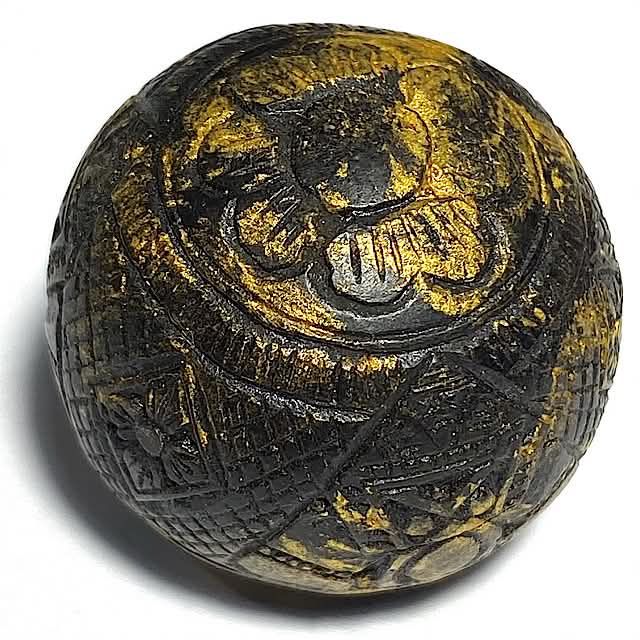
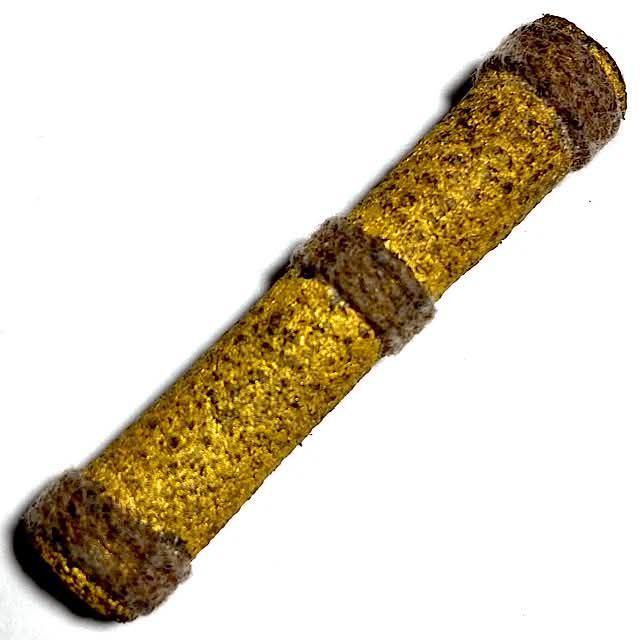
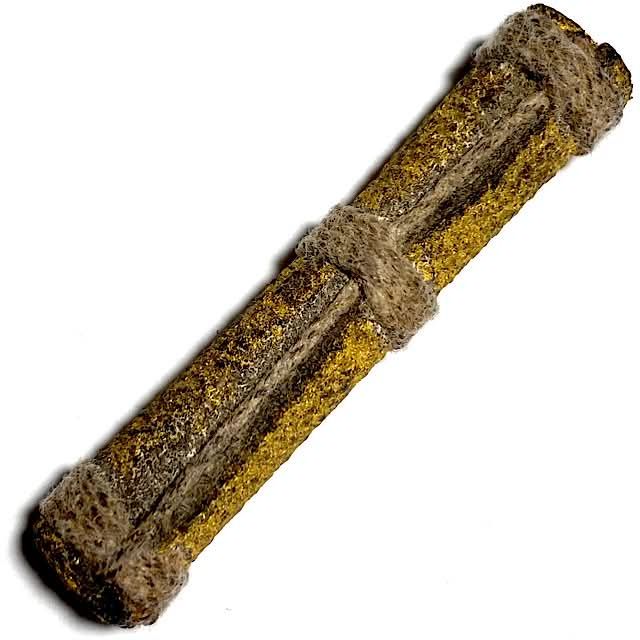
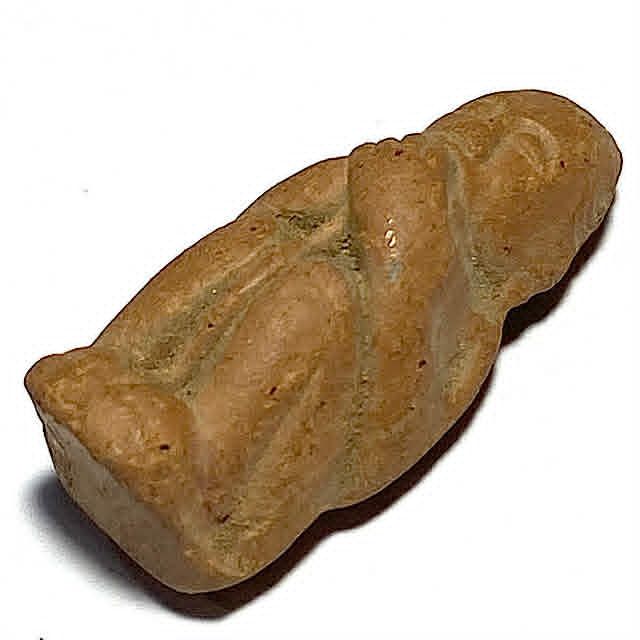
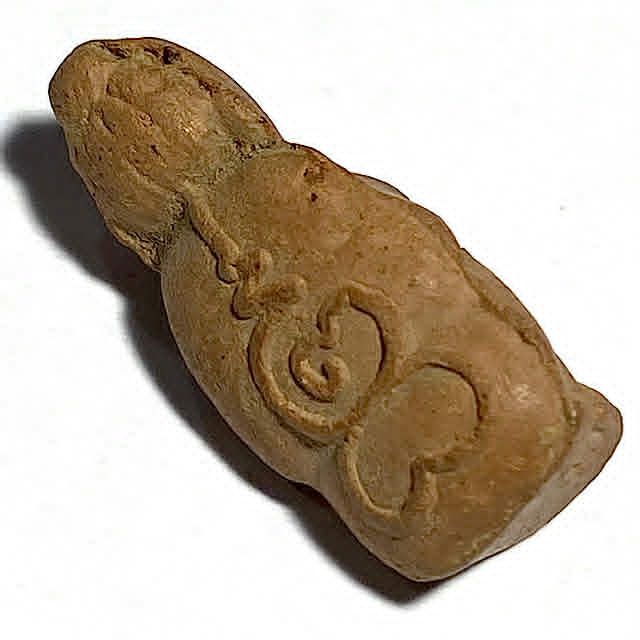
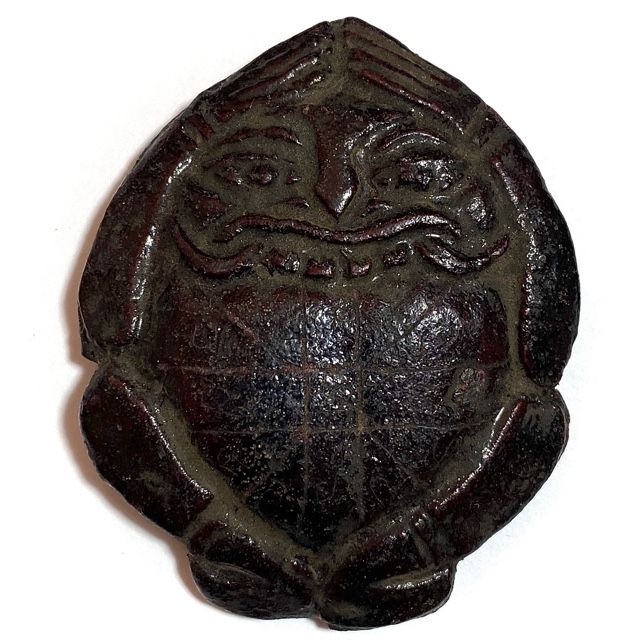
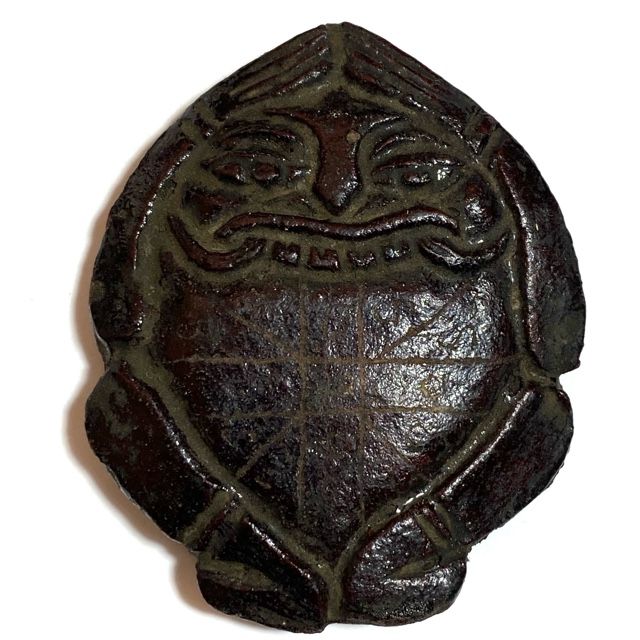
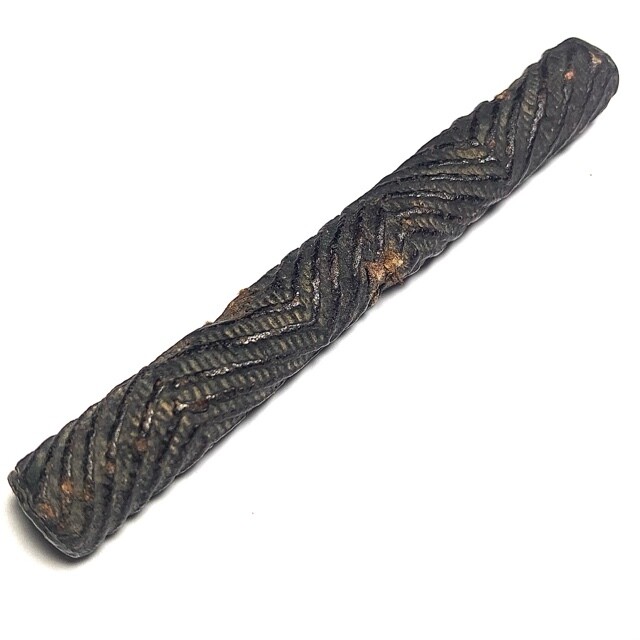
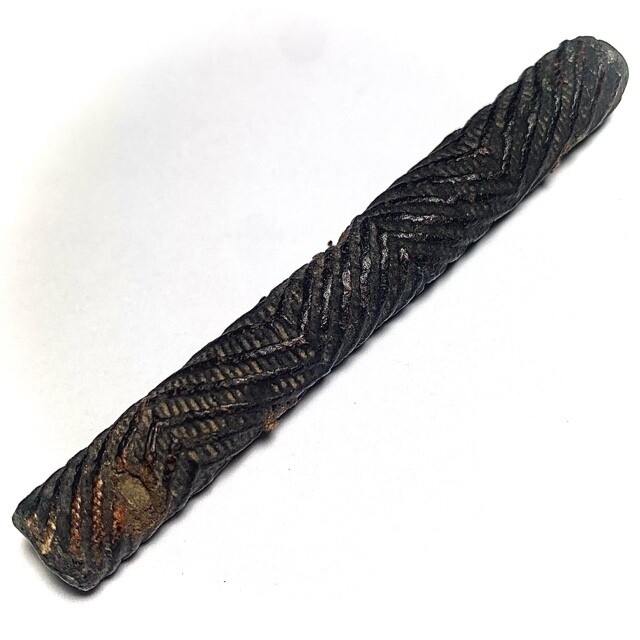
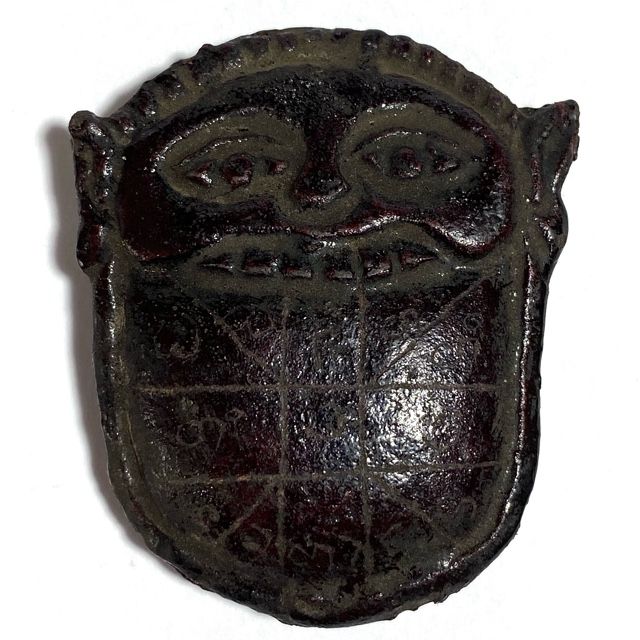
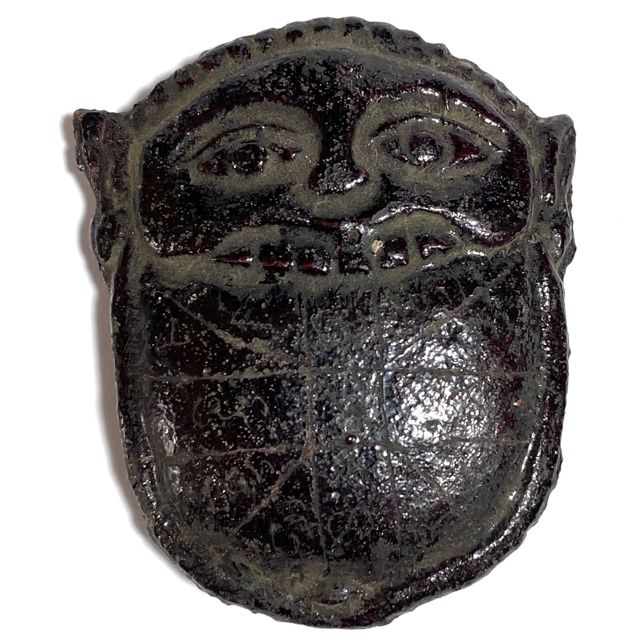
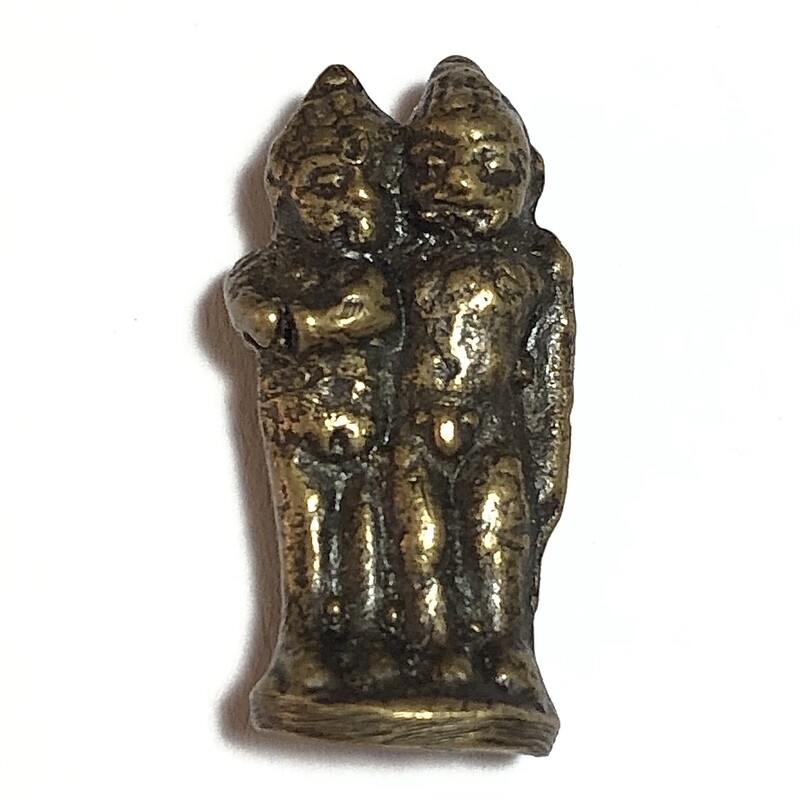
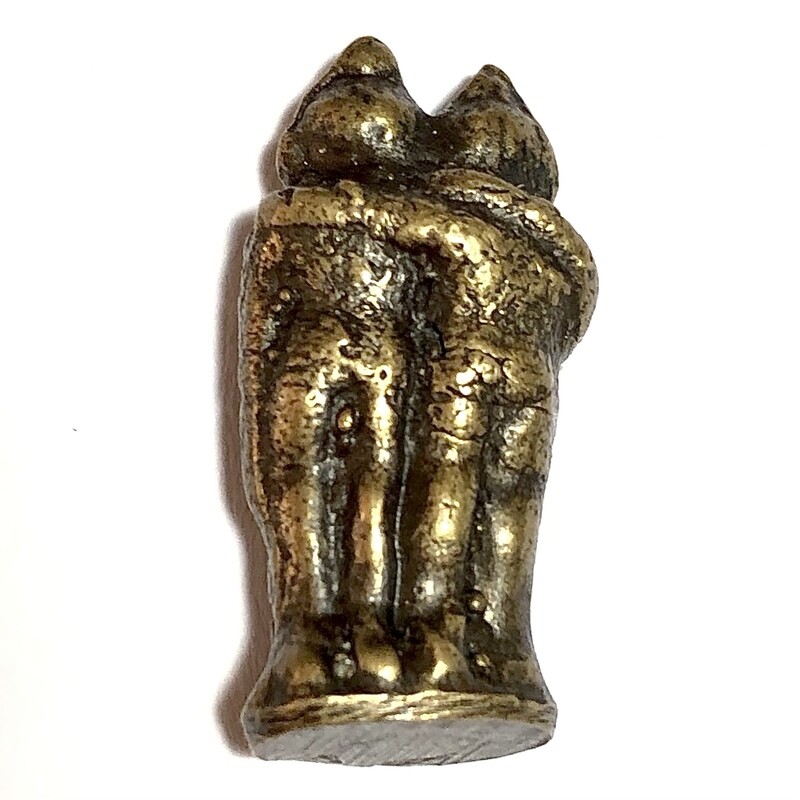
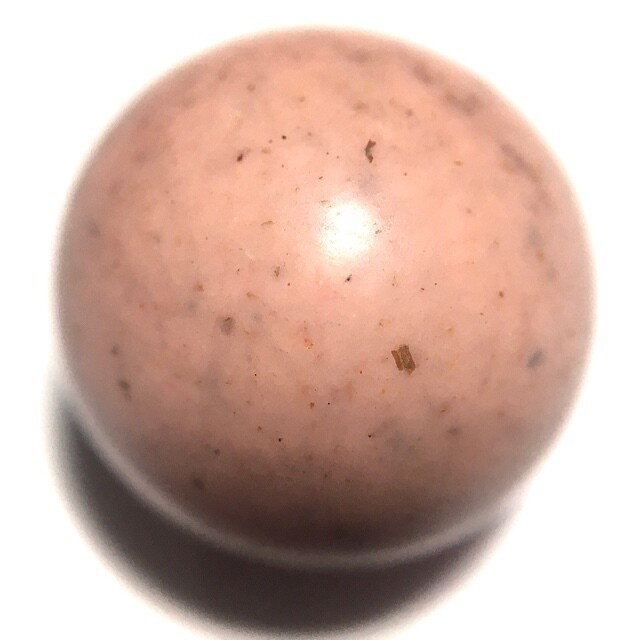
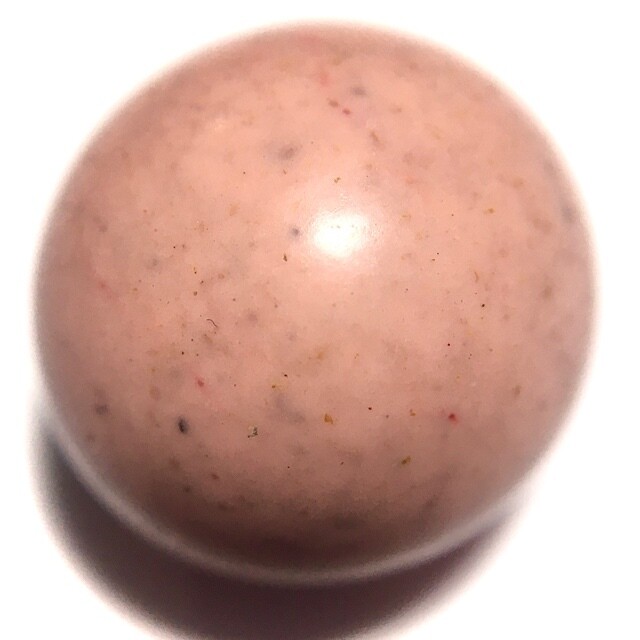
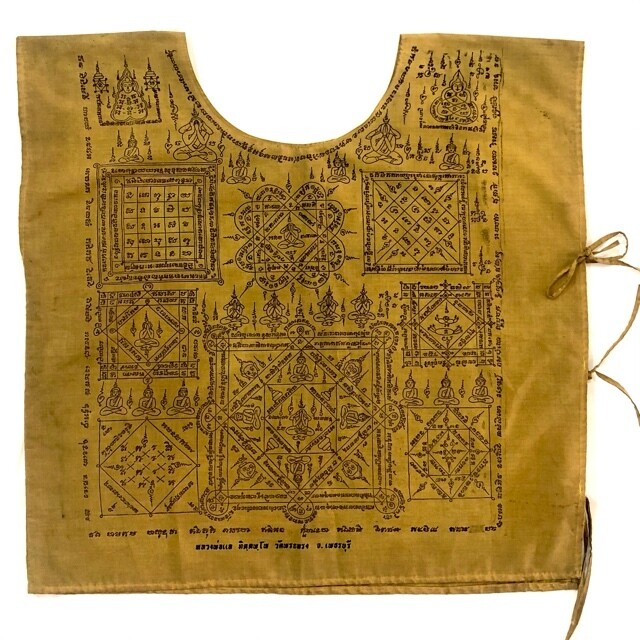
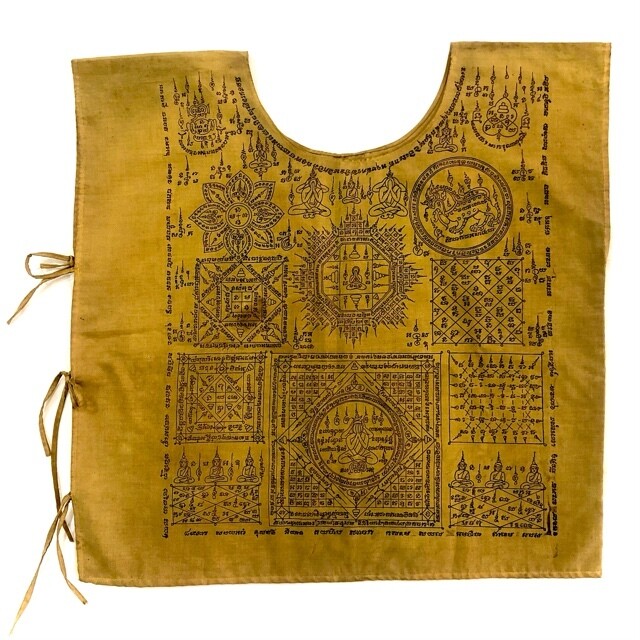
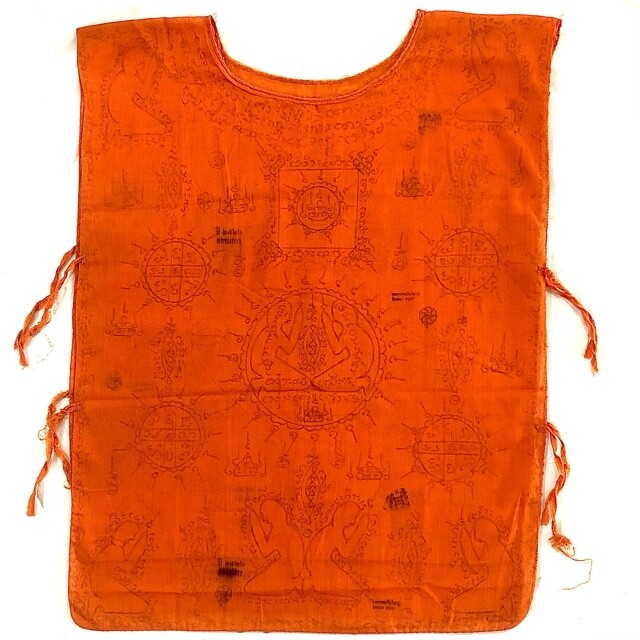
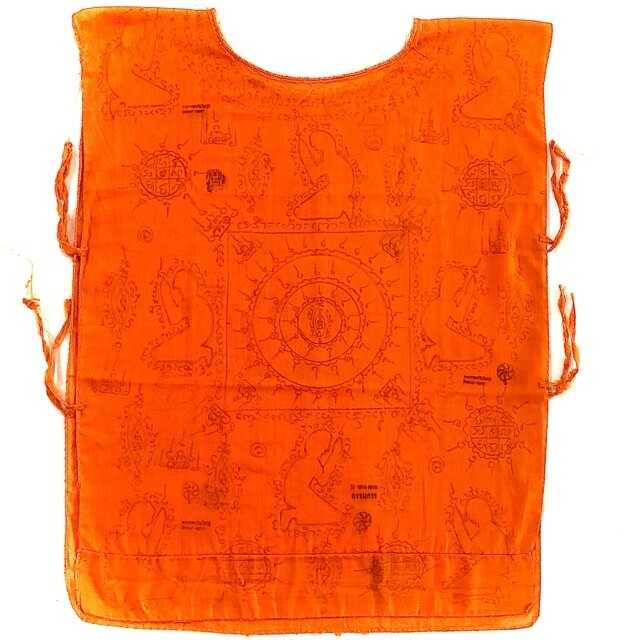
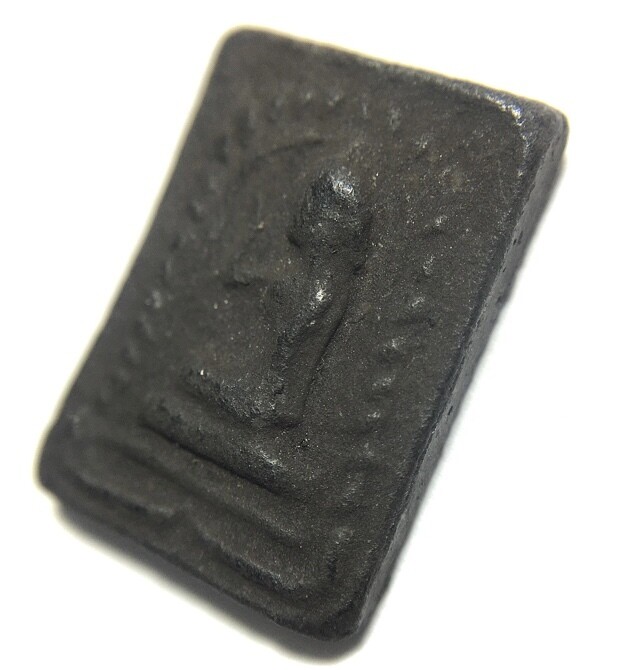
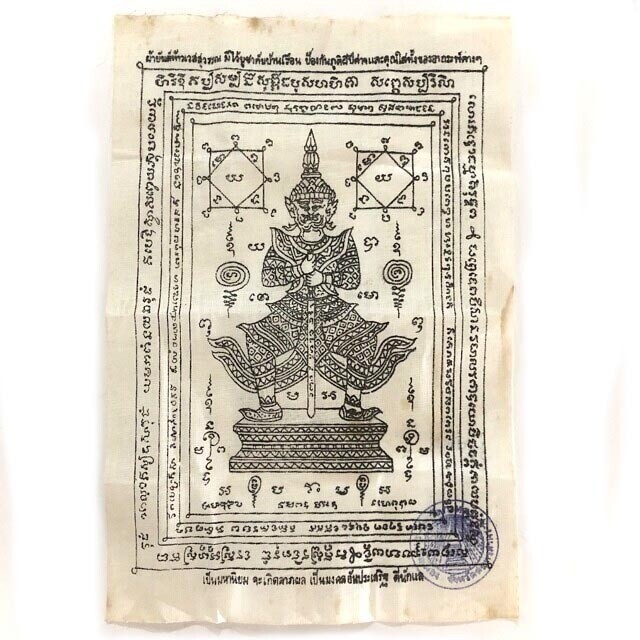
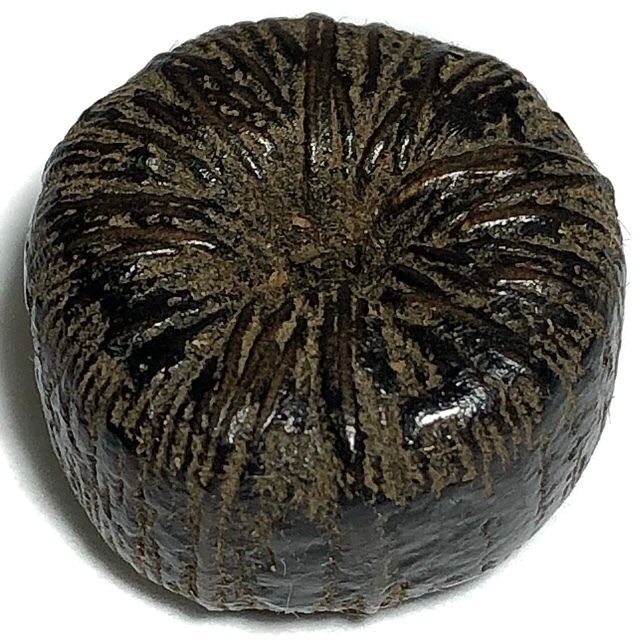
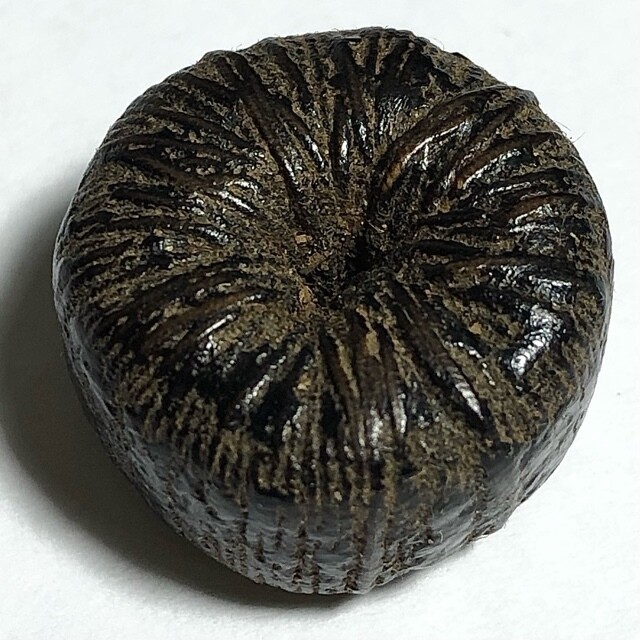
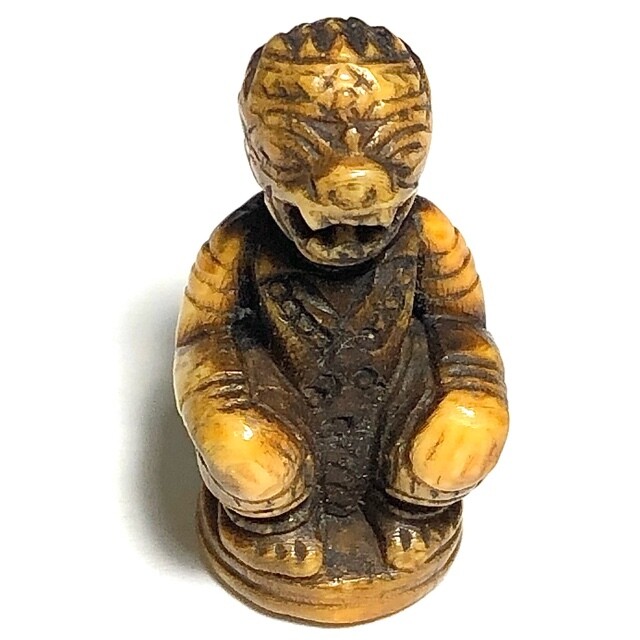
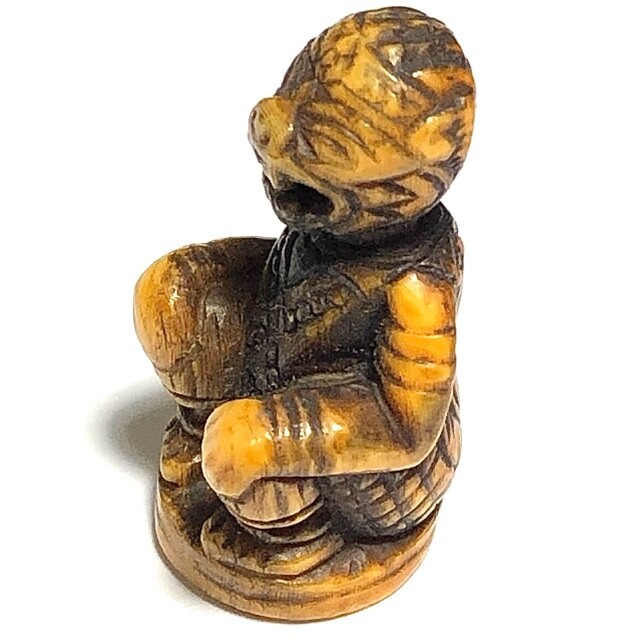
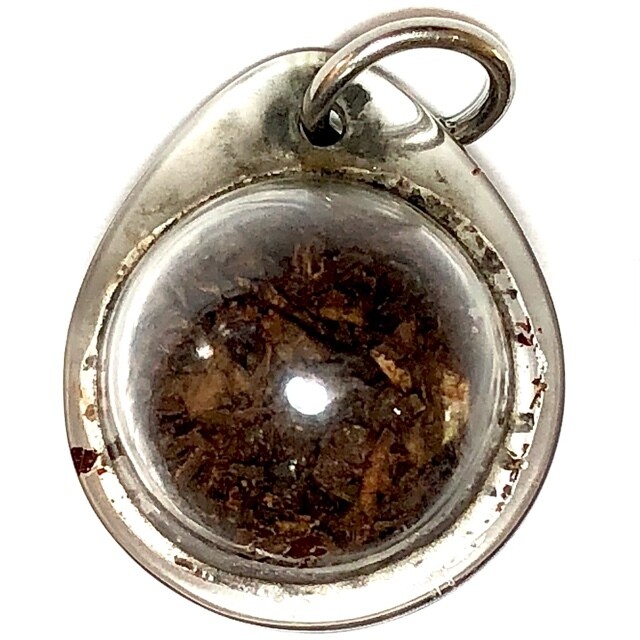
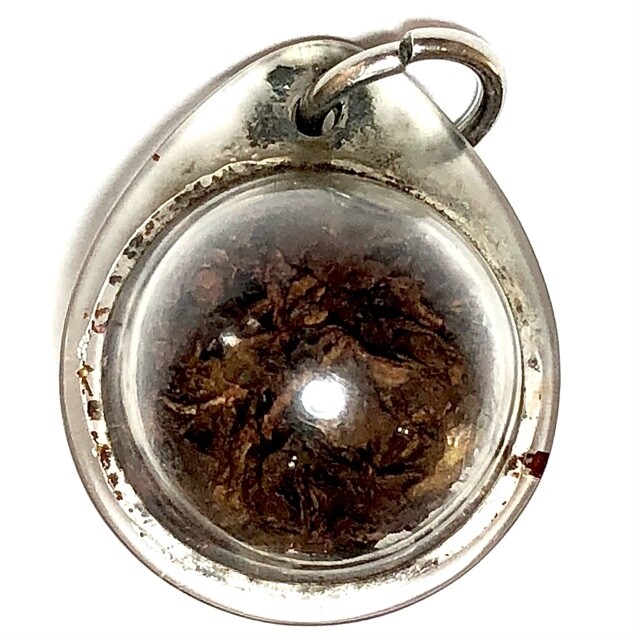
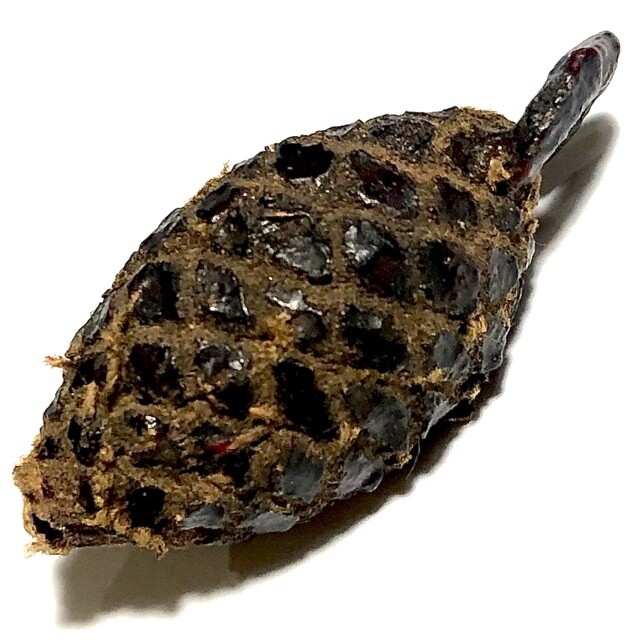
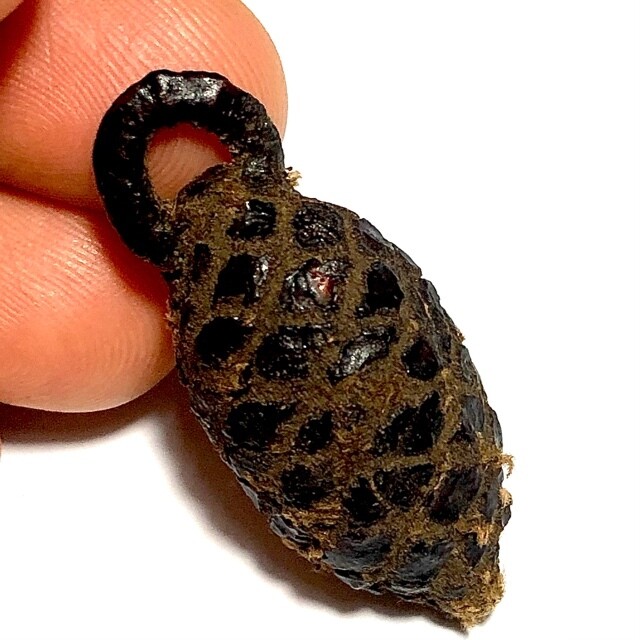
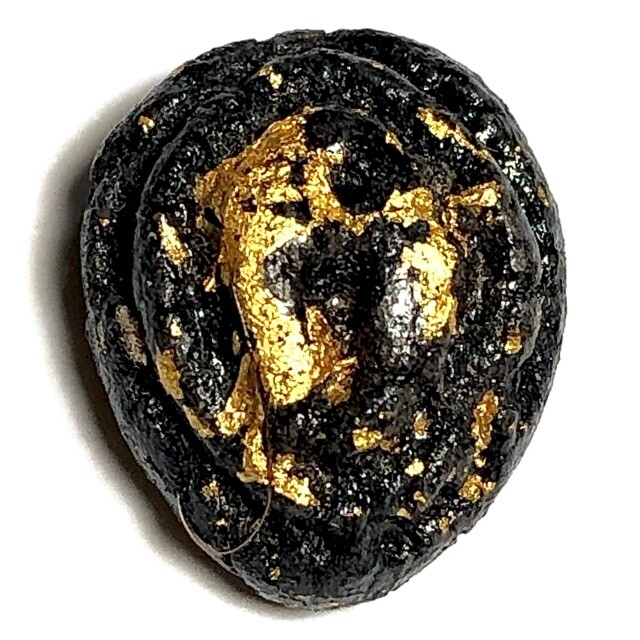
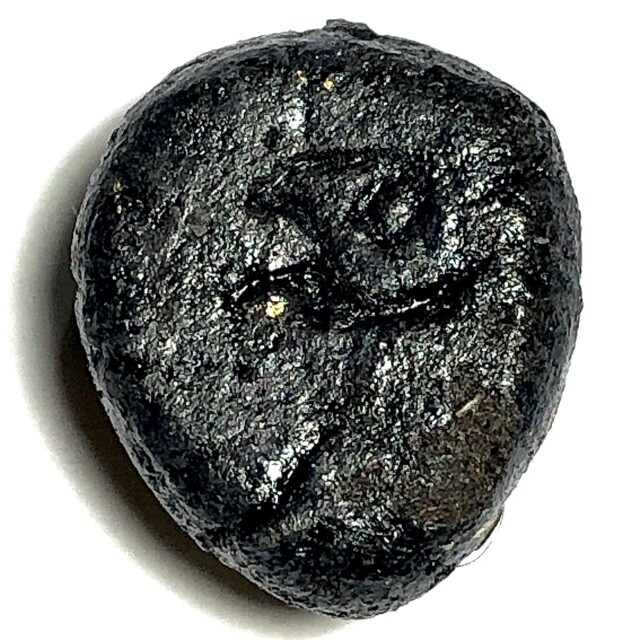
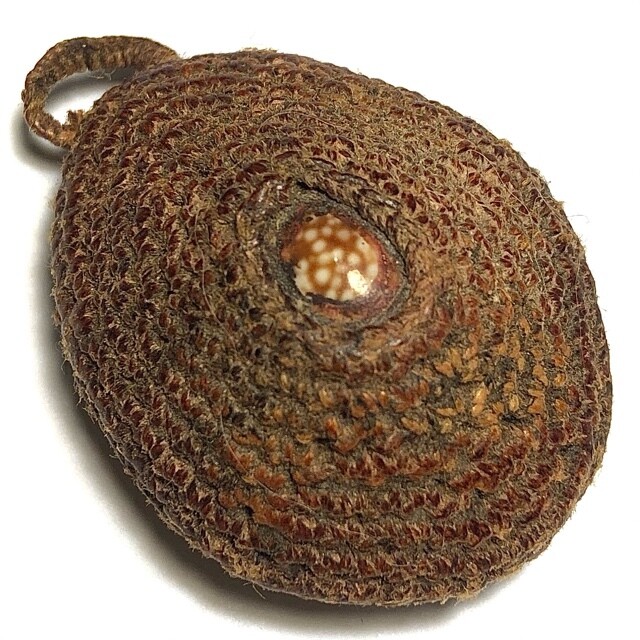
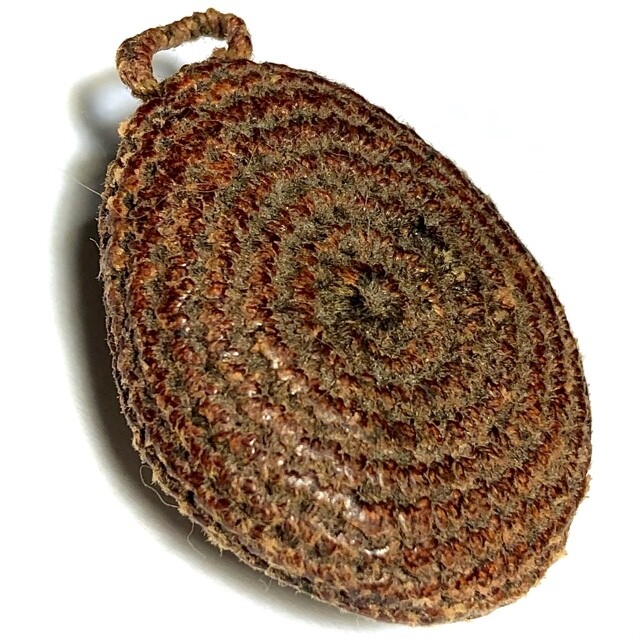
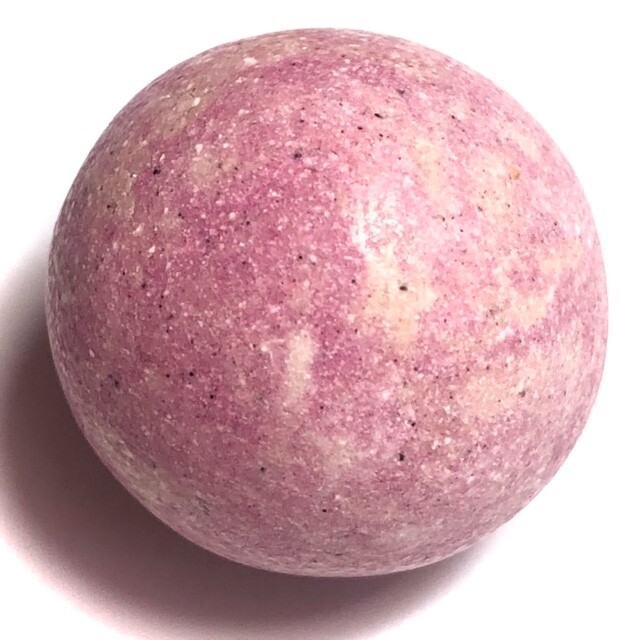
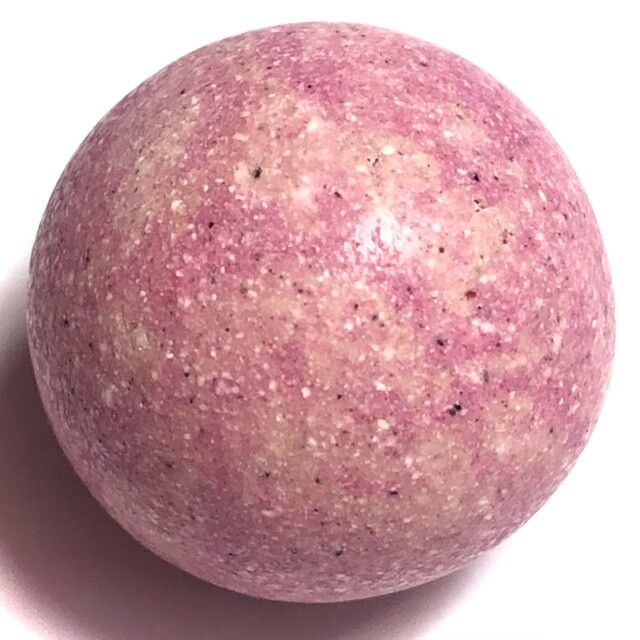
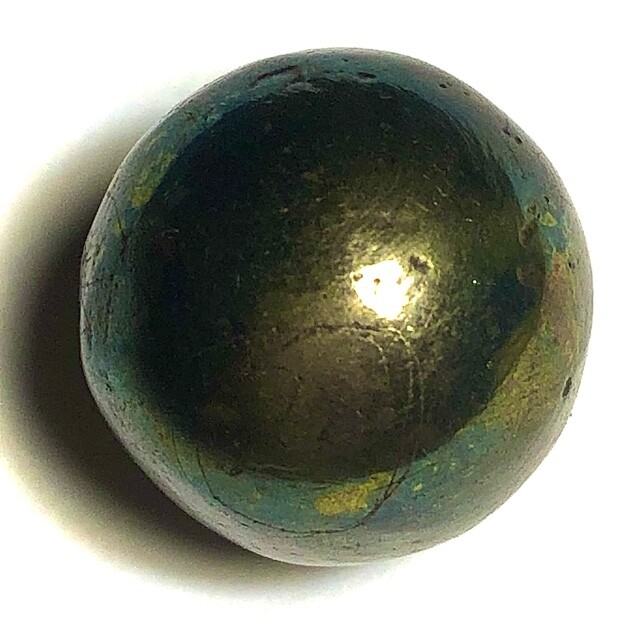
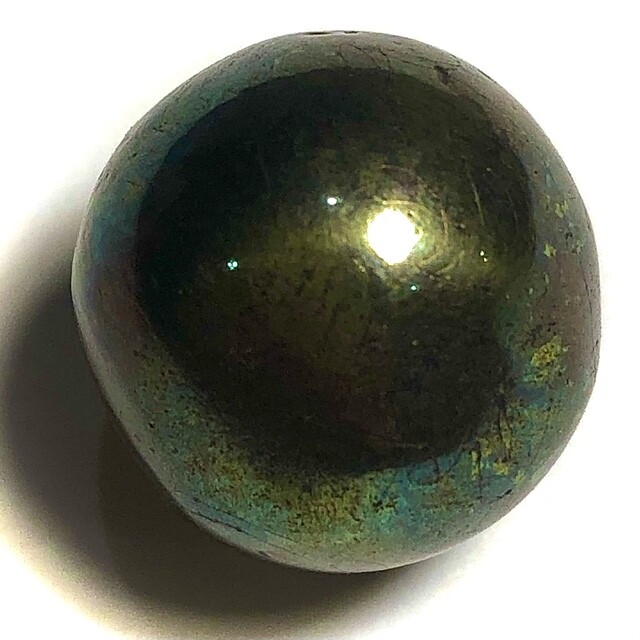
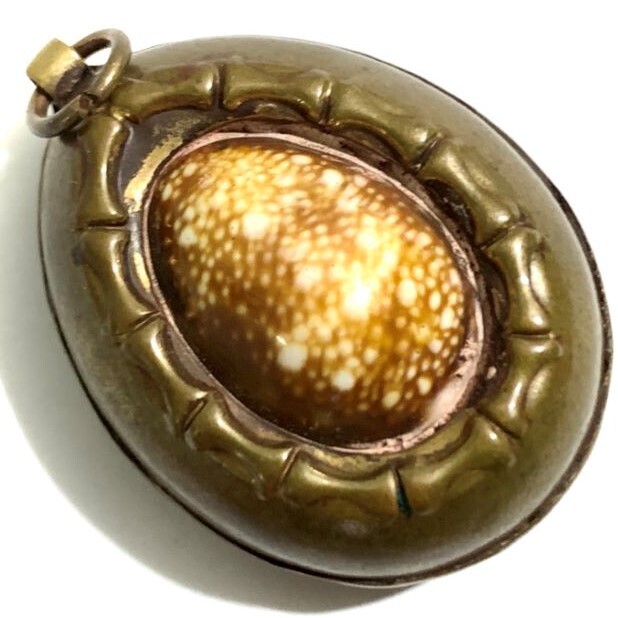
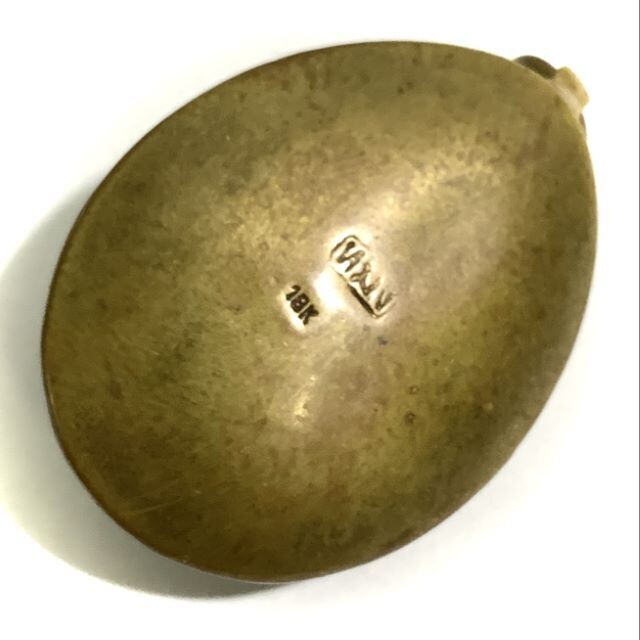
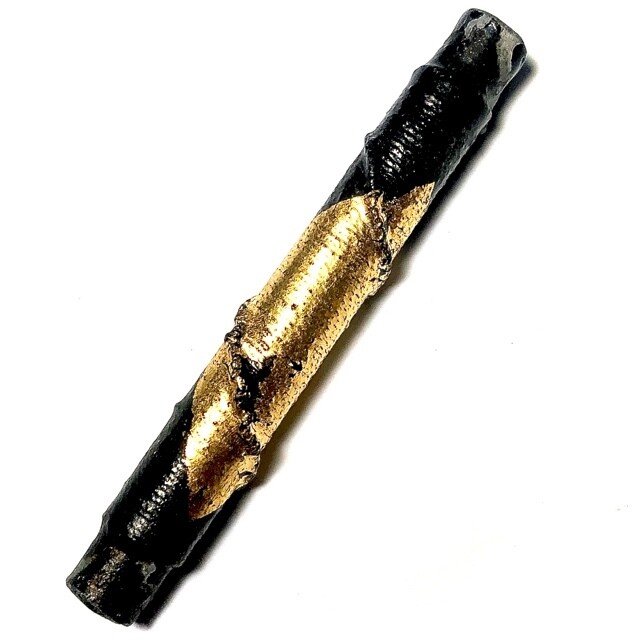
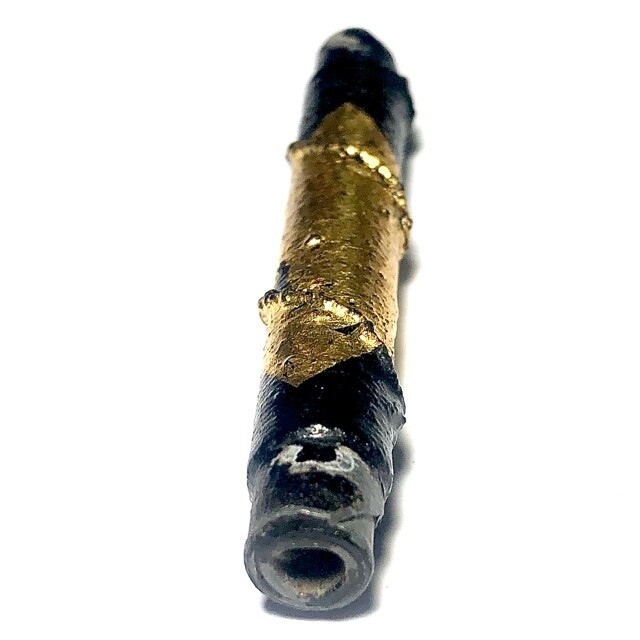
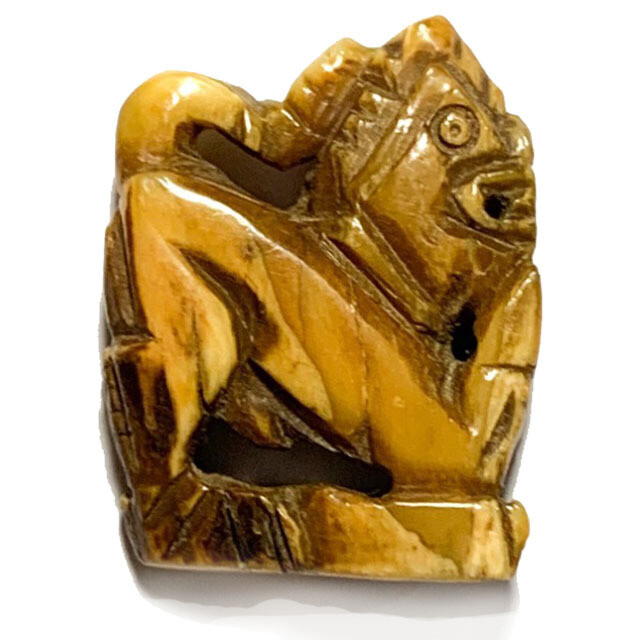
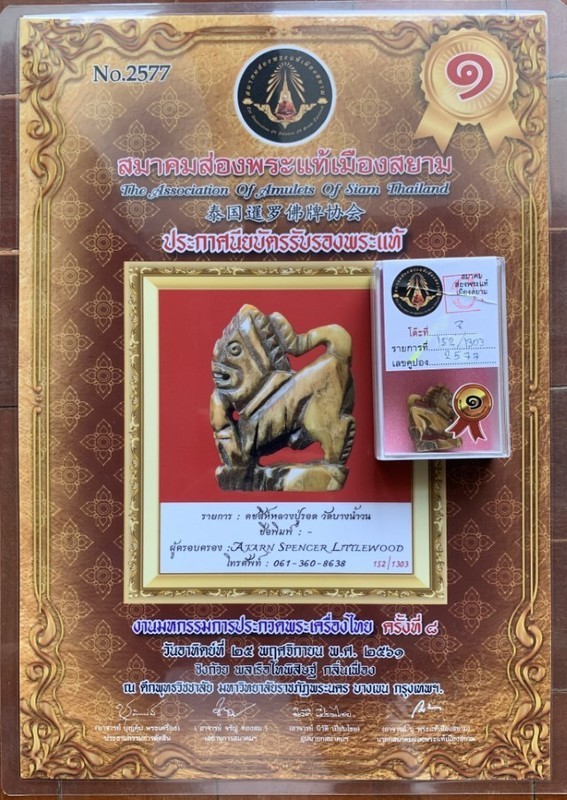
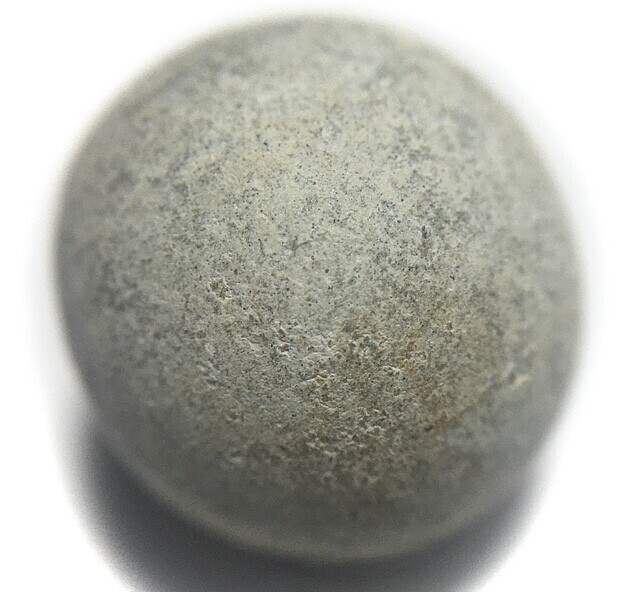
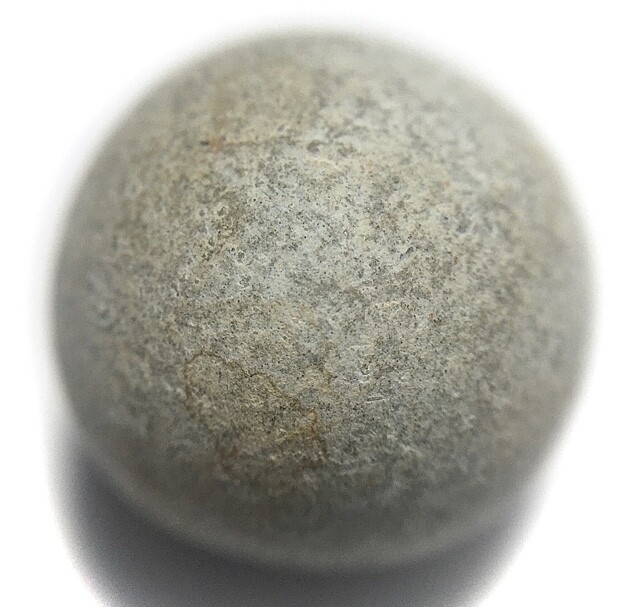
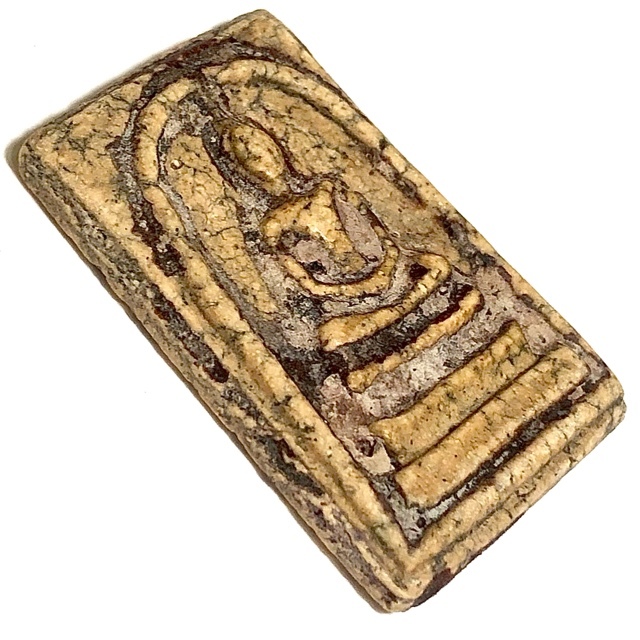
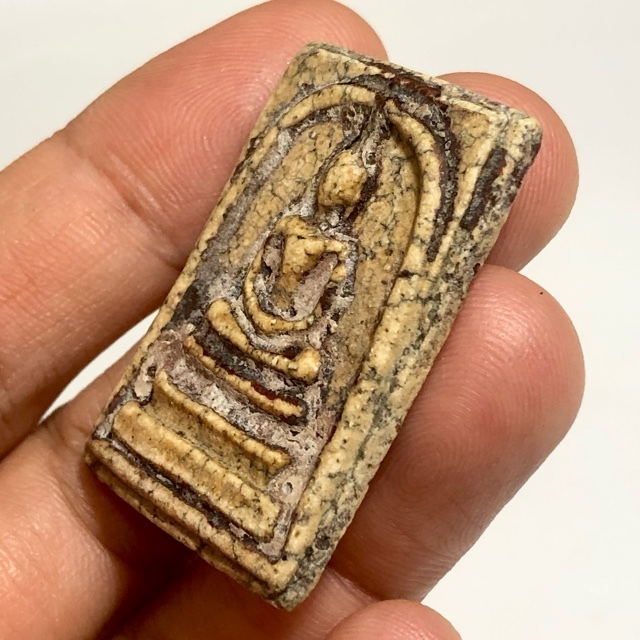
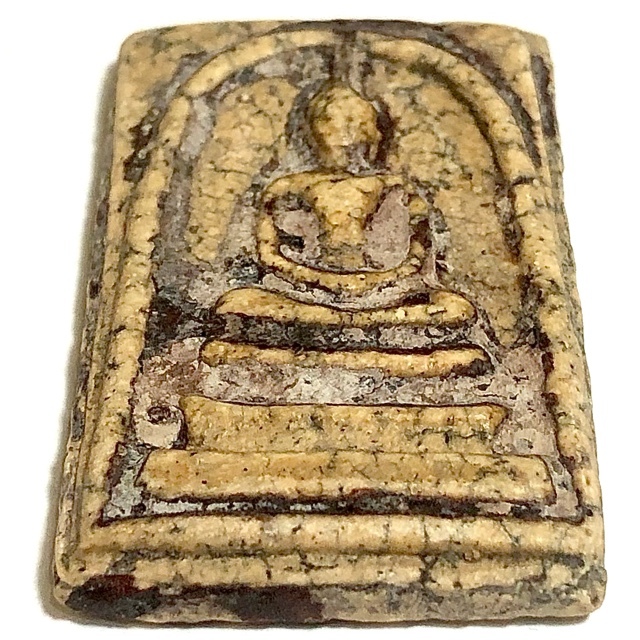
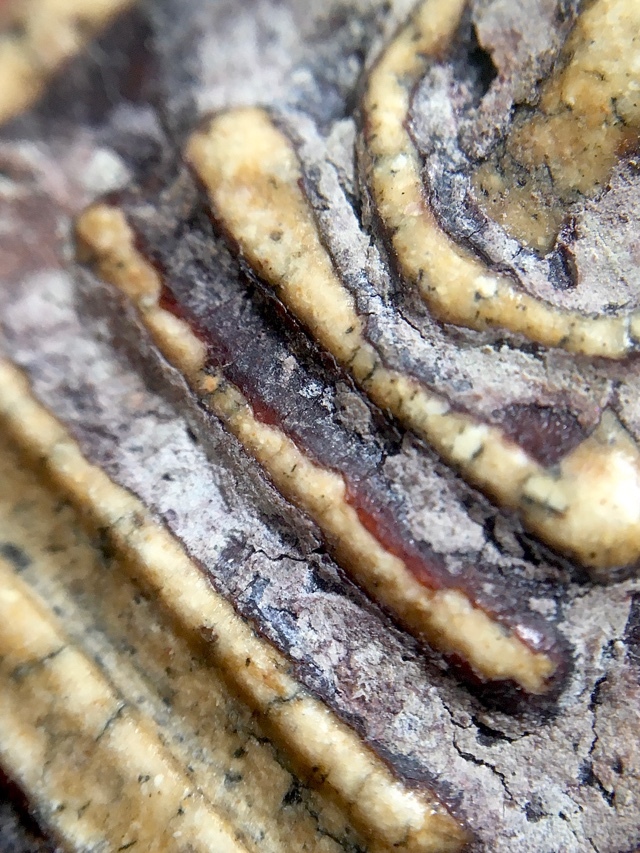
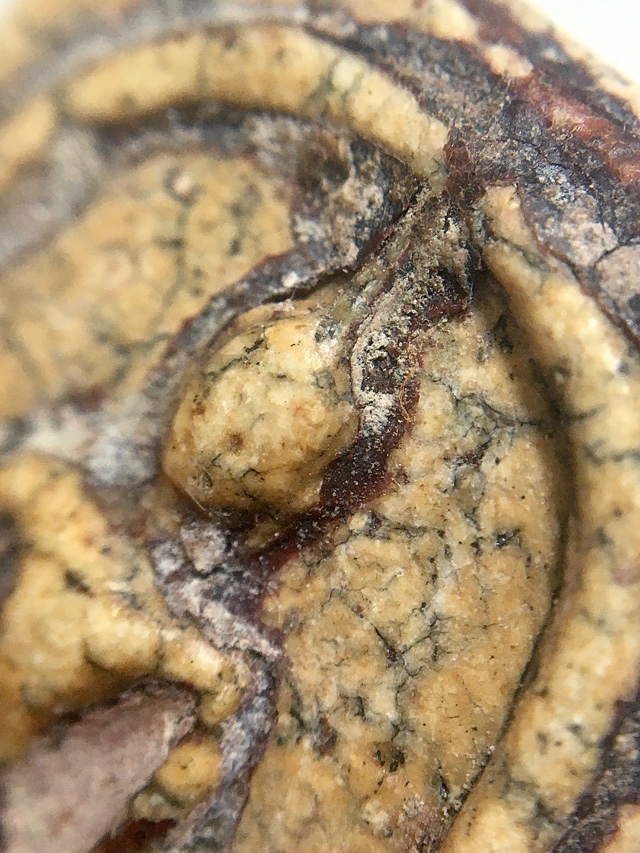
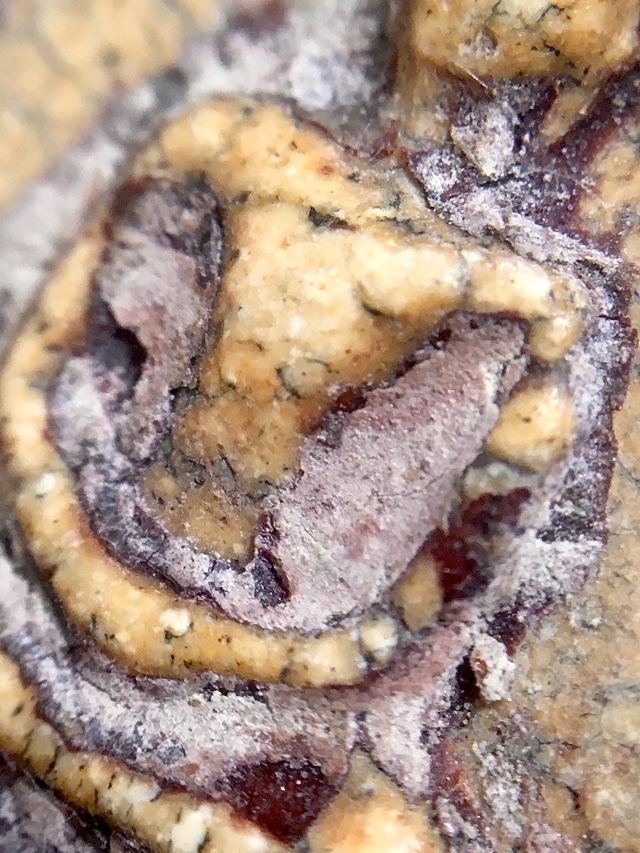
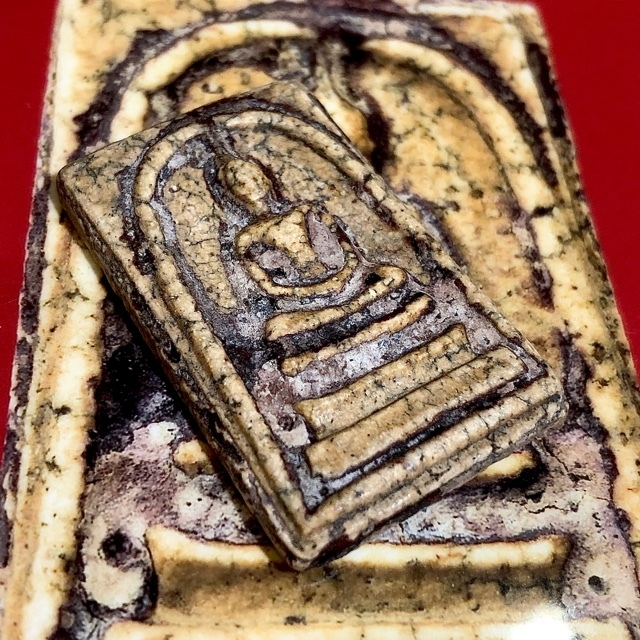
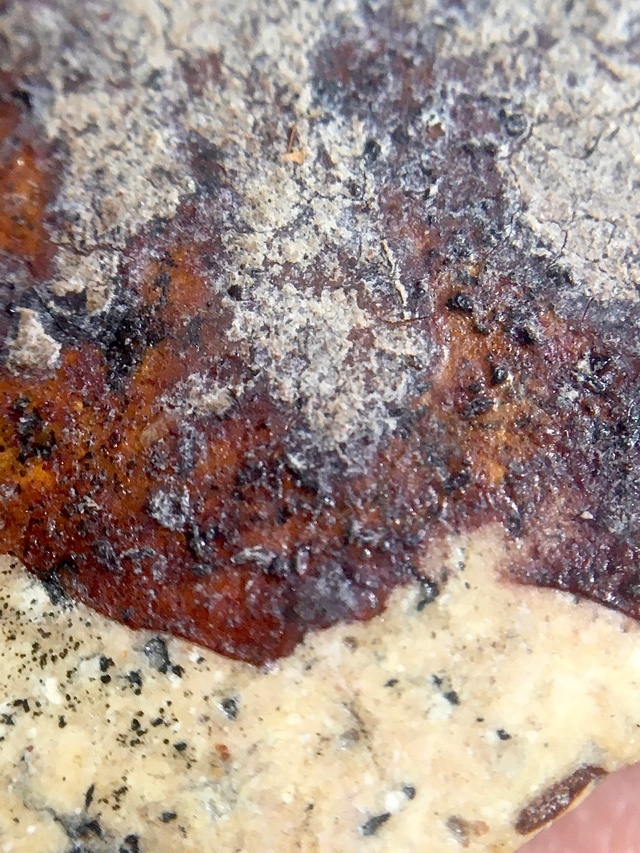
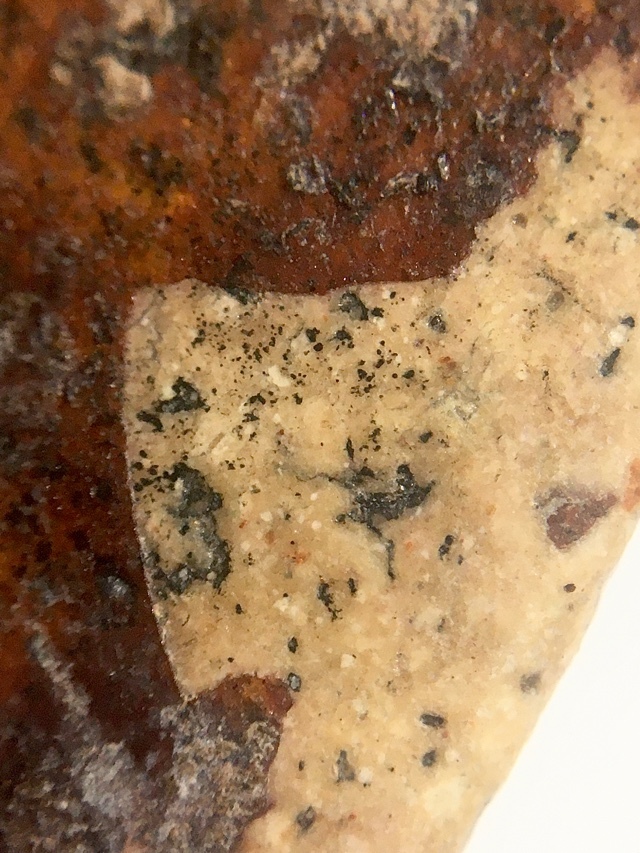
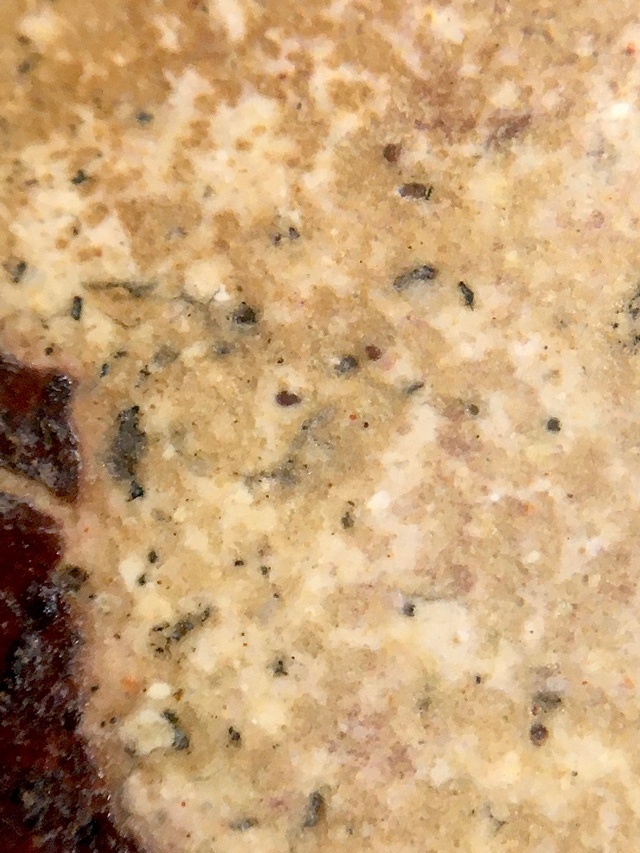
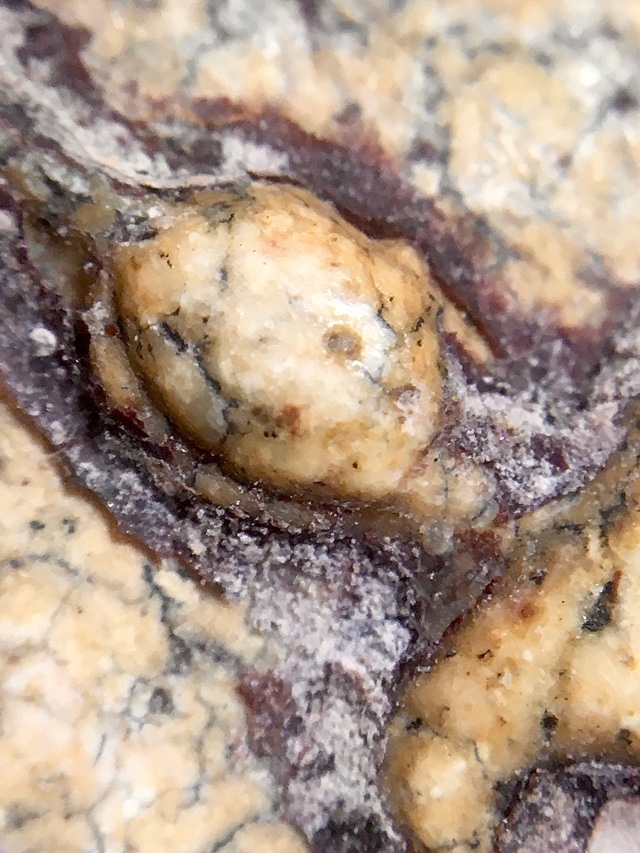
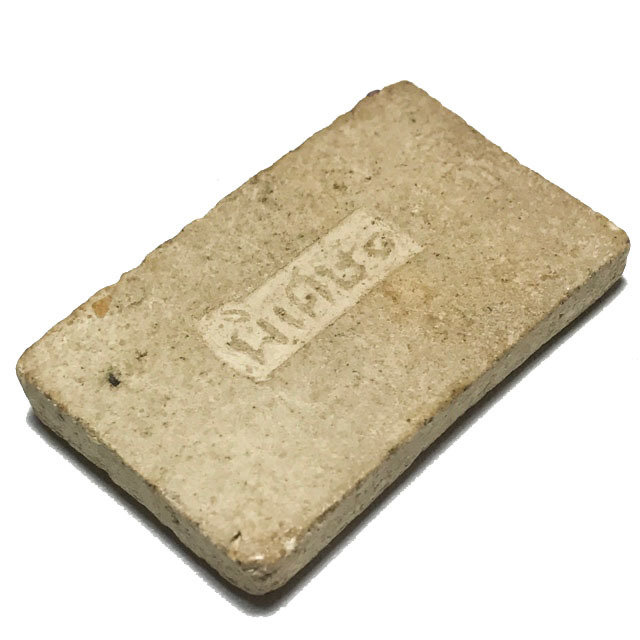
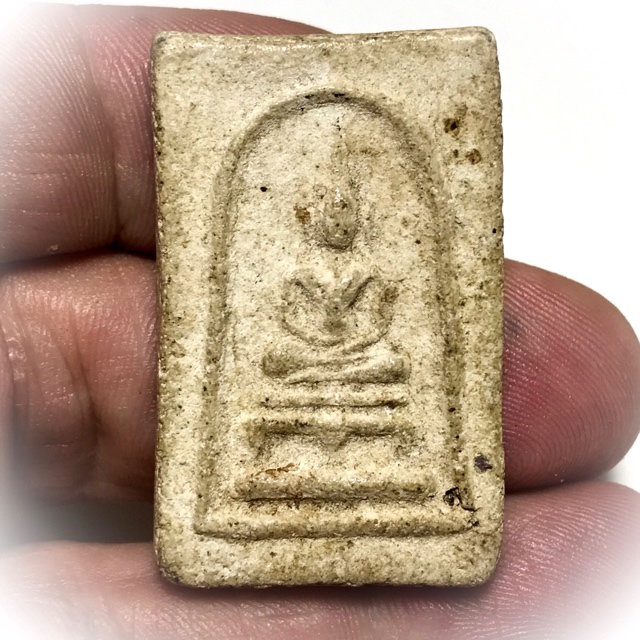
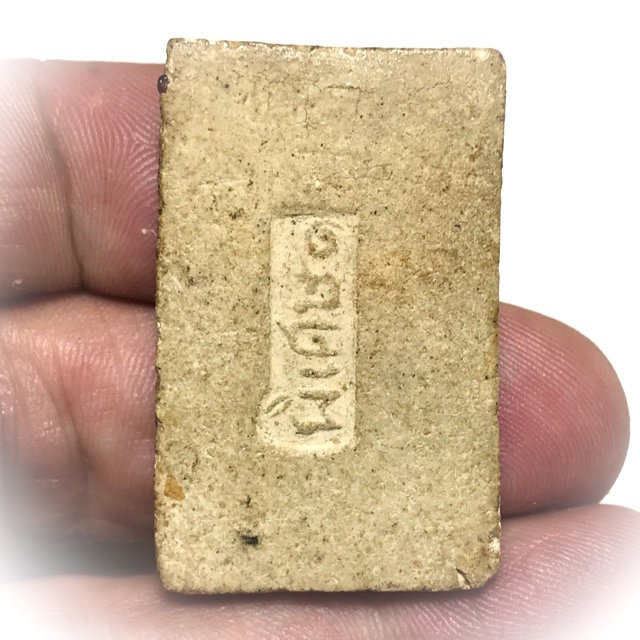
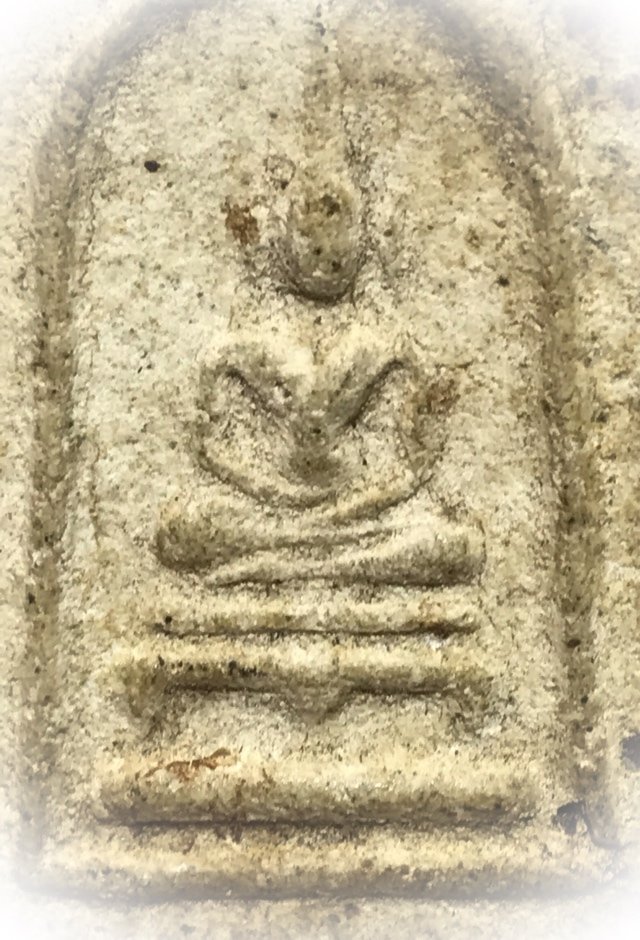
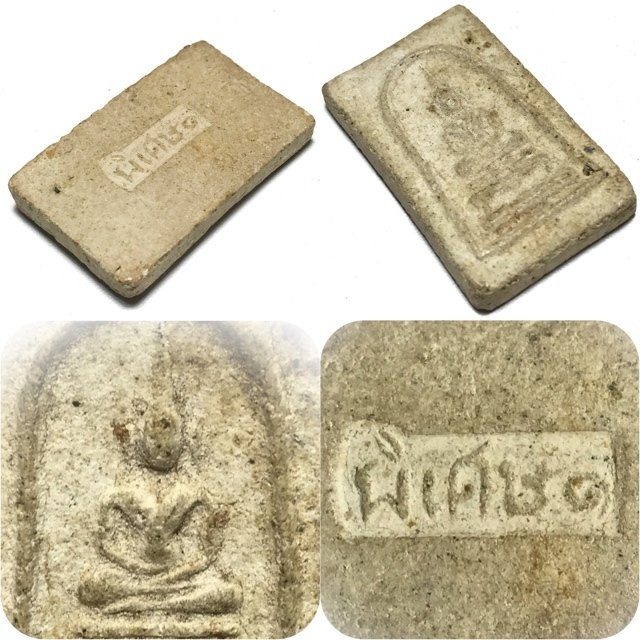
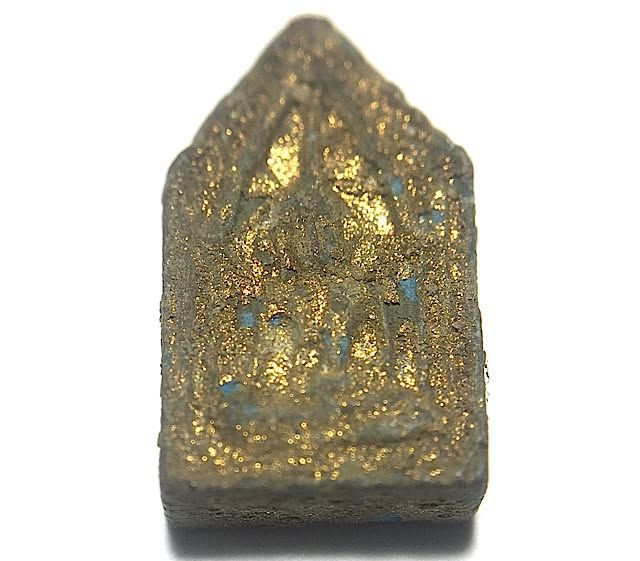
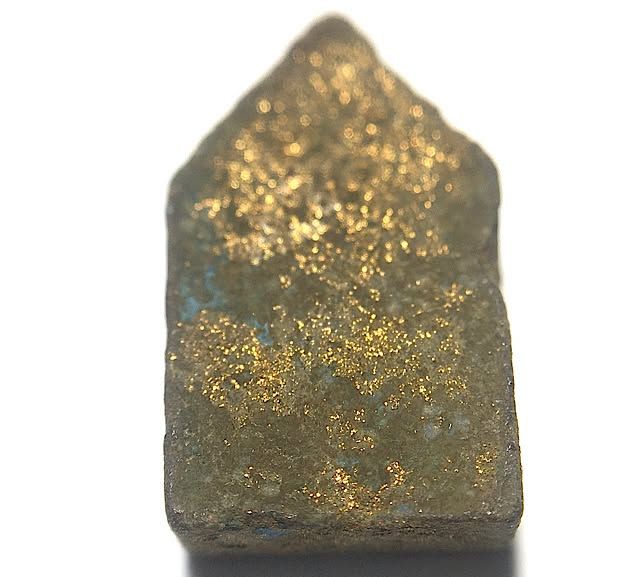
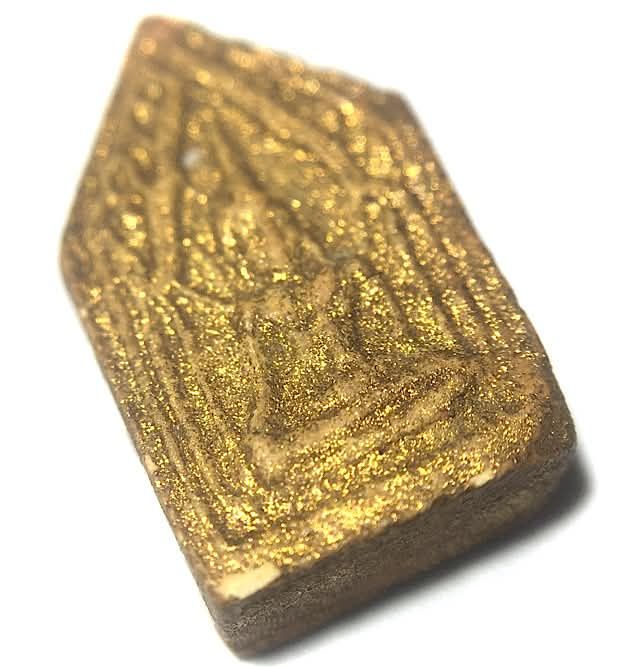
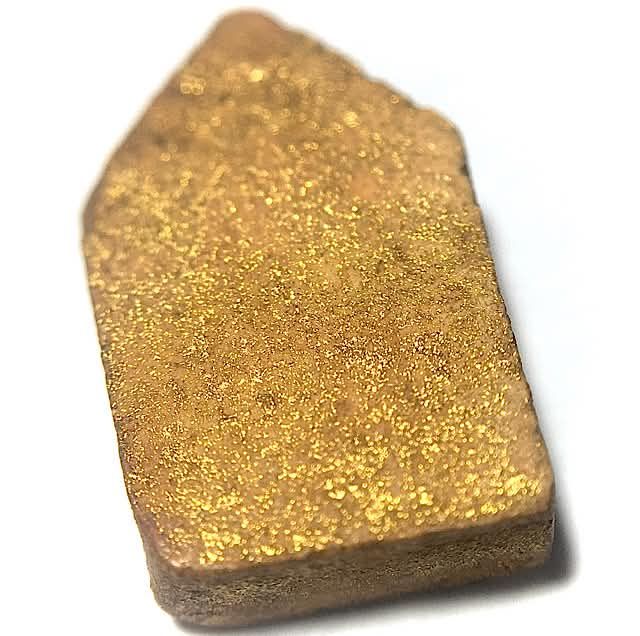
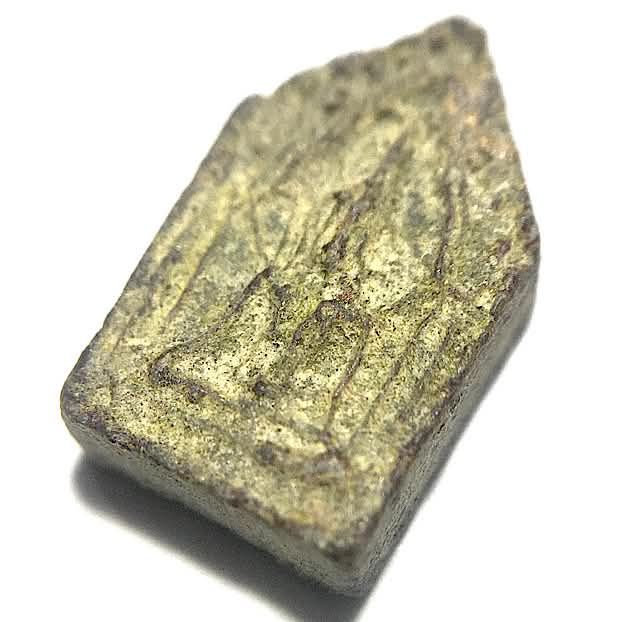
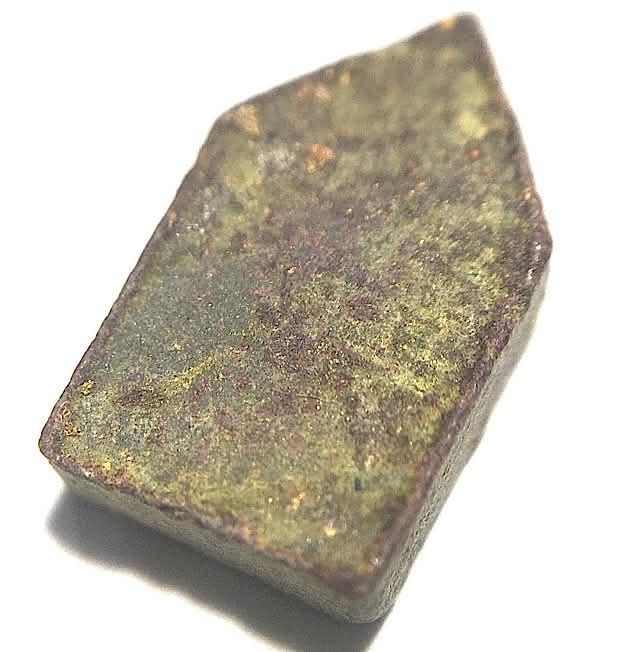
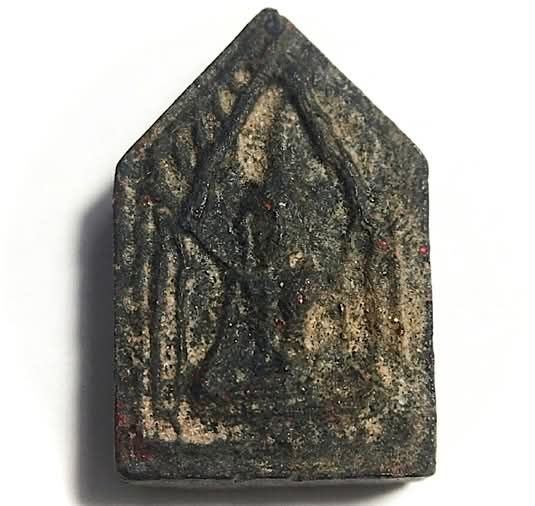
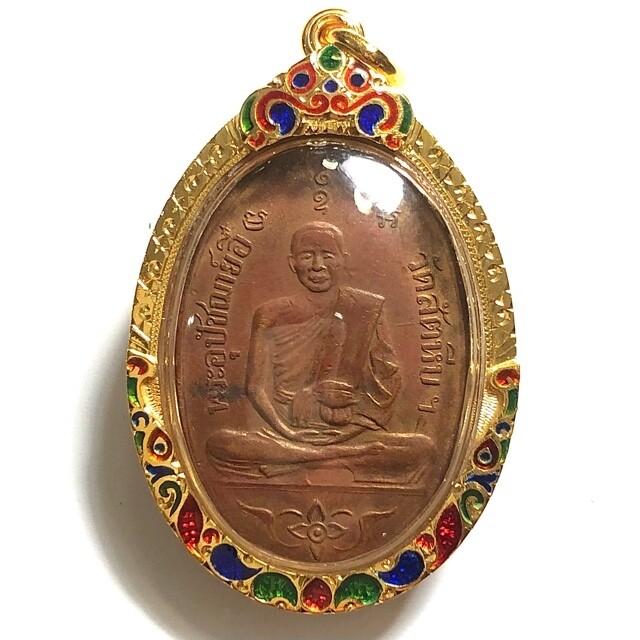
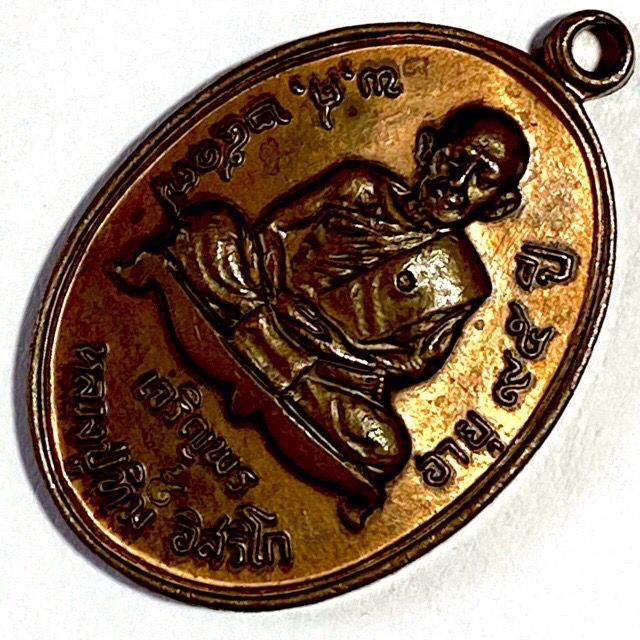
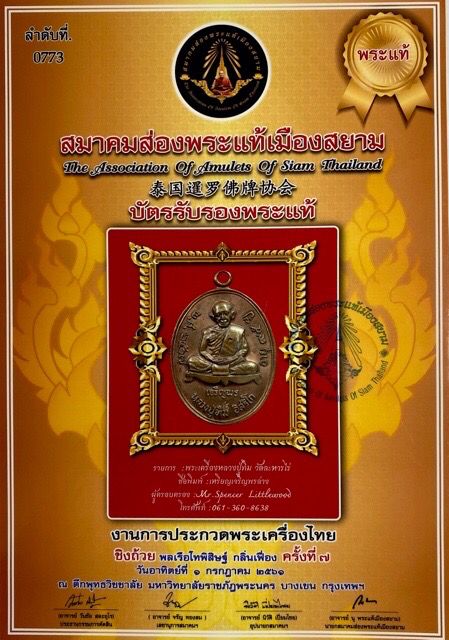
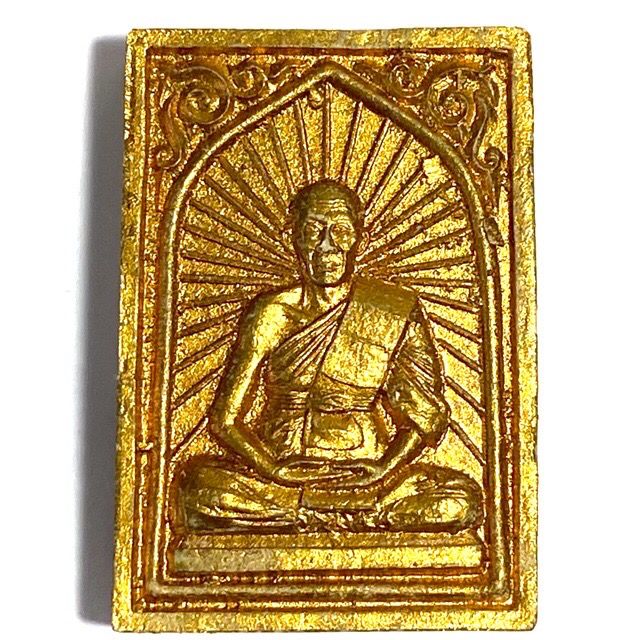
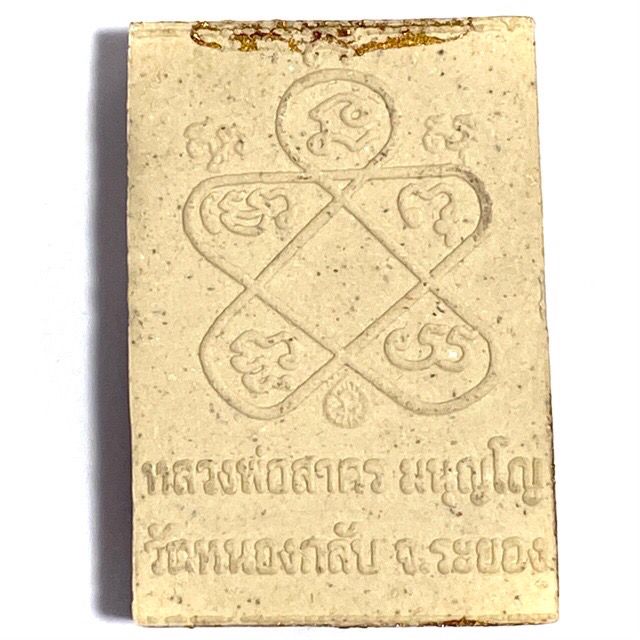
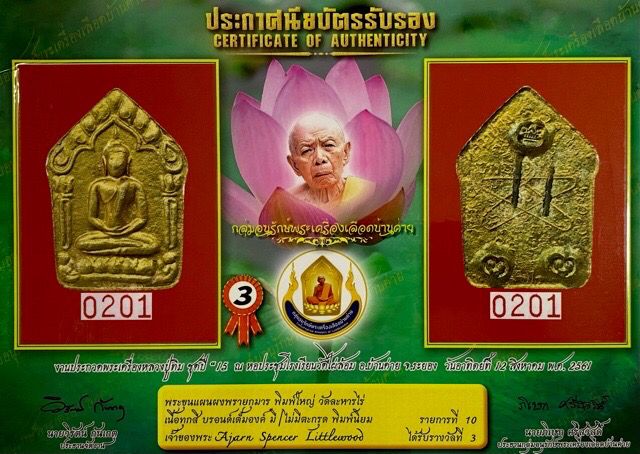
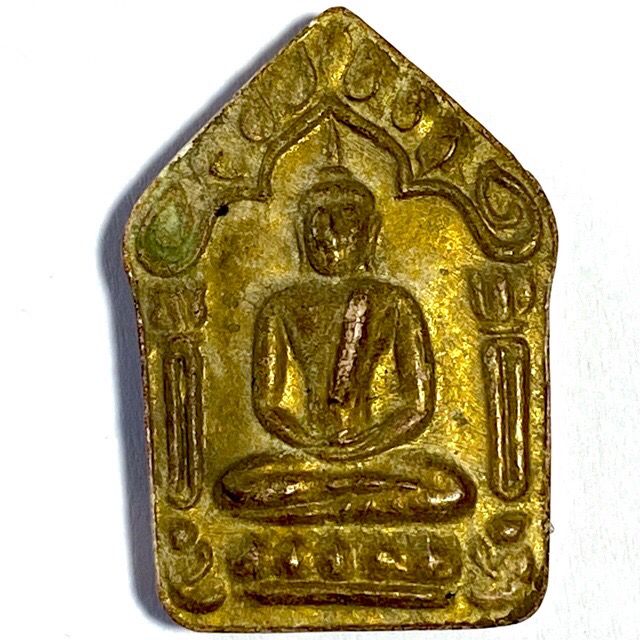
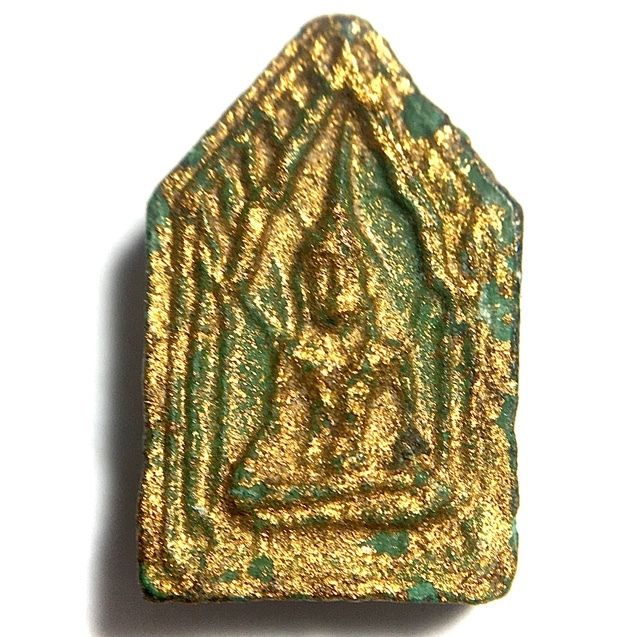
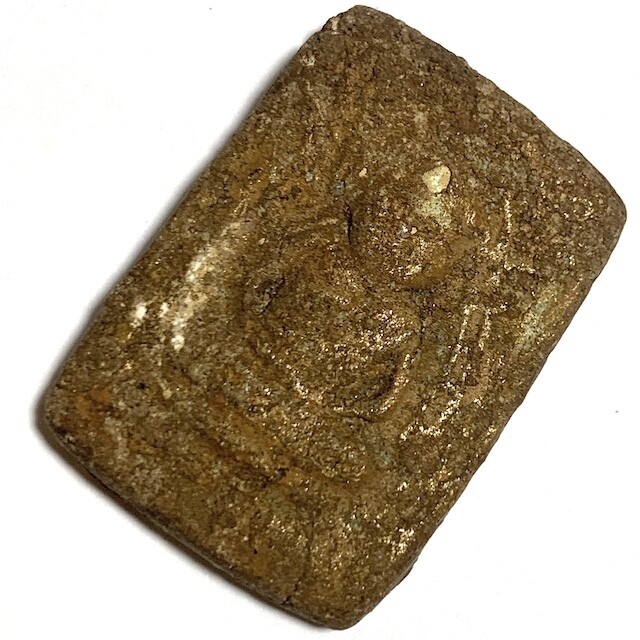
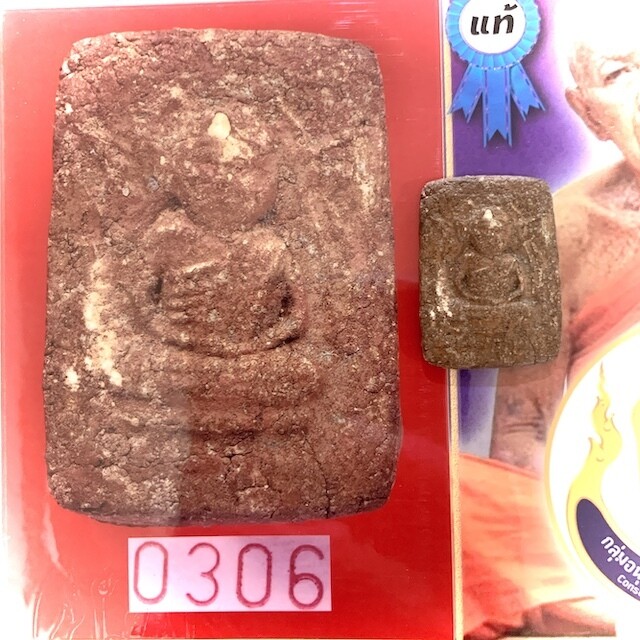
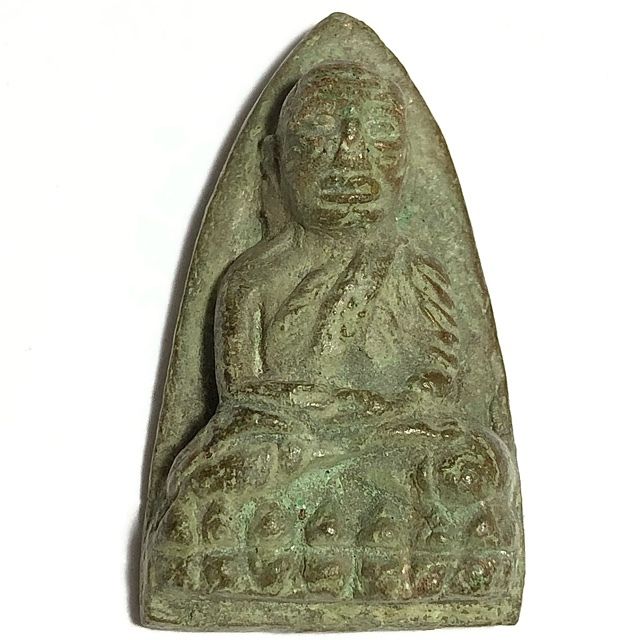
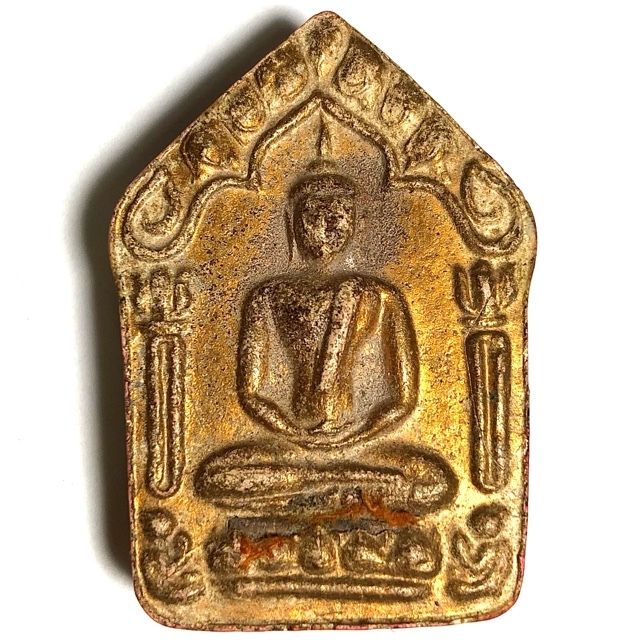
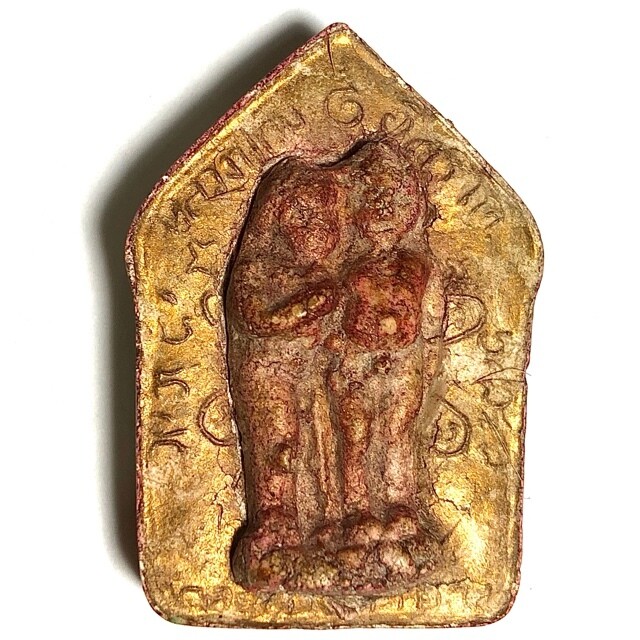
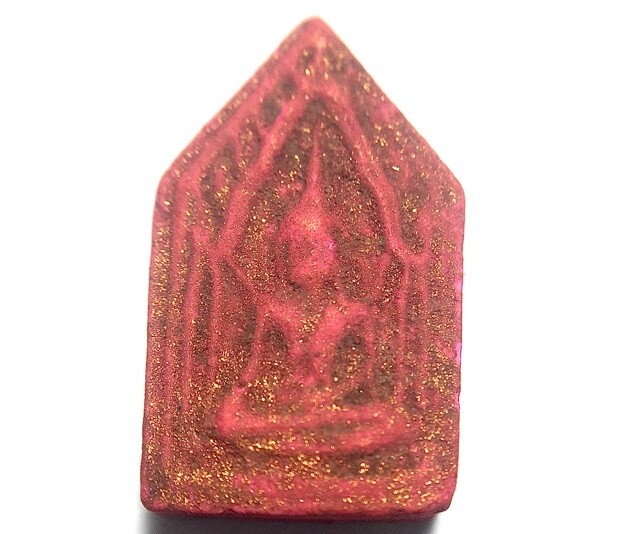
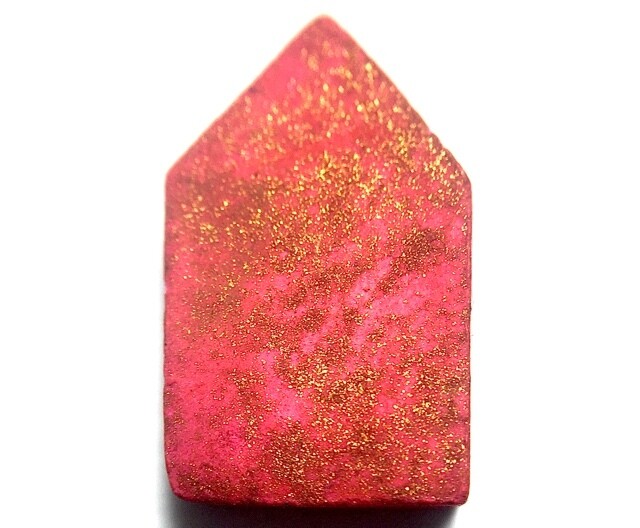
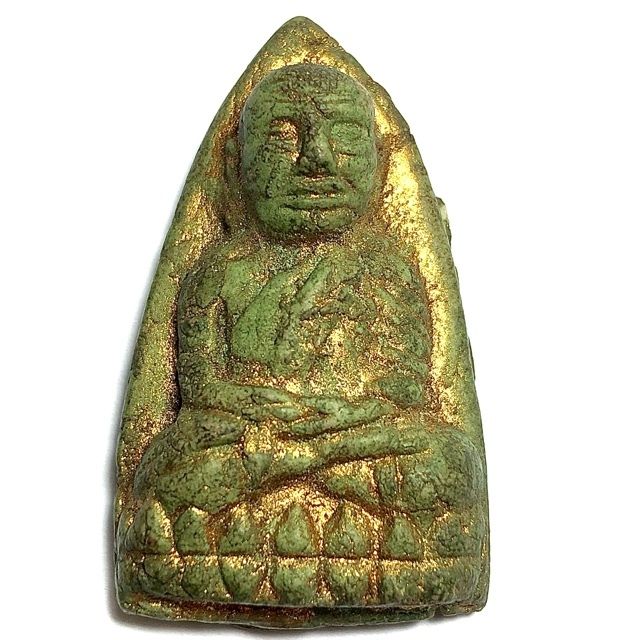
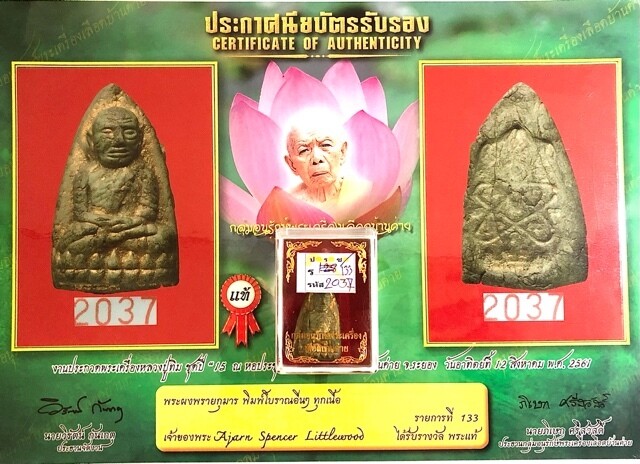
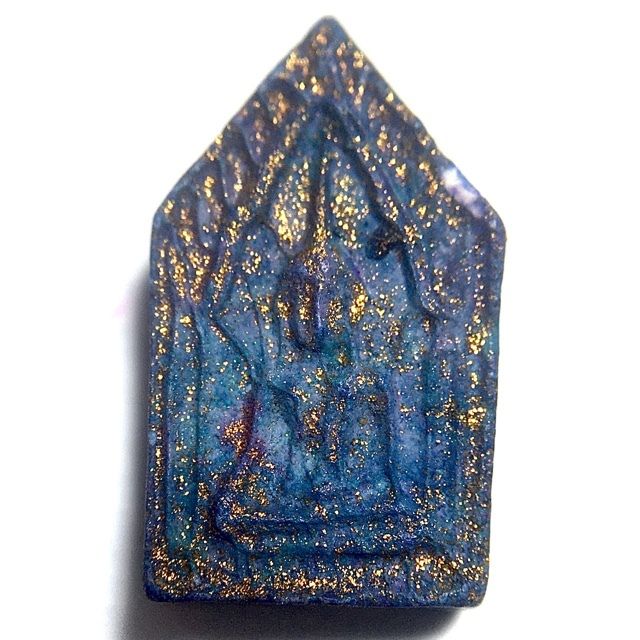
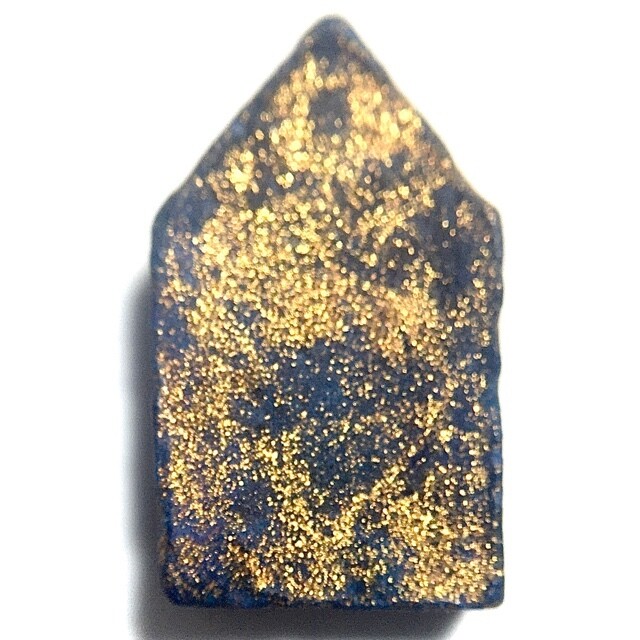
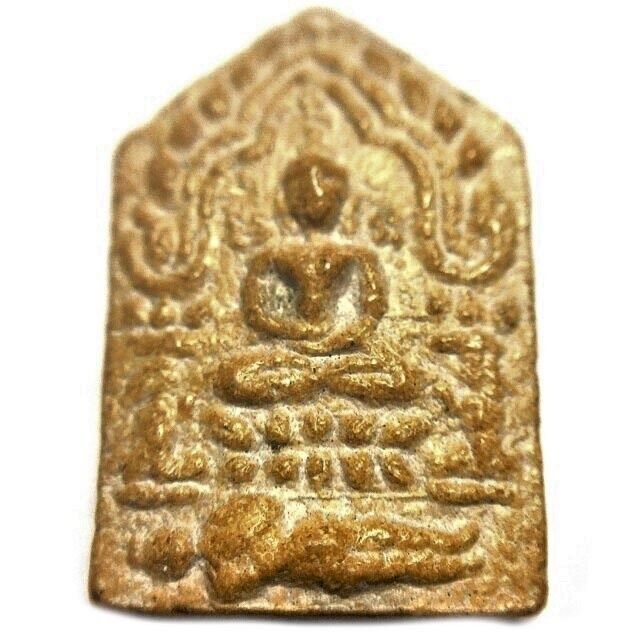
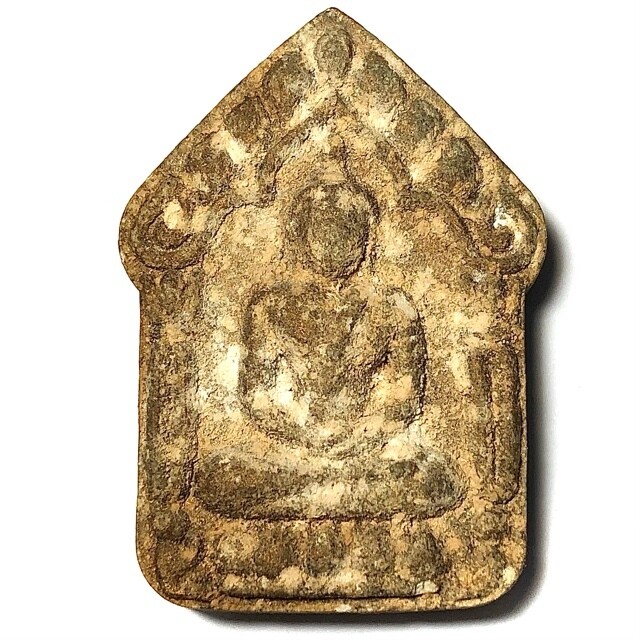
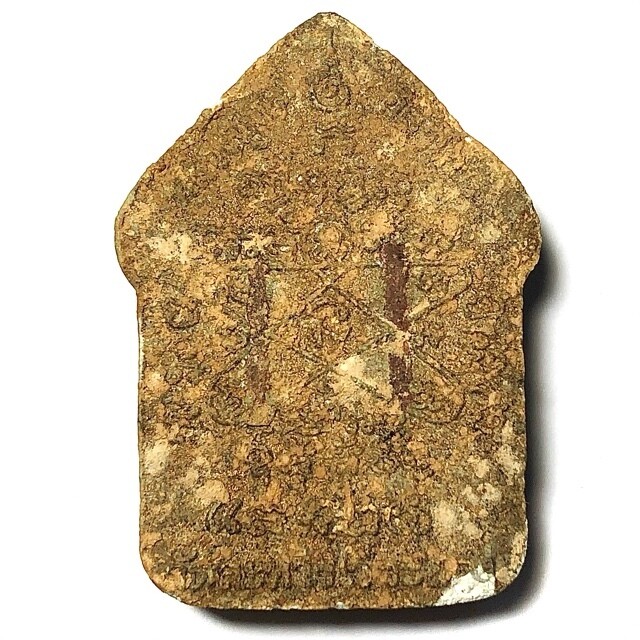
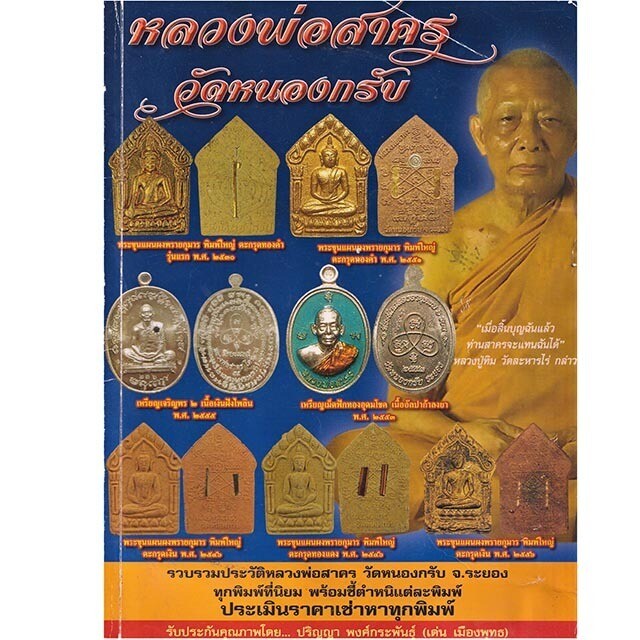
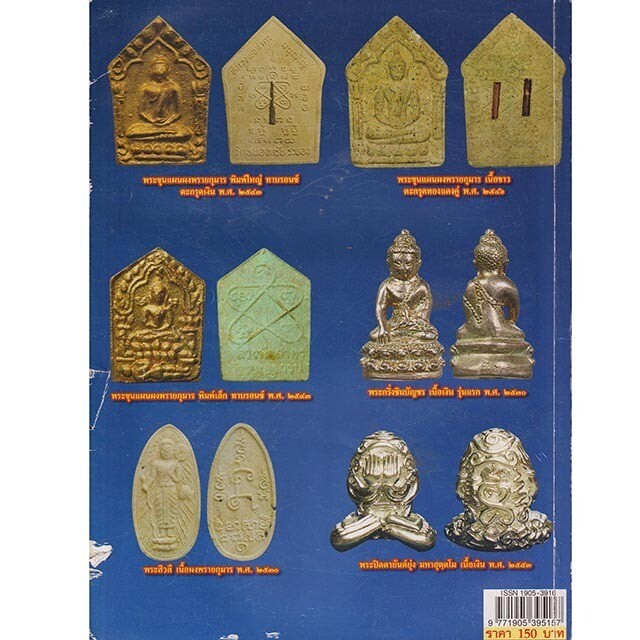
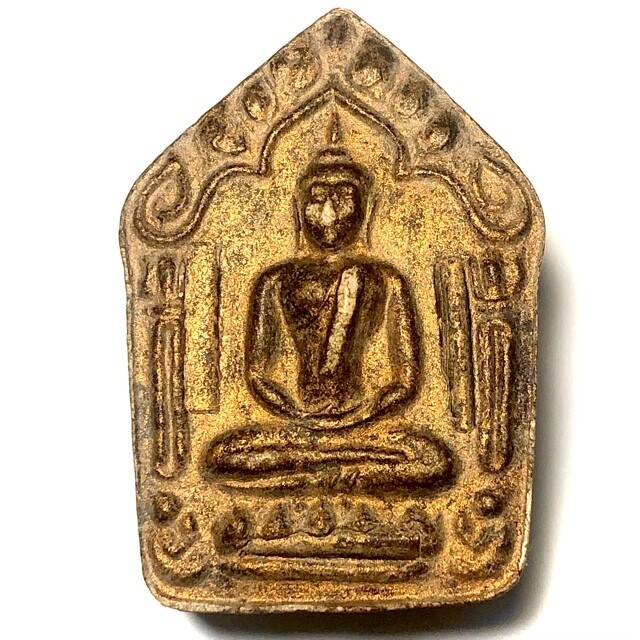
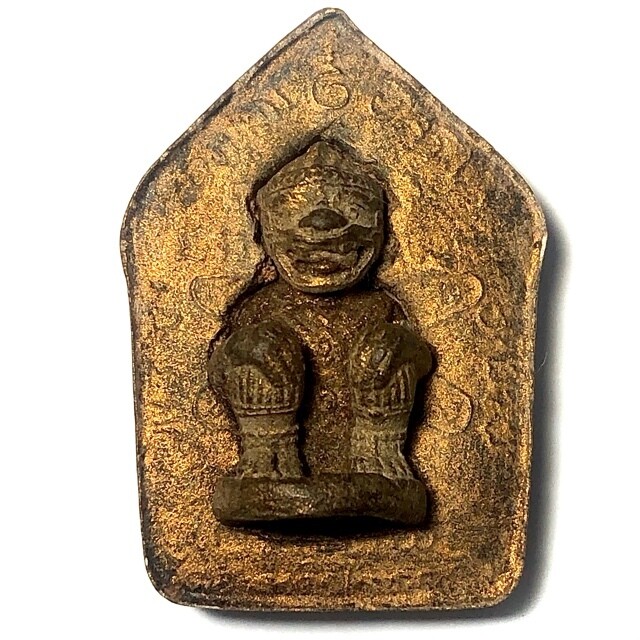
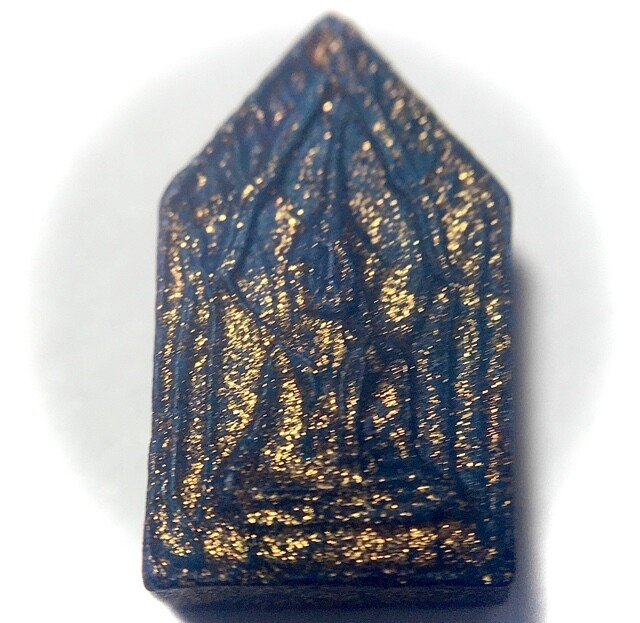
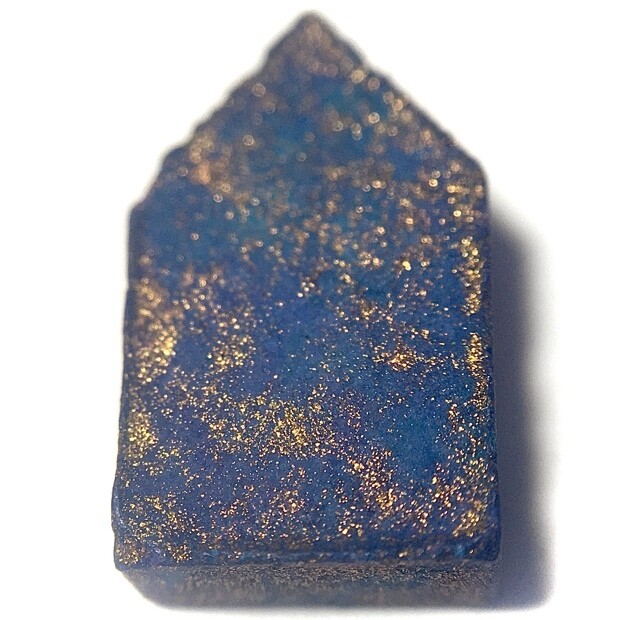
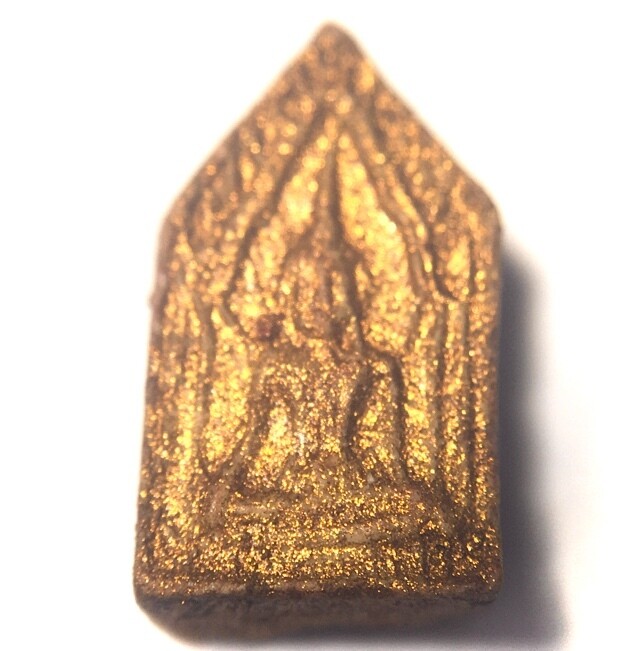
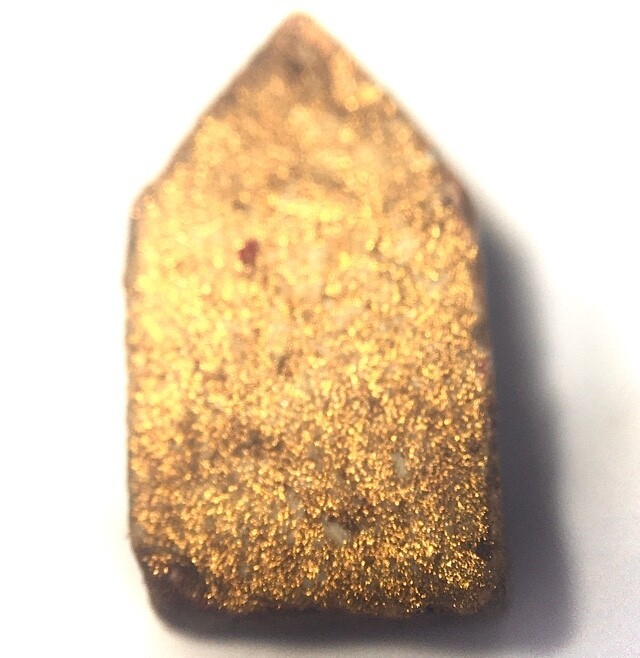
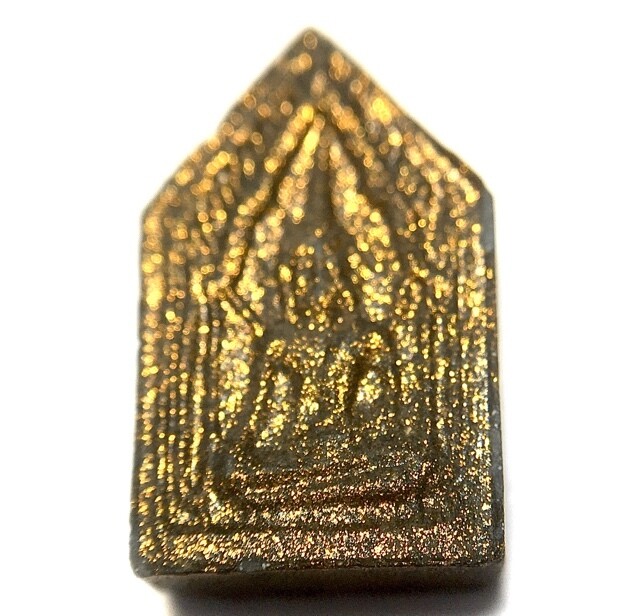
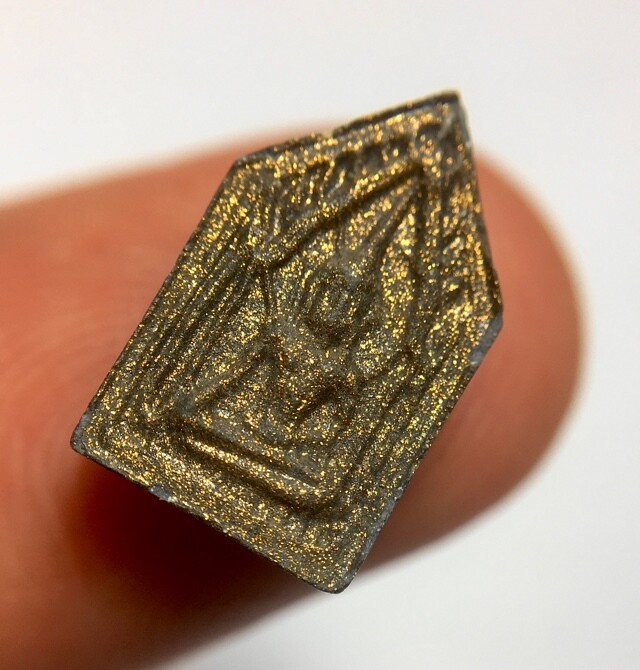
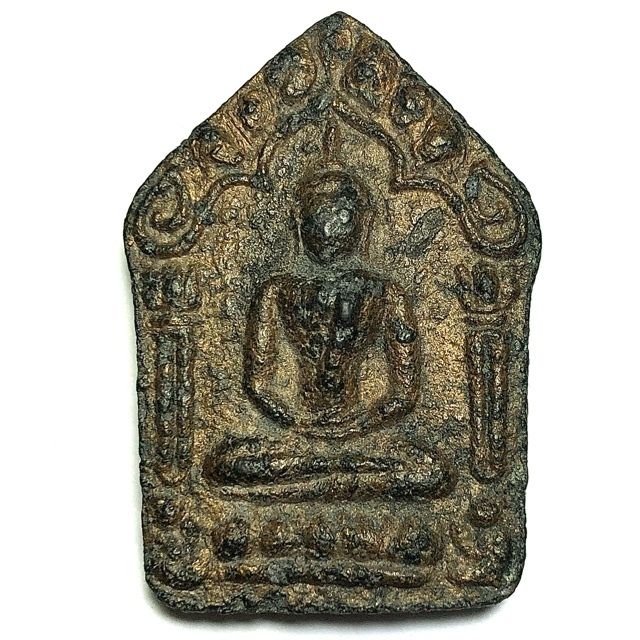
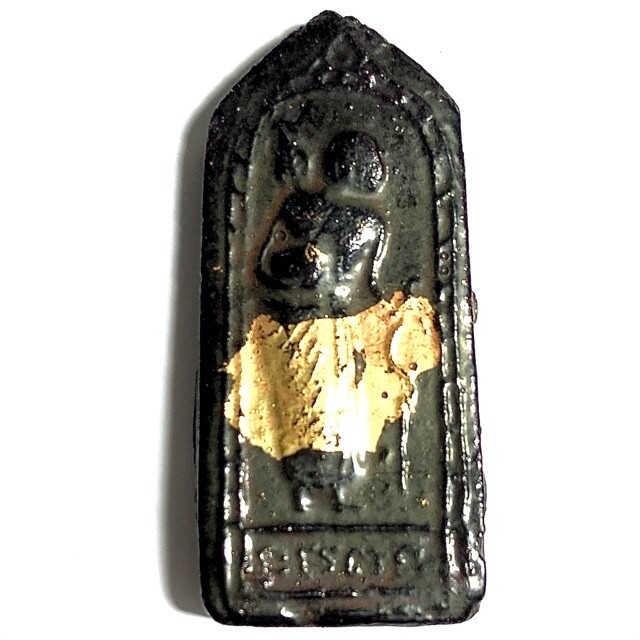
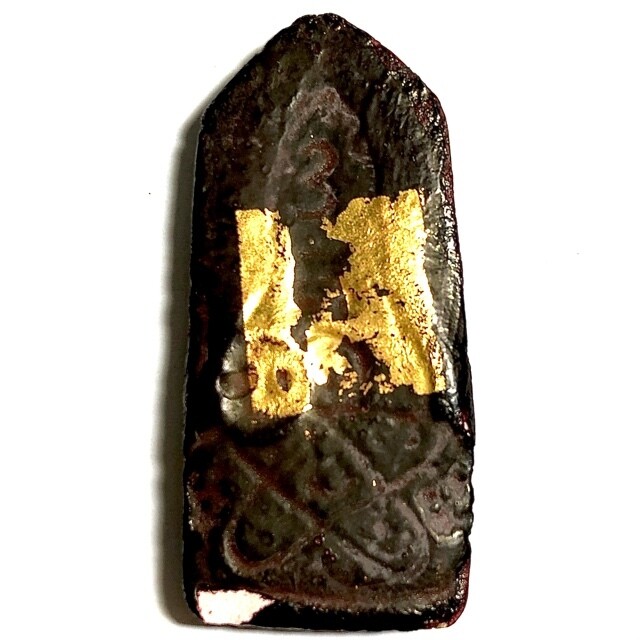
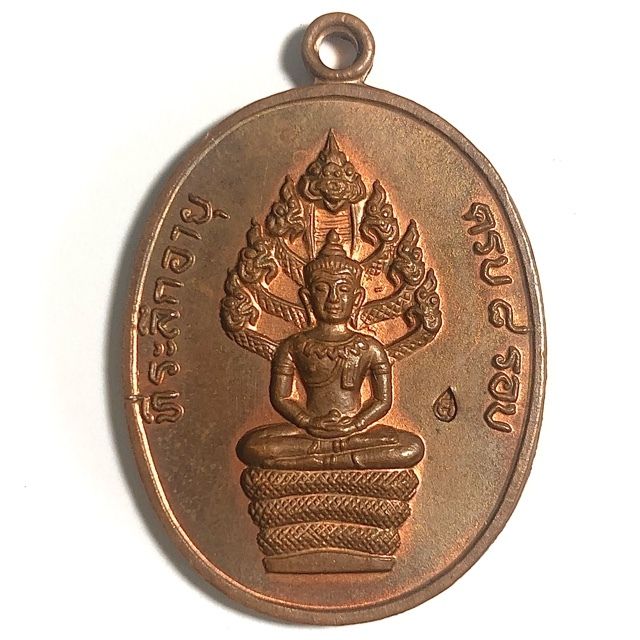
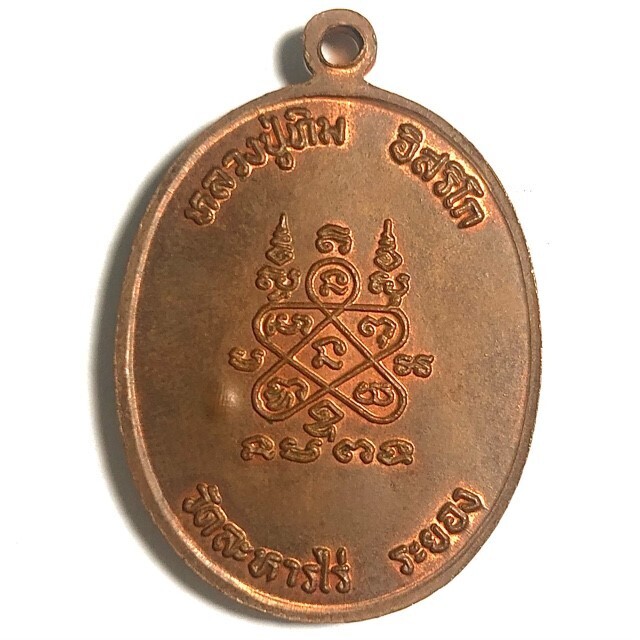
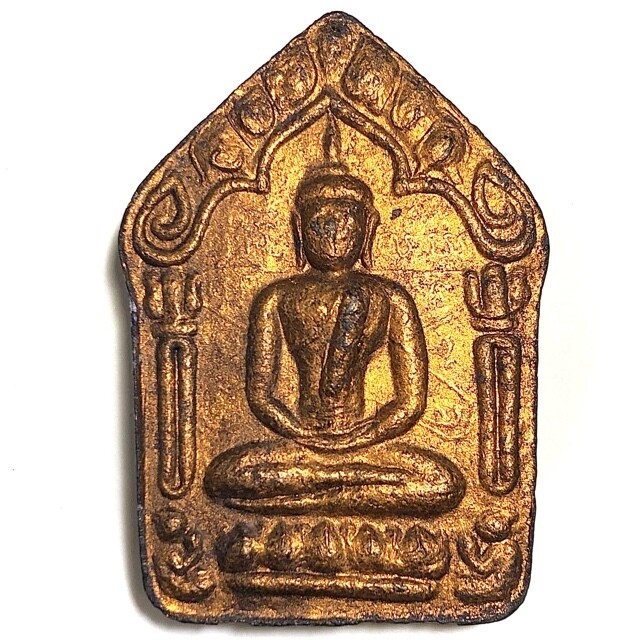
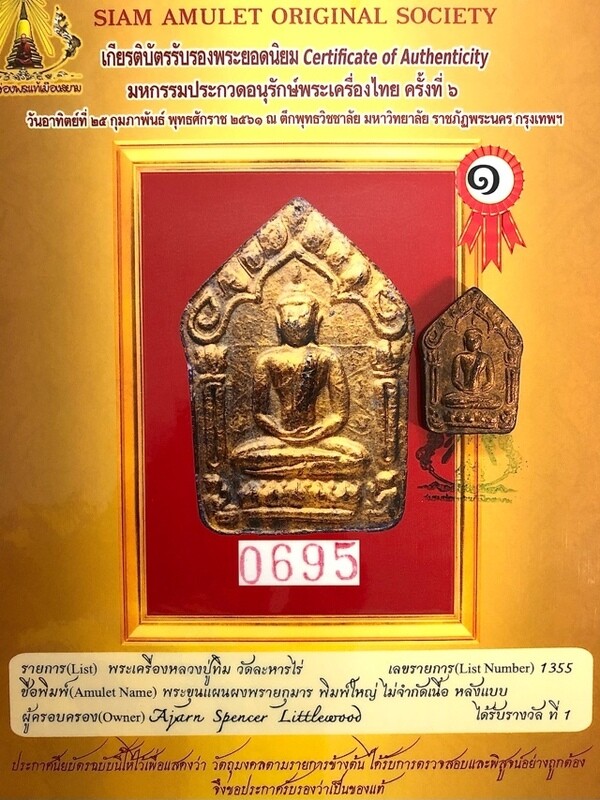
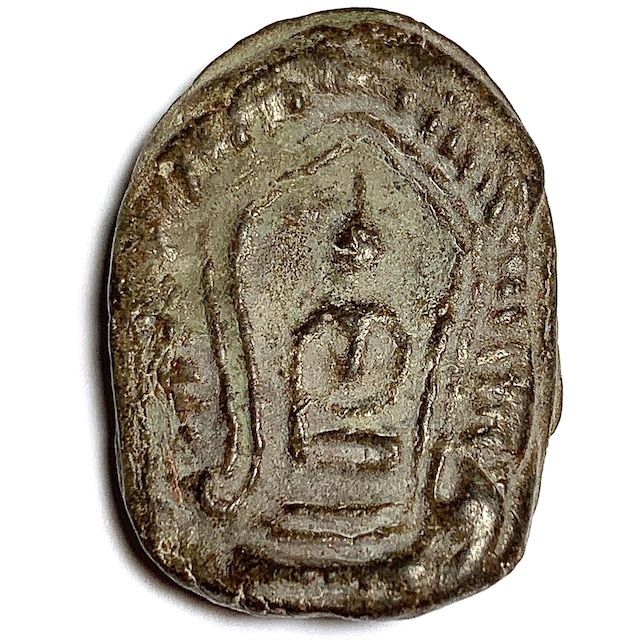
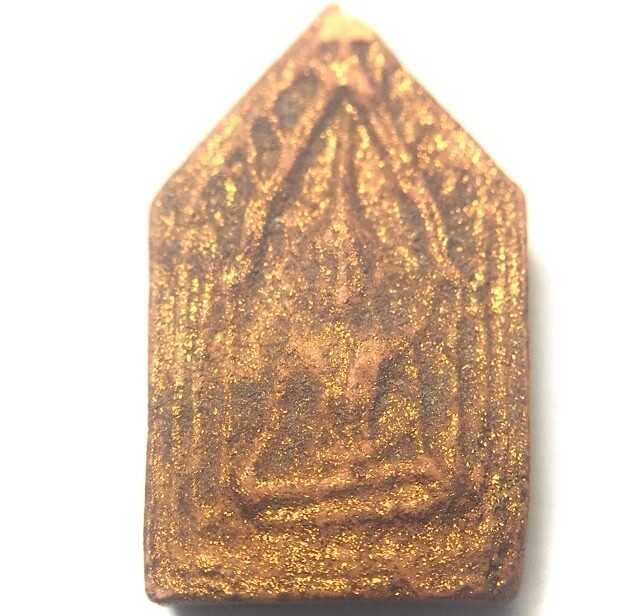
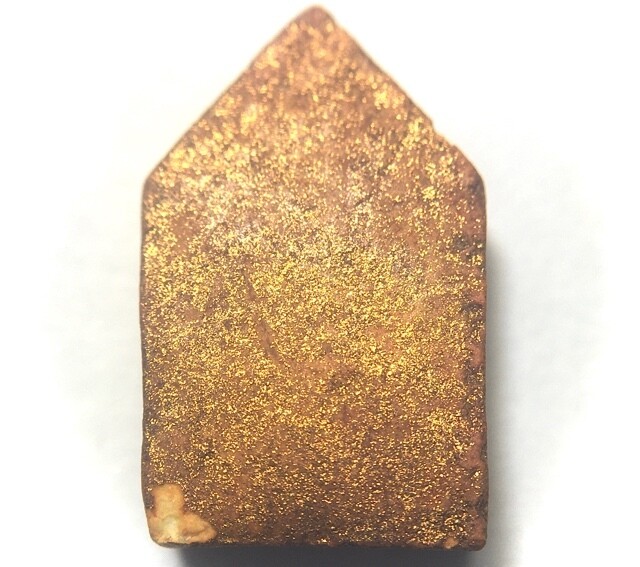
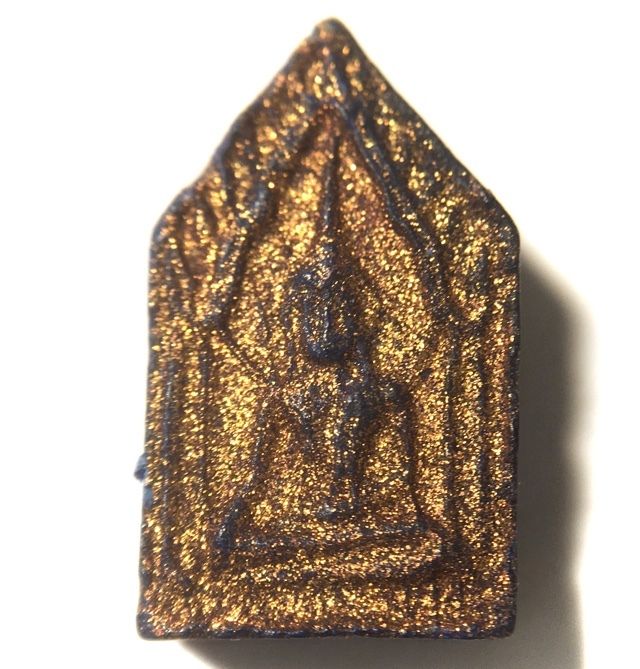
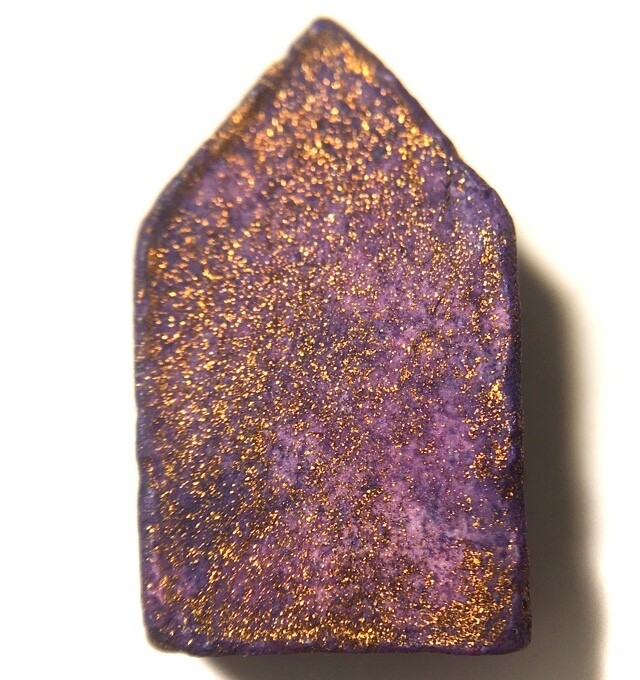
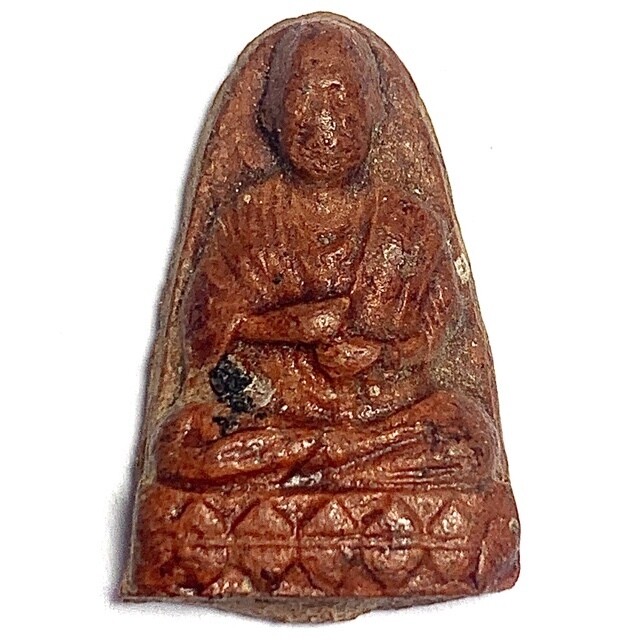
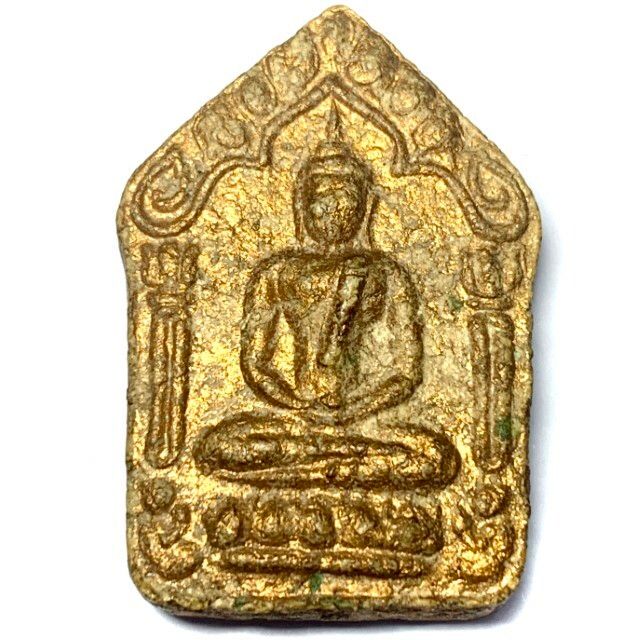
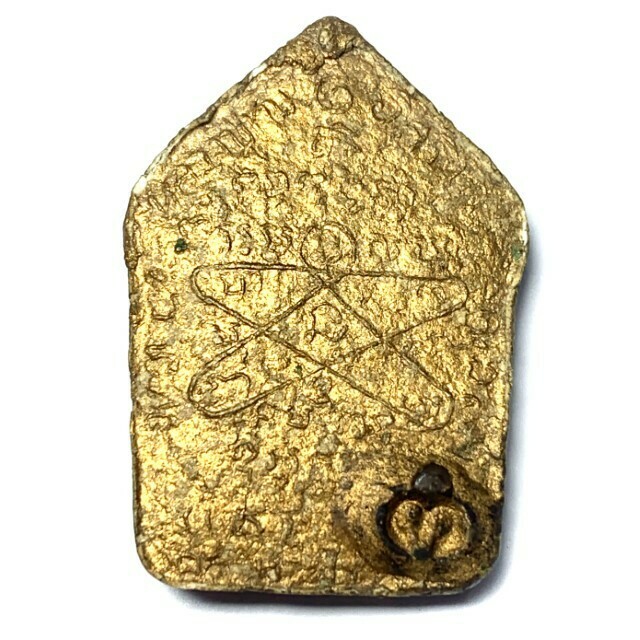
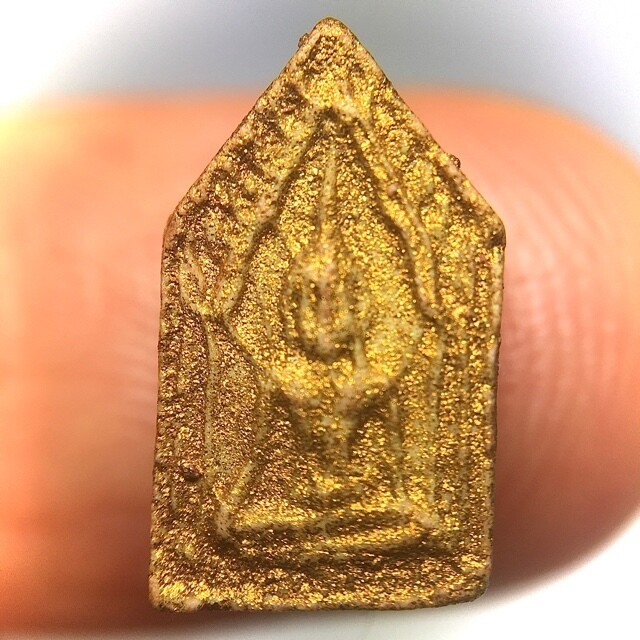
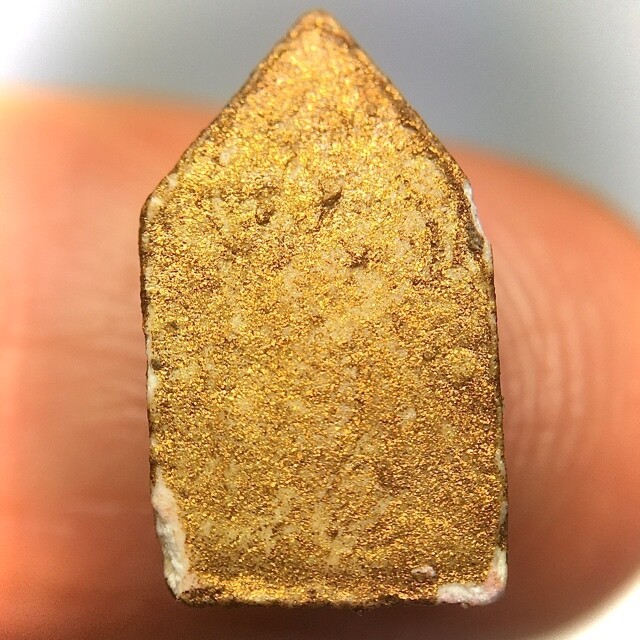
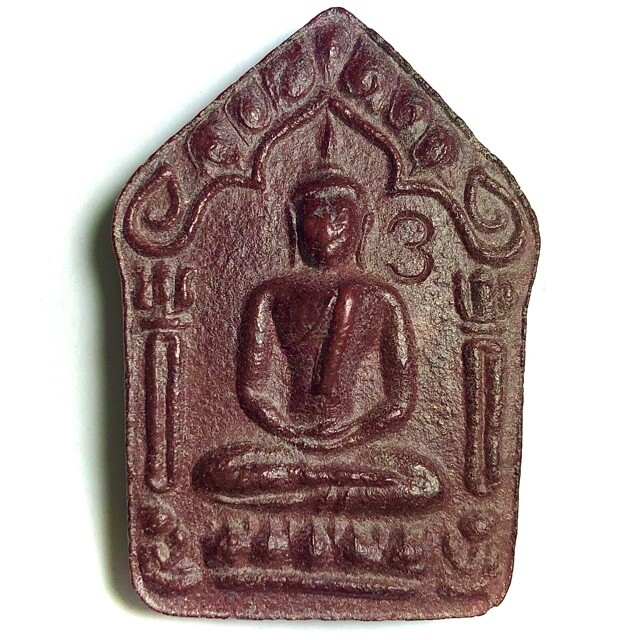
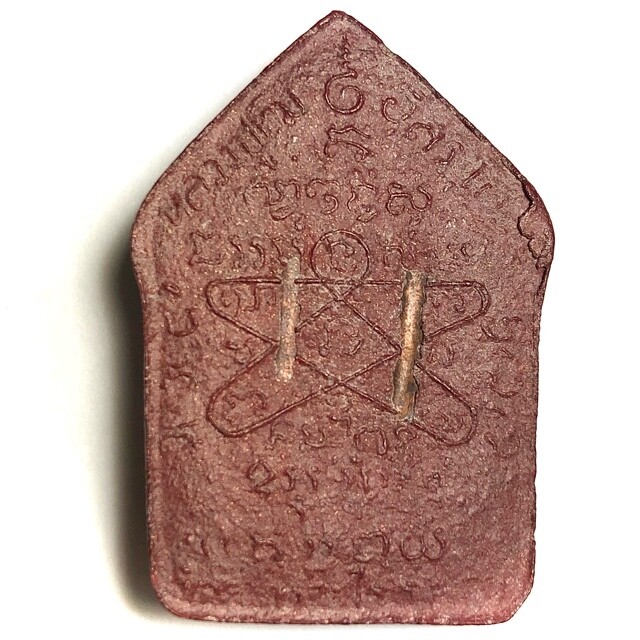
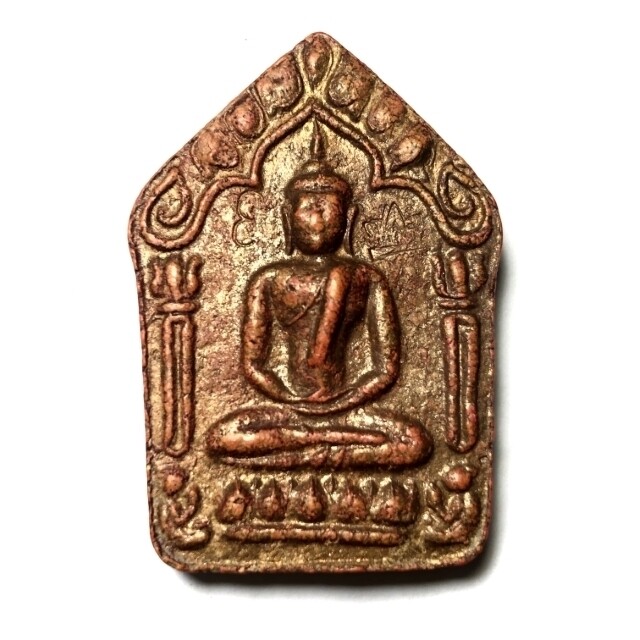
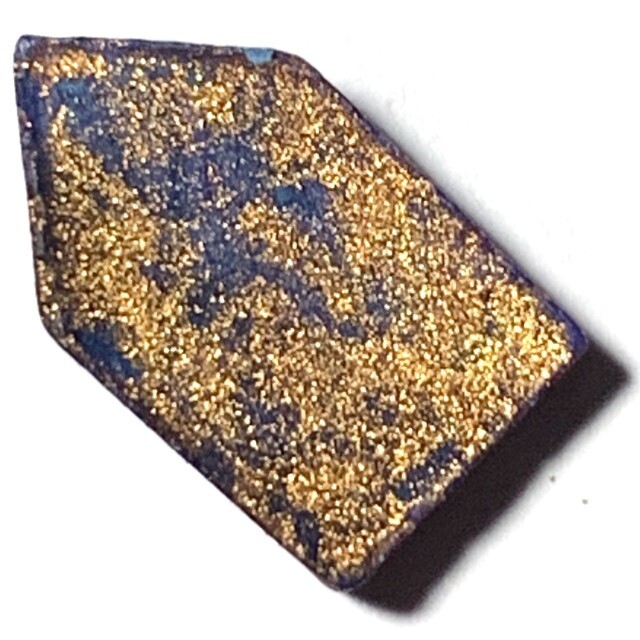
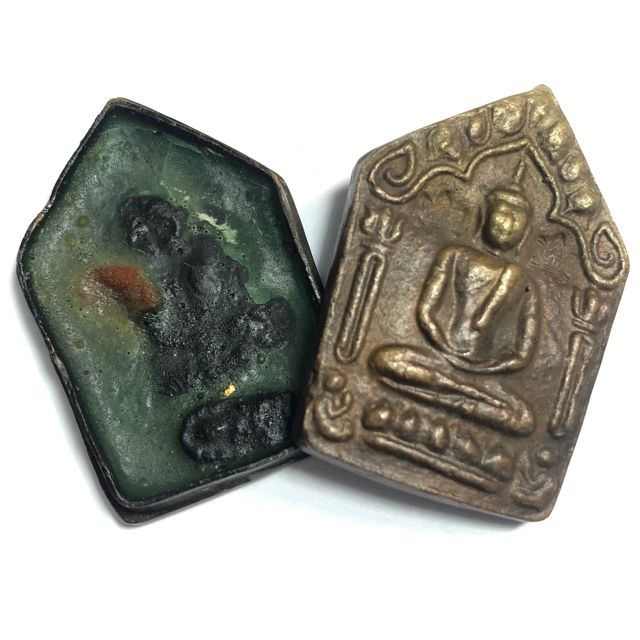
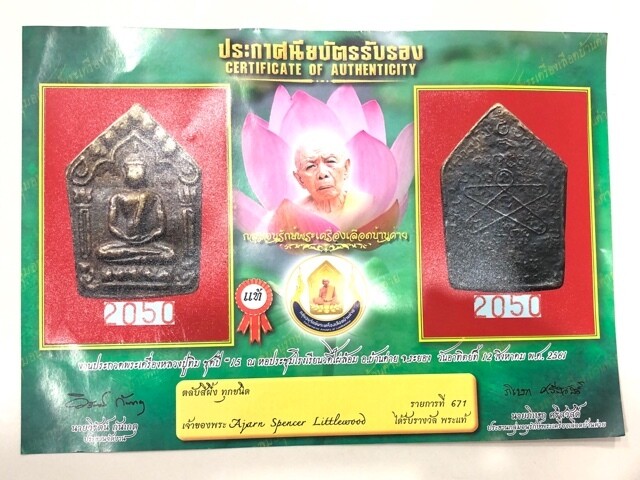
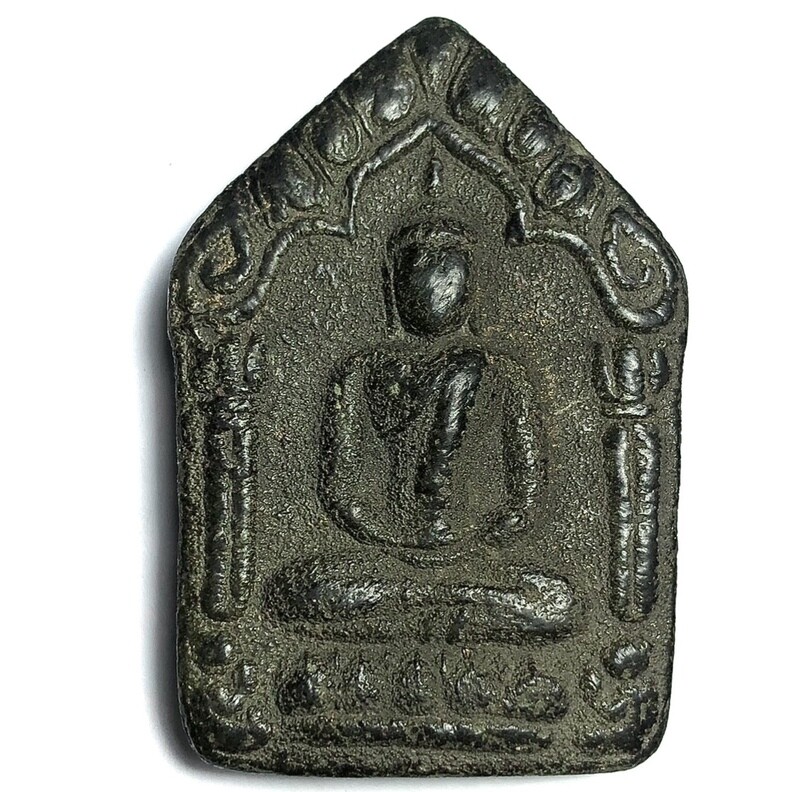
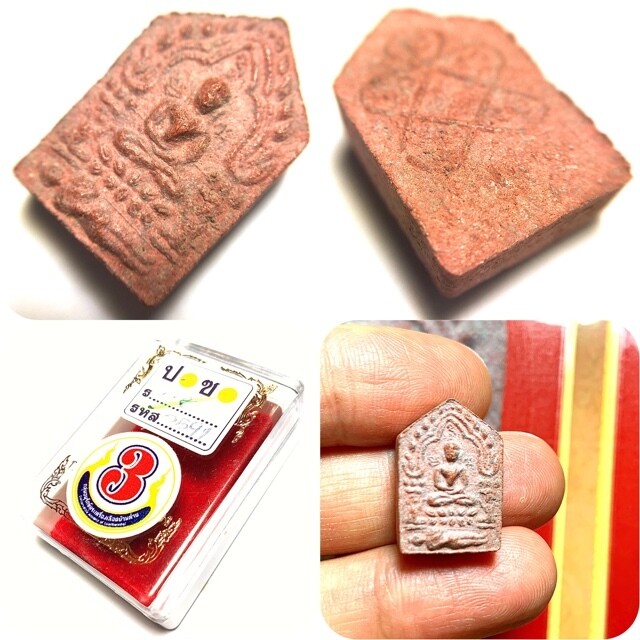
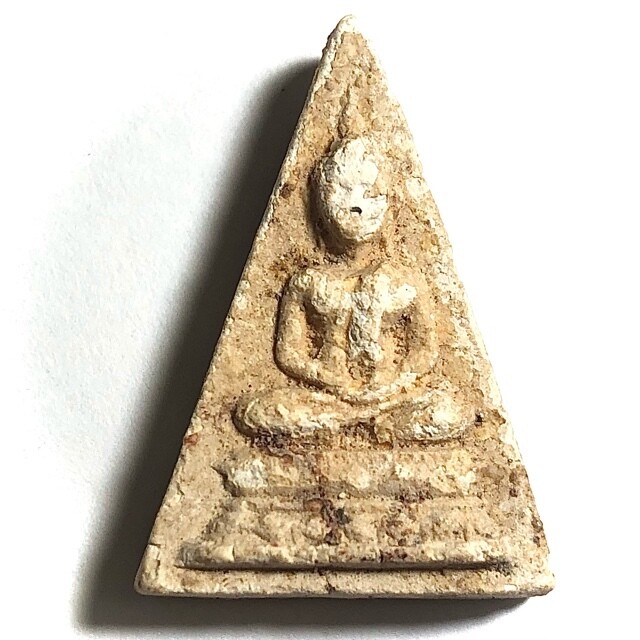
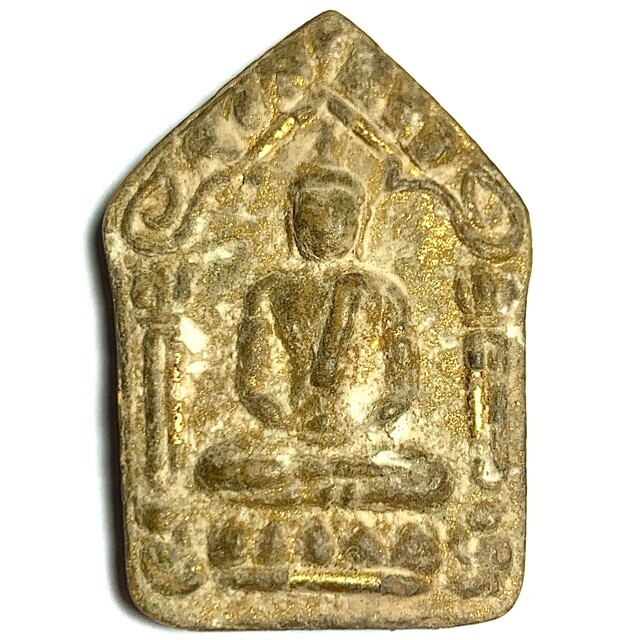
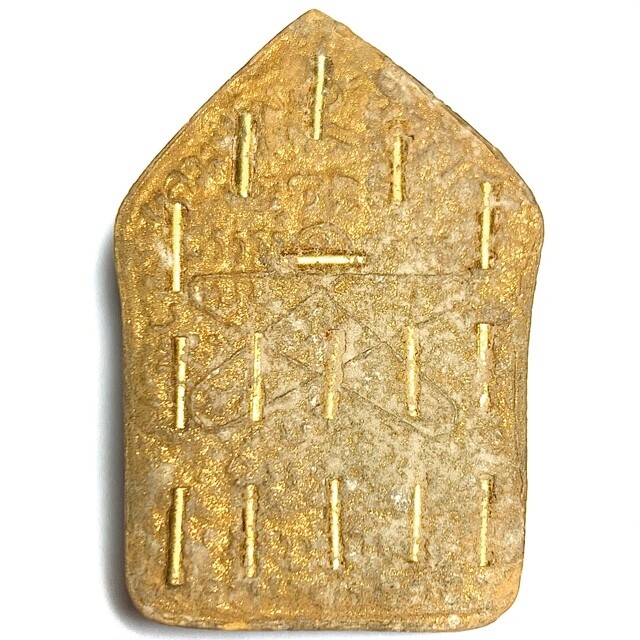
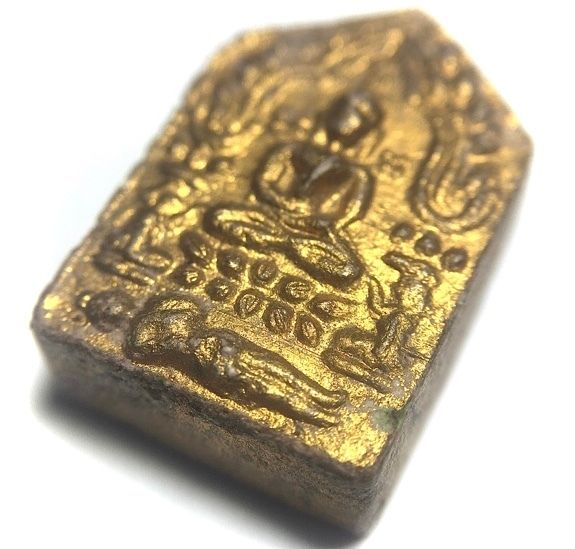
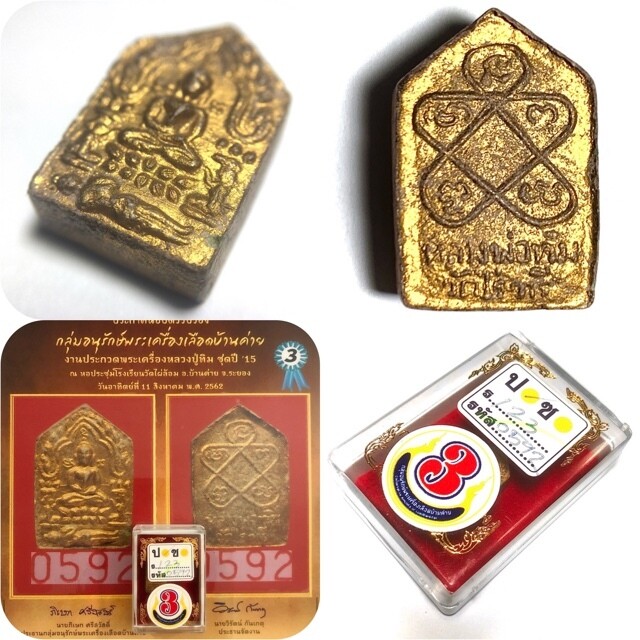
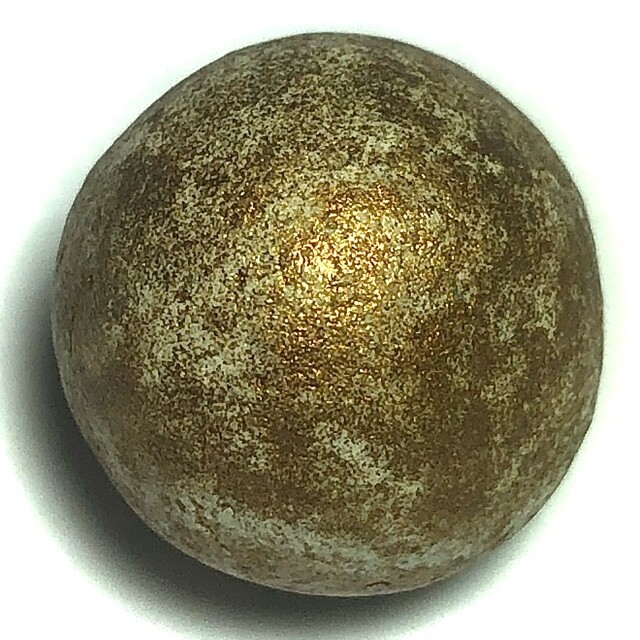
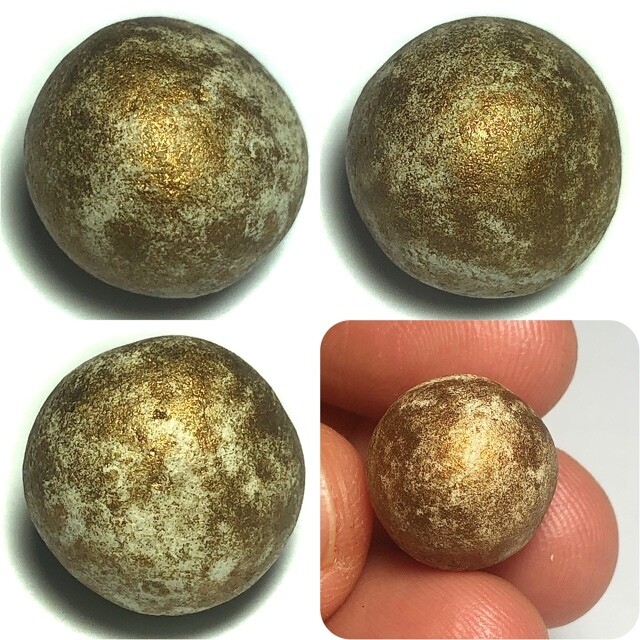
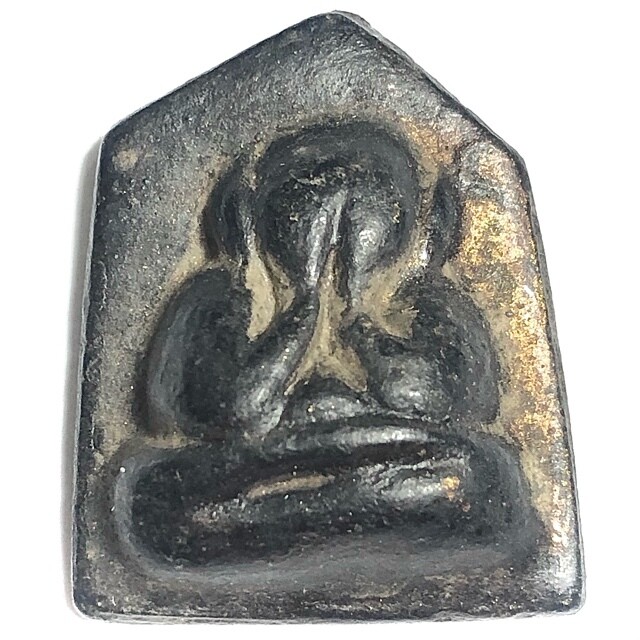
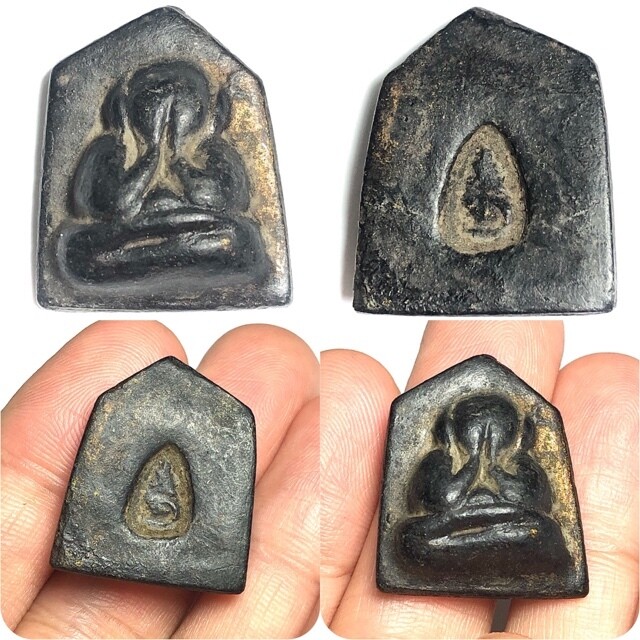
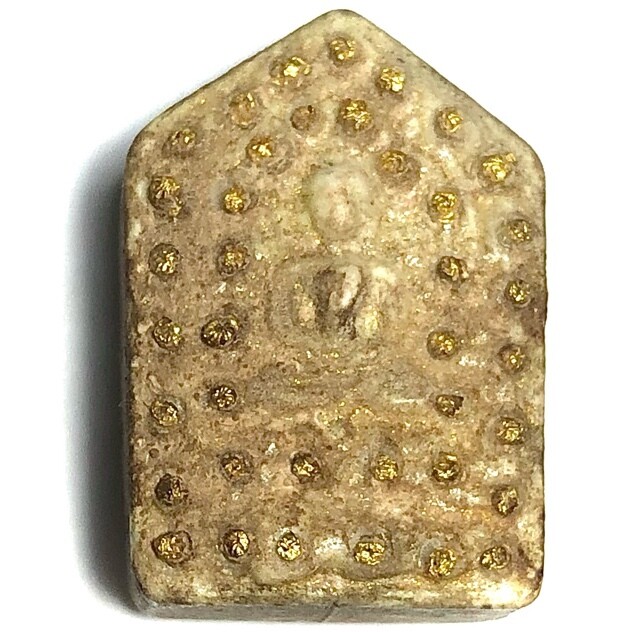
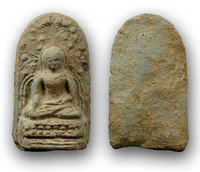
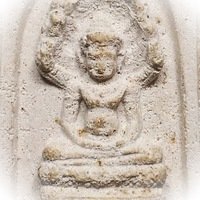
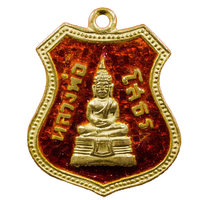
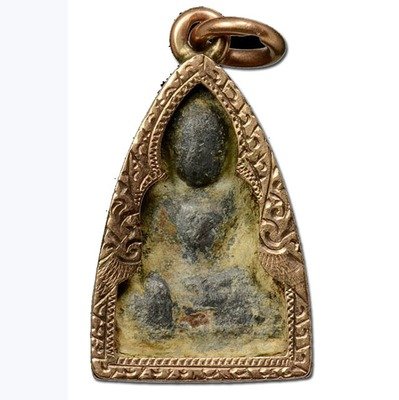
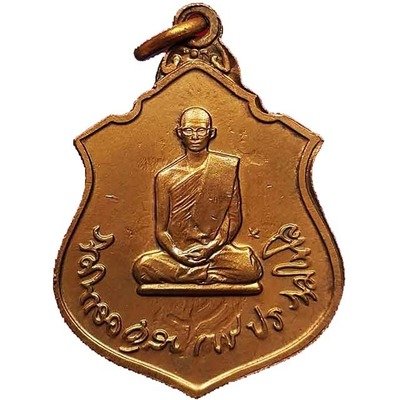
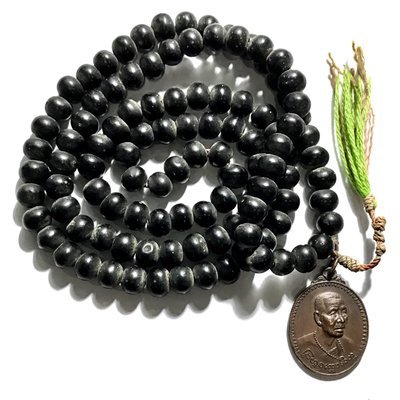
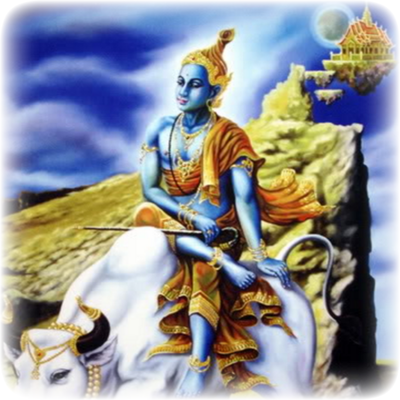
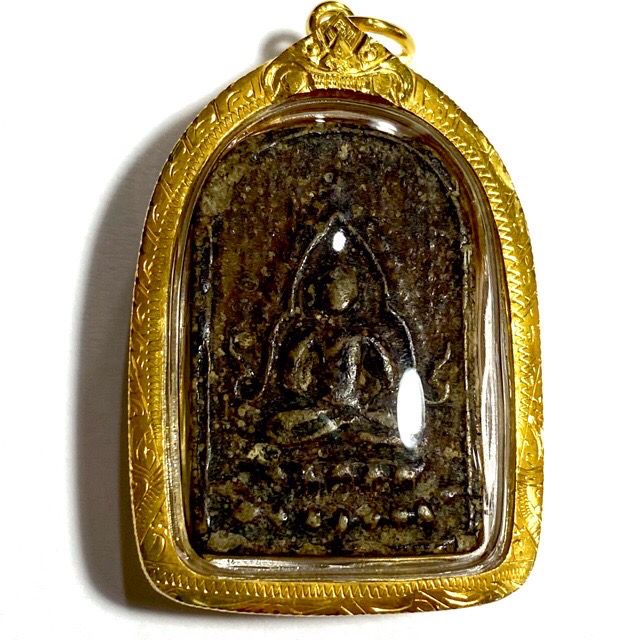
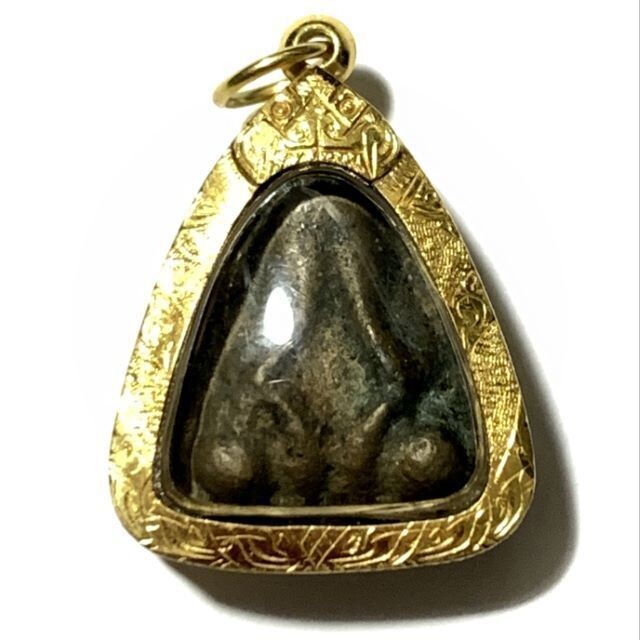
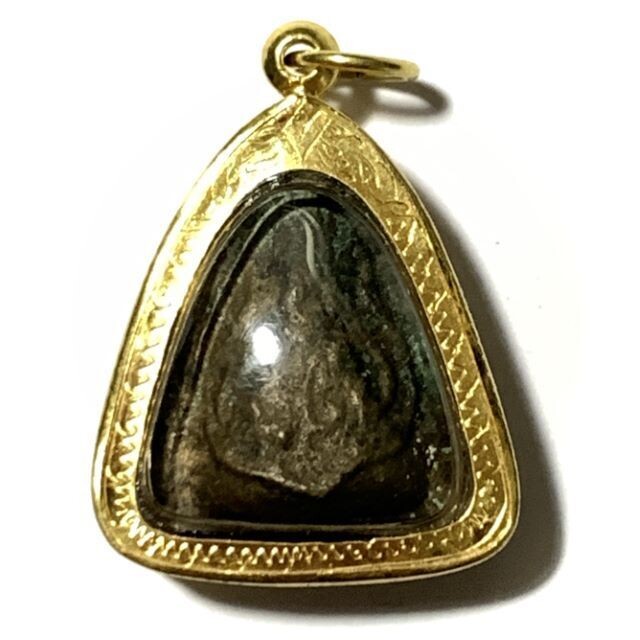
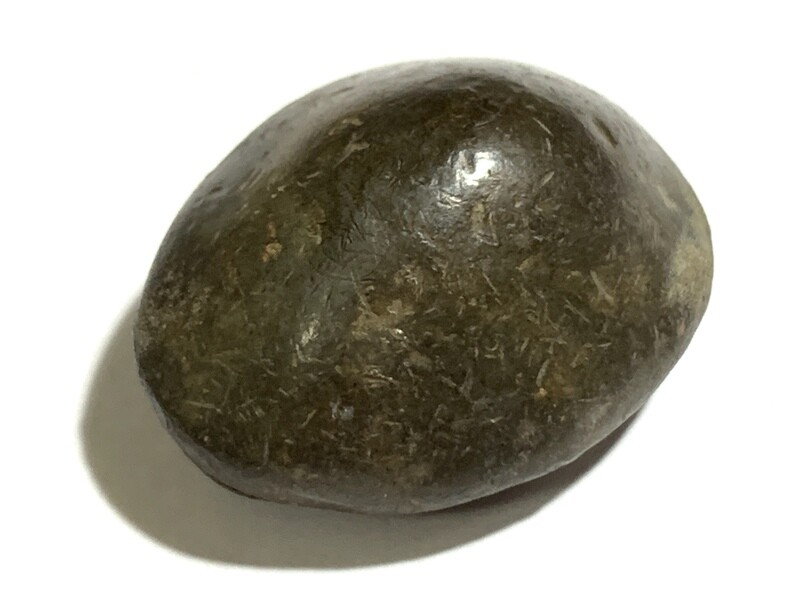
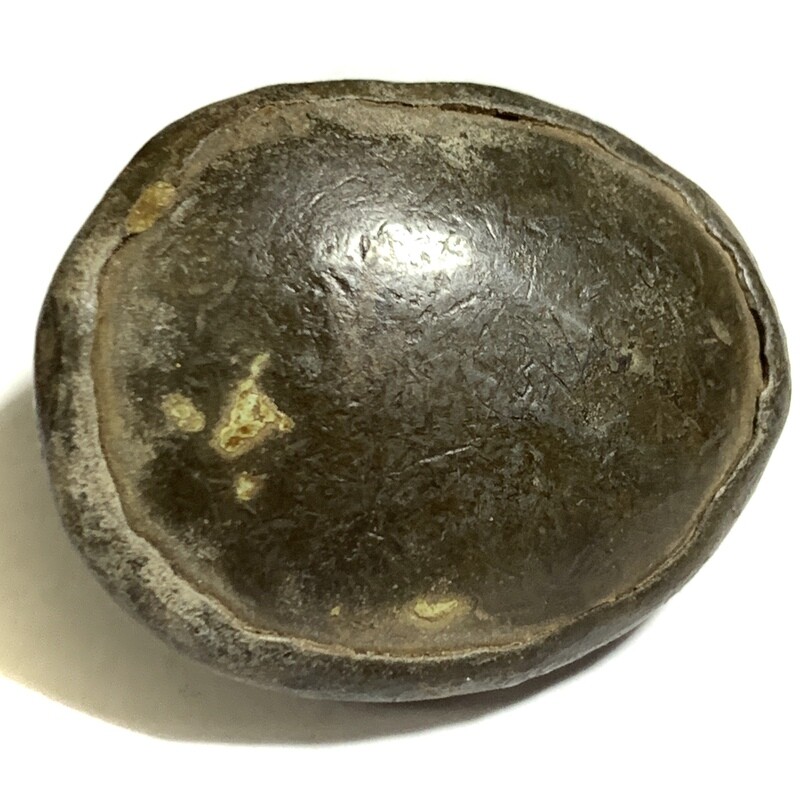
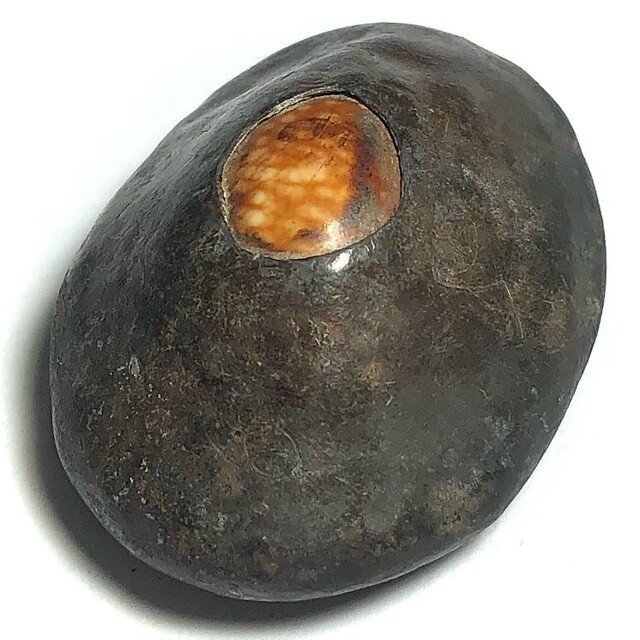
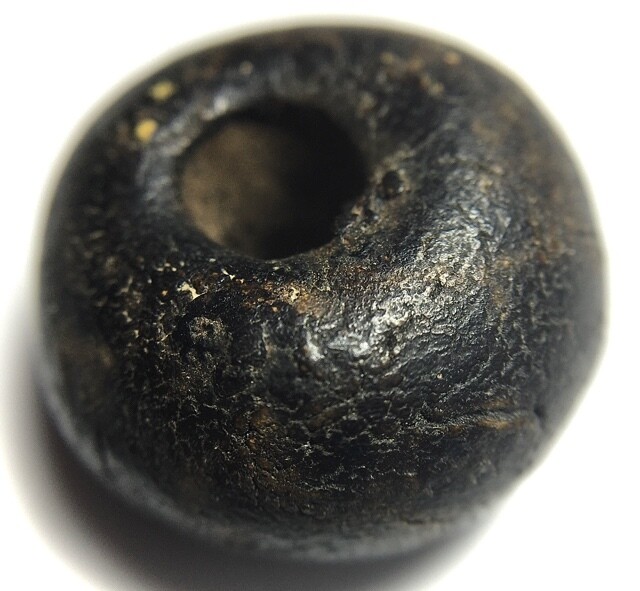
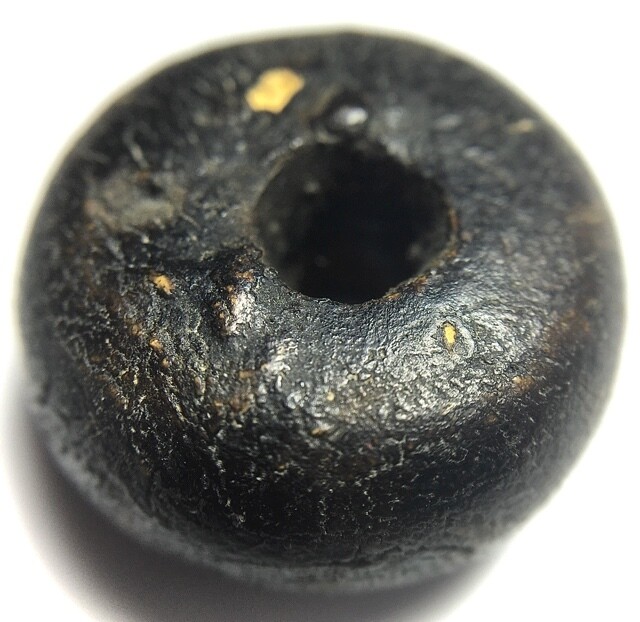
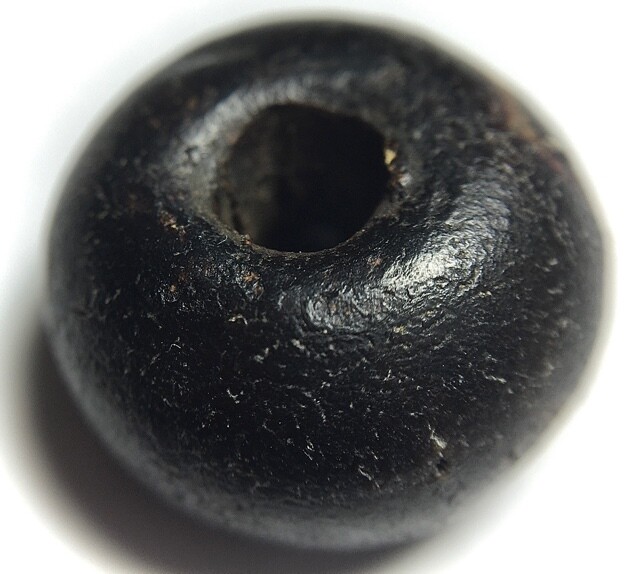
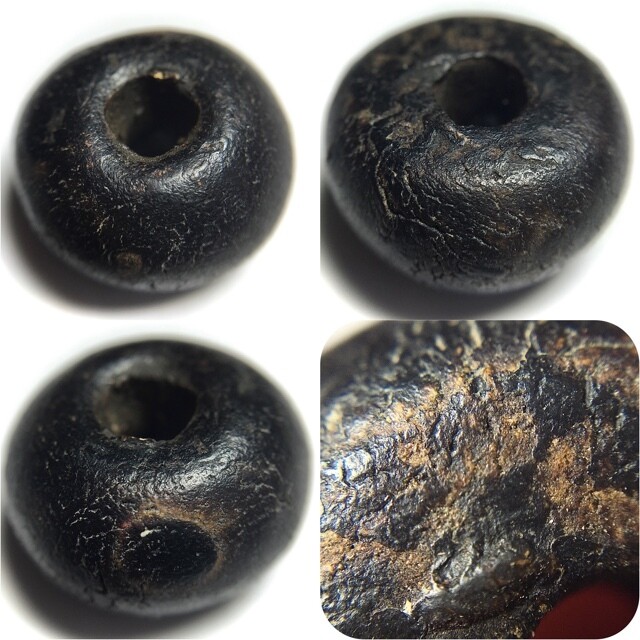
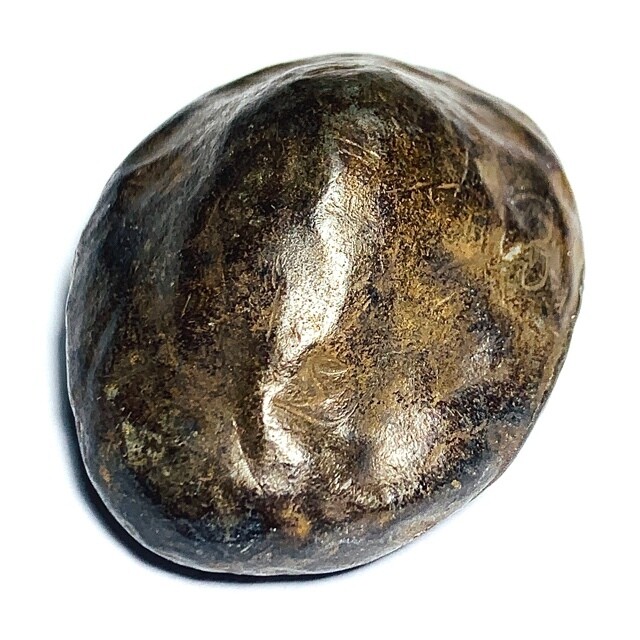
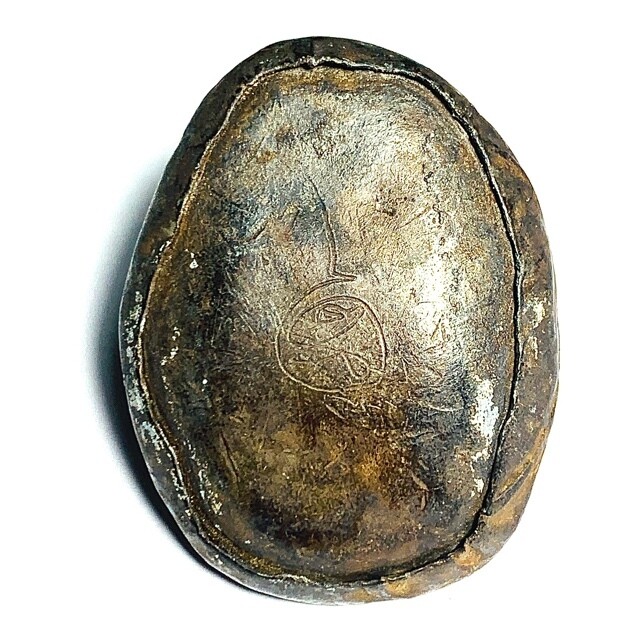
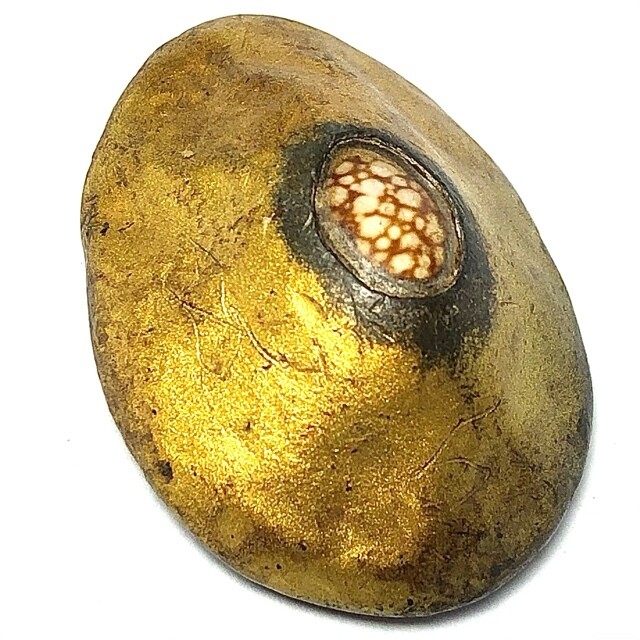
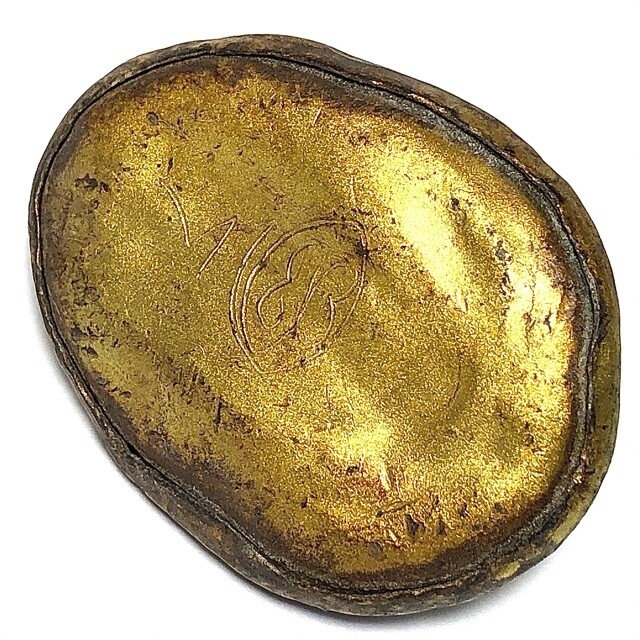
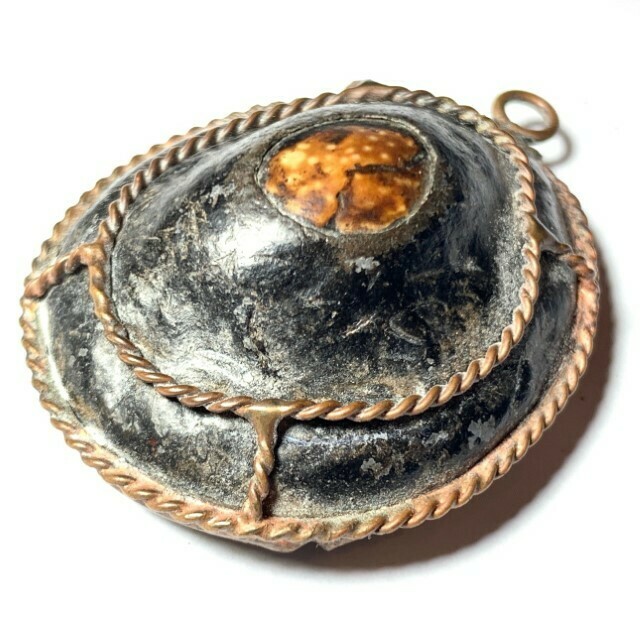
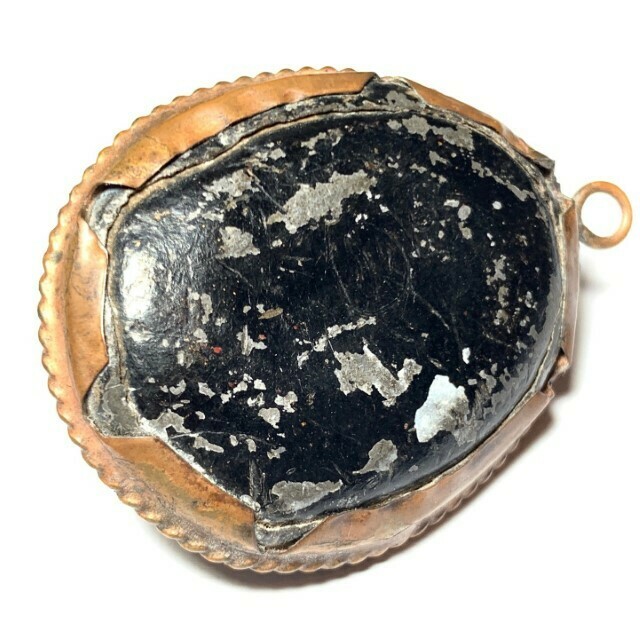
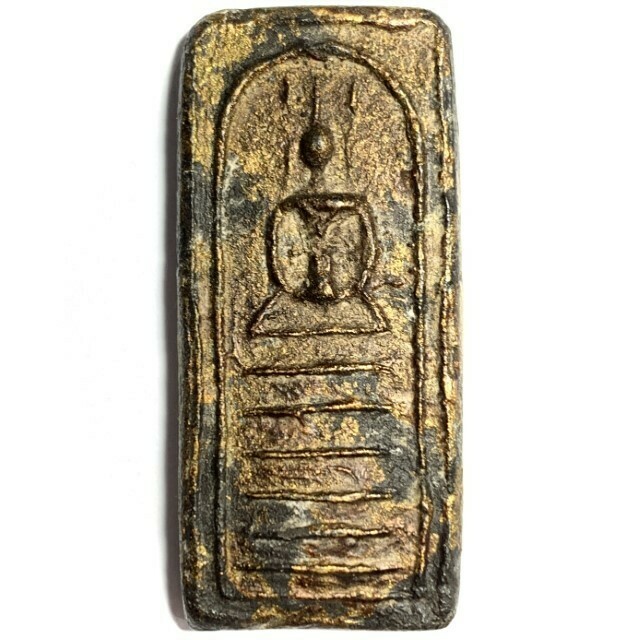
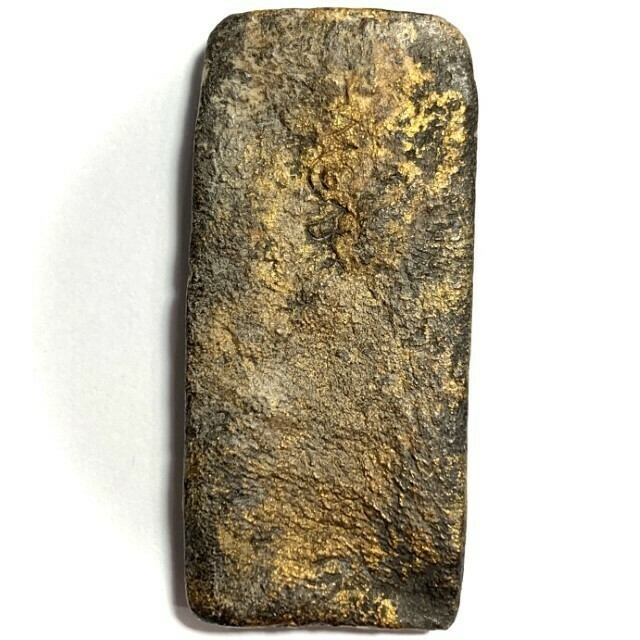
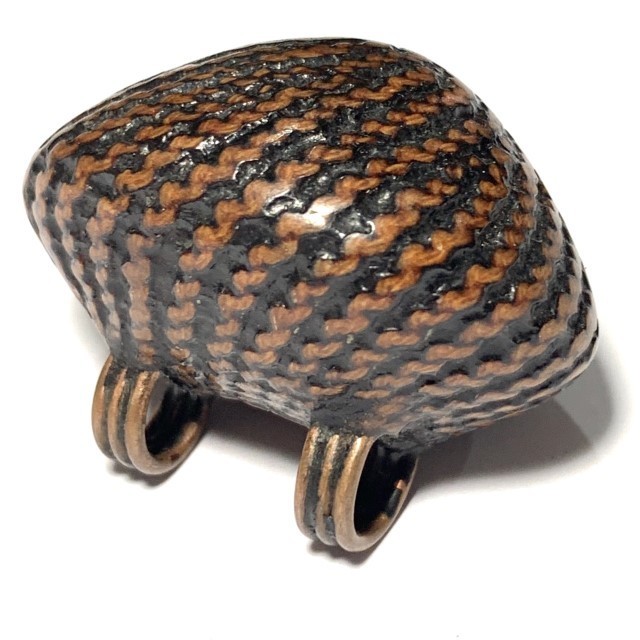
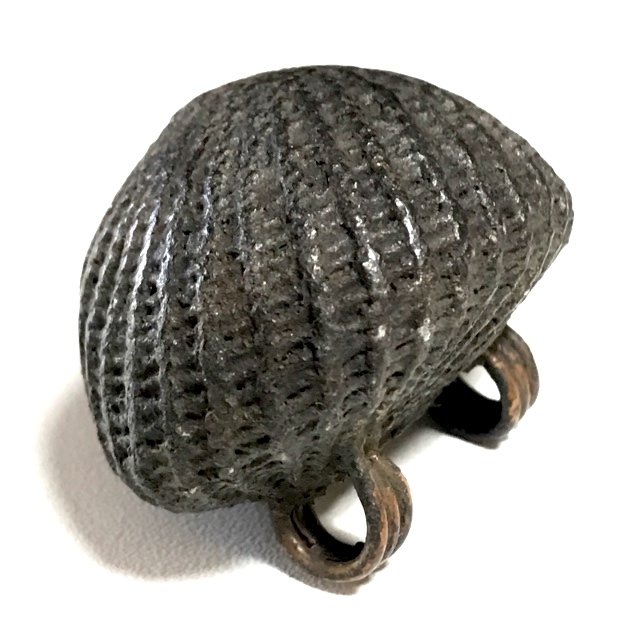
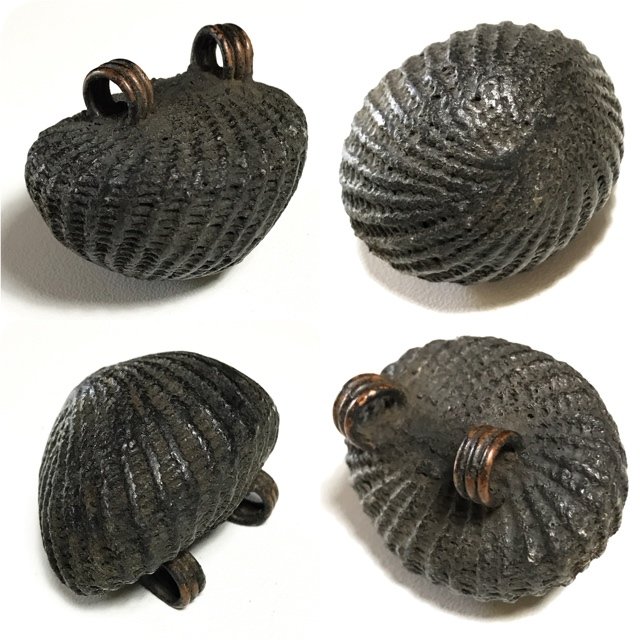
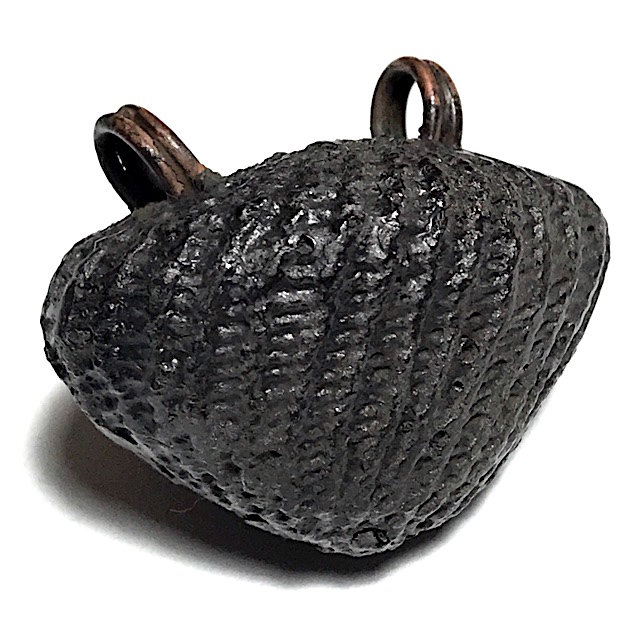
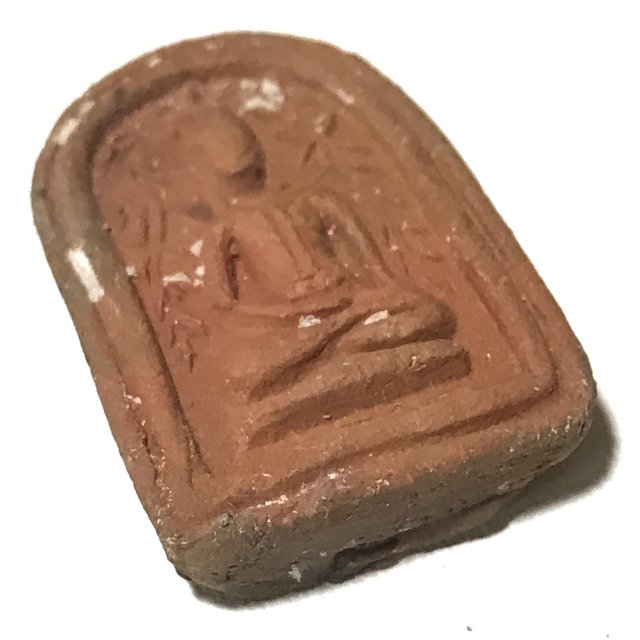
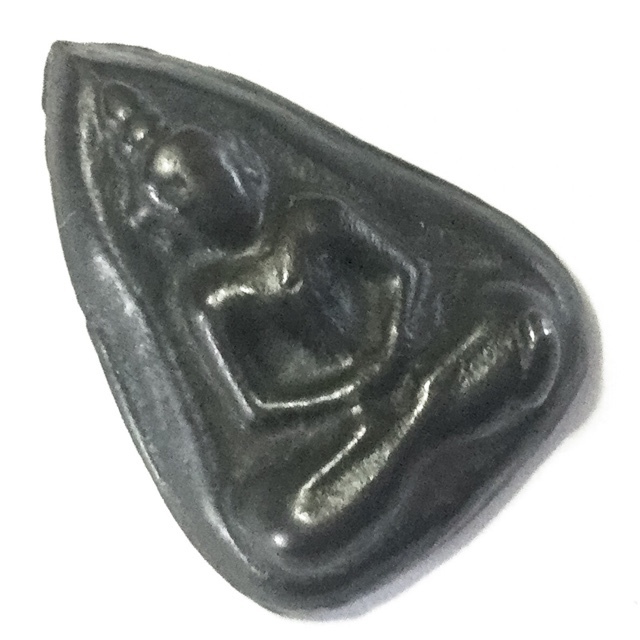
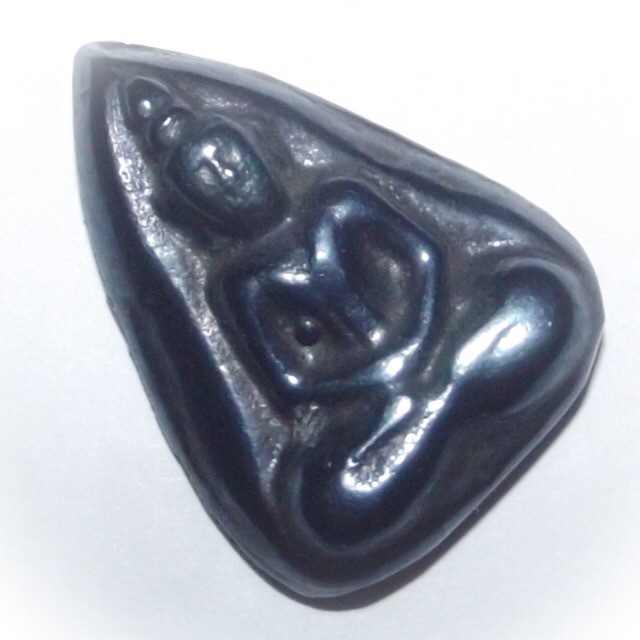
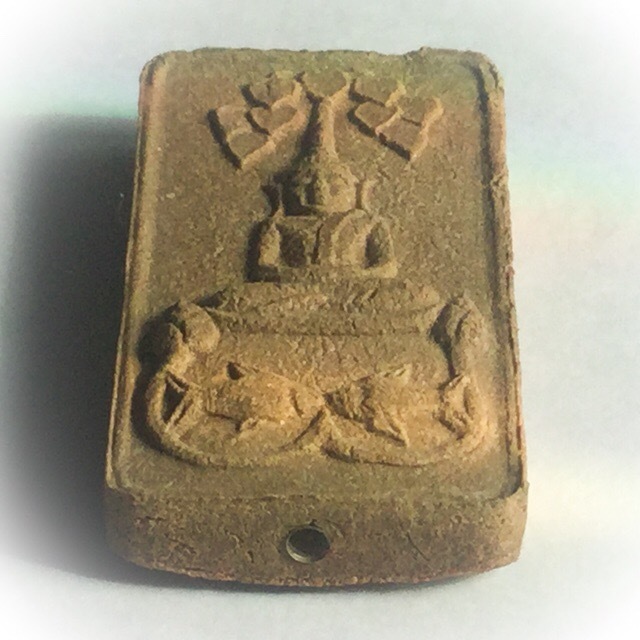
Pra Lila Sadet Glab Buddha walking through the forest amulet, from Ajarn Chum Chai Kiree made in 2511 BE. A very rare model from the 2511 BE Piti Sadej Glab Magical Ceremony, and a World Famous amulet Of historical epic fame, by the Great Legendary Lay Master Ajarn Chum, in conjunction with his Ordained Accomplice in Sorcery and Buddha Magic; Pra Ajarn Kong, of Wat Ban Suan.
This example is made from Nuea Wan Sabu Luead (Red Bloodsoap Herb Powders), mixed with 200 other kinds of Sacred Herbs, and powders from broken amulets from 108 ancient Kru Hiding Place Burial Chambers. The Pim Pra Lila version Amulet is one of the rarest of all the amulets from Ajarn Chum Chai Kiree and Pra Ajarn Kong, along with the Pra Yord Khun Pol, Pra Nakprok Taep Nimit, Pra Khun Phaen Awk Seuk, and the Pra Kong Chai Chum amulets.
The series is not only famous for the miraculous Sadej Glab ceremony, but for the presence of ‘Pong Kru‘ Muan Sarn Powders. Pong Kru is powder from 108 different ‘Gru’ (or ‘Kru’ if you like – a Kru is a hiding chamber within a Chedi Stupa, or other secret burial place where monks and master amulet makers will hide the amulets, to be later found and distributed as objects of faith and continuation of the Buddha Sasana).
This sacred powder of 108 Gru was made by Ajarn Kong and famous Lay Master, Ajarn Chum Chai Kiree, which they had been empowering and chanting into since the war till the time they made the amulets. The powders included 500 types of sacred magical ingredients, including; Pong Ittijae, Pong Dtrinisinghae, Pong Yant Bpatamang, Pong Yant Normo Pra Intr (Indra).
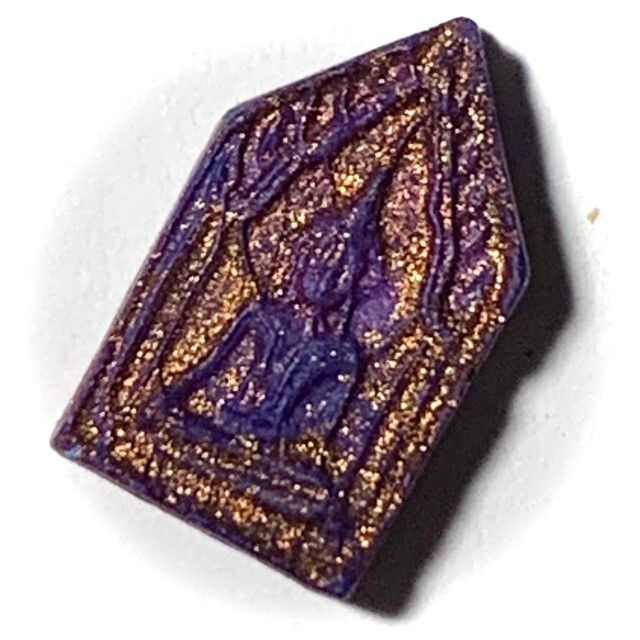
This amulet is highly recommended for Ladies due to its smaller size
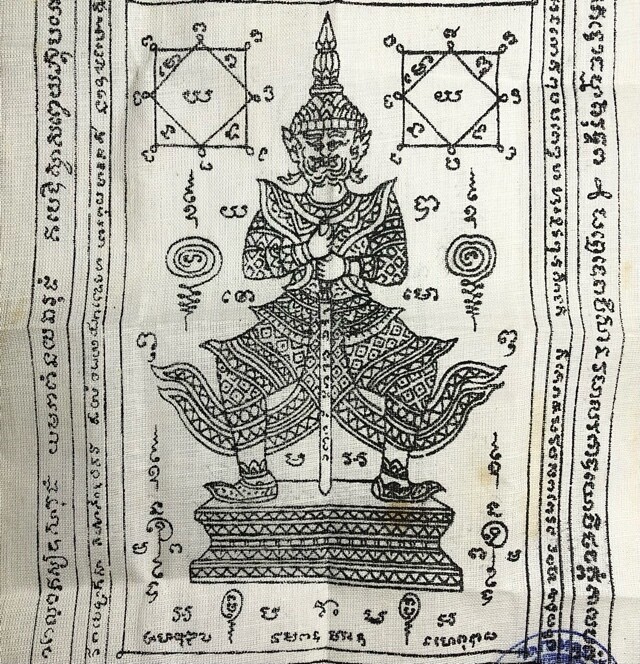
Ajarn Chum, who was so very Adept in Khom Agkhara spells and the Sacred Geometry of Yant, made a three month ceremony of constructing a Yant (Piti Chak Yant). The Sangha then gave the special powder the Name ‘Pra Pong Wised Kong Chay Chum’ .
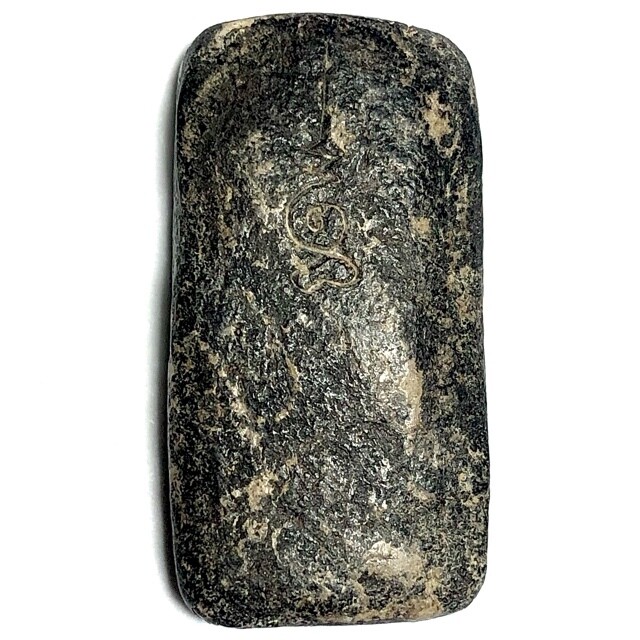
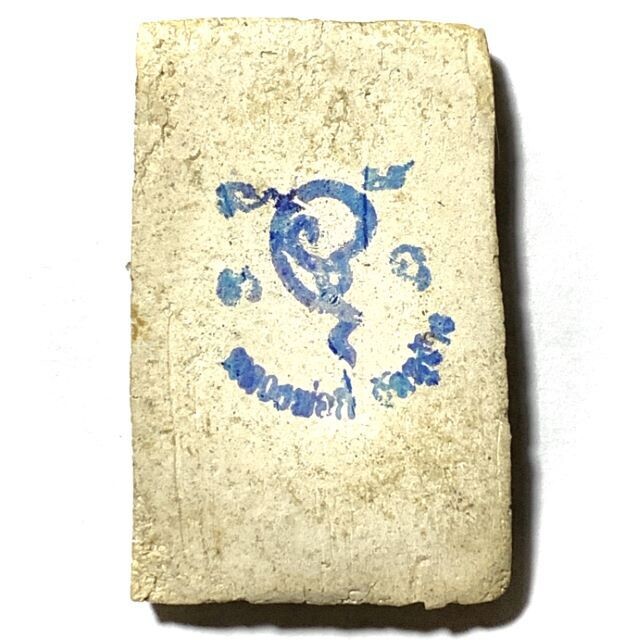
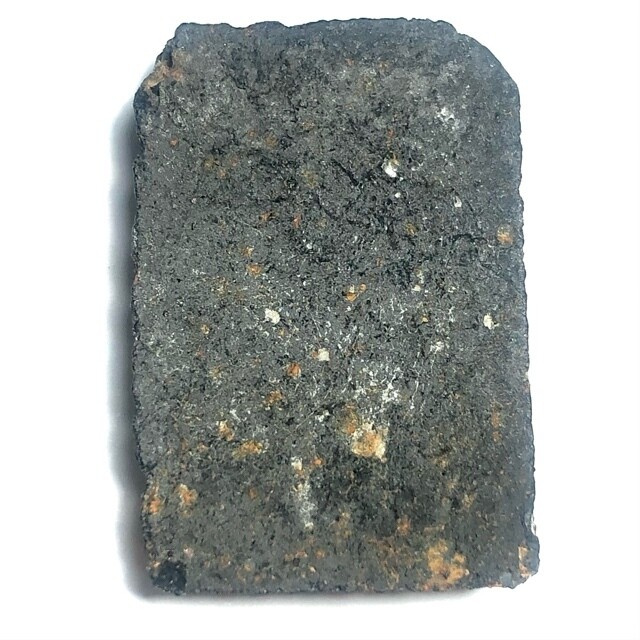
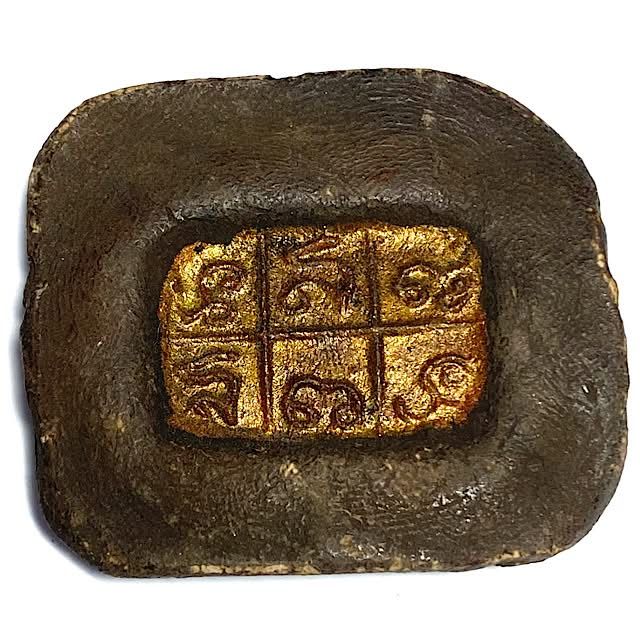
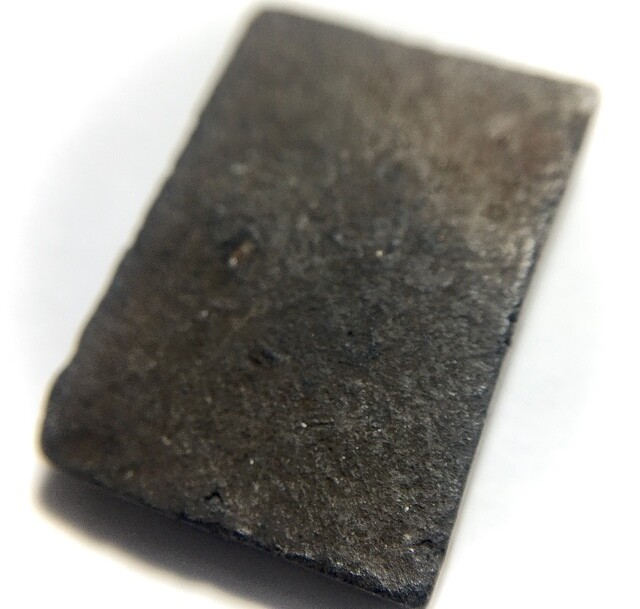
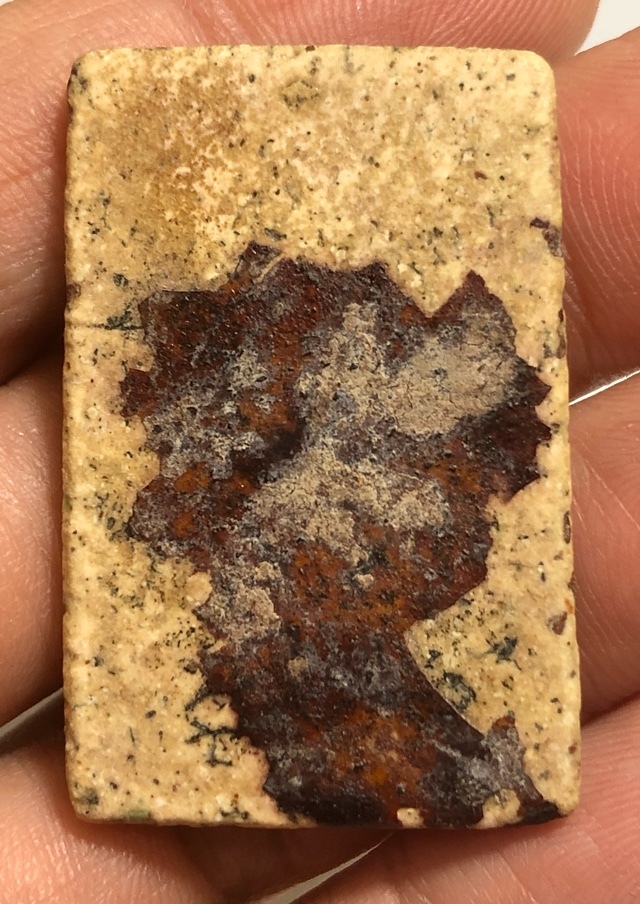
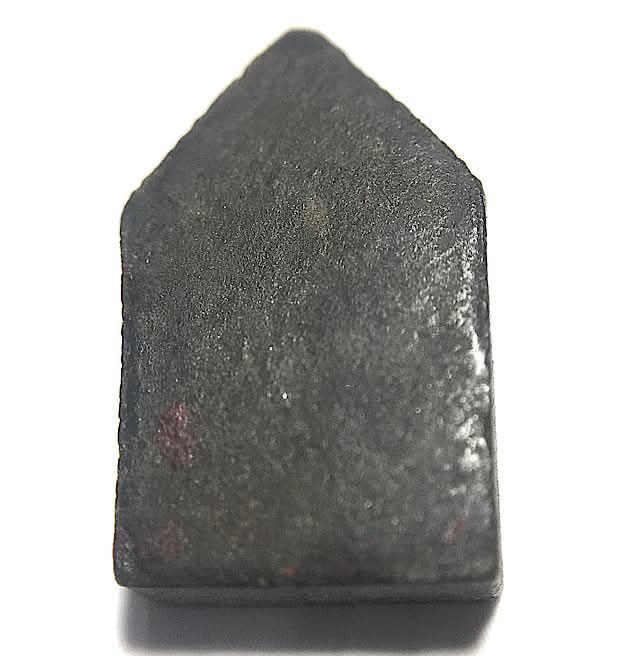
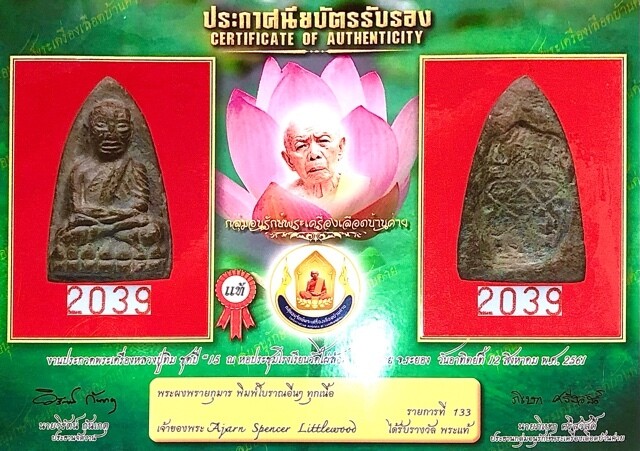
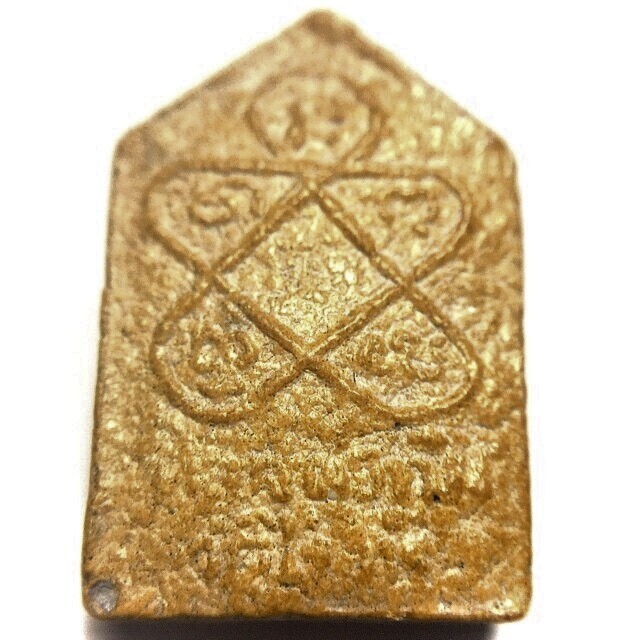
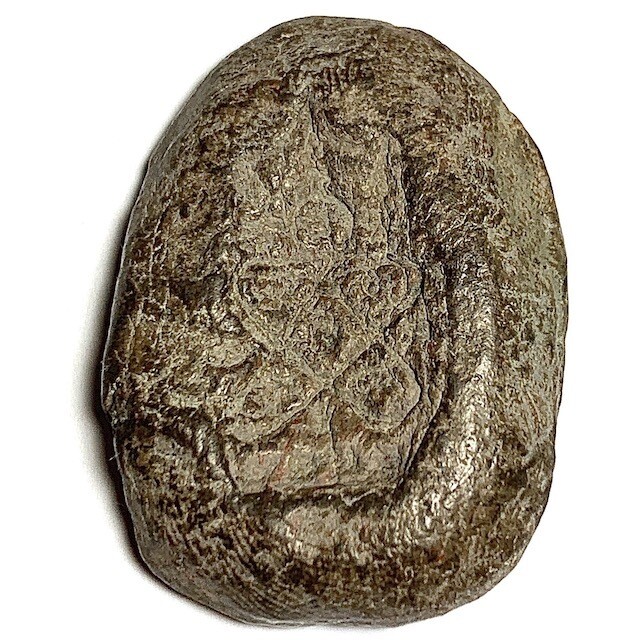
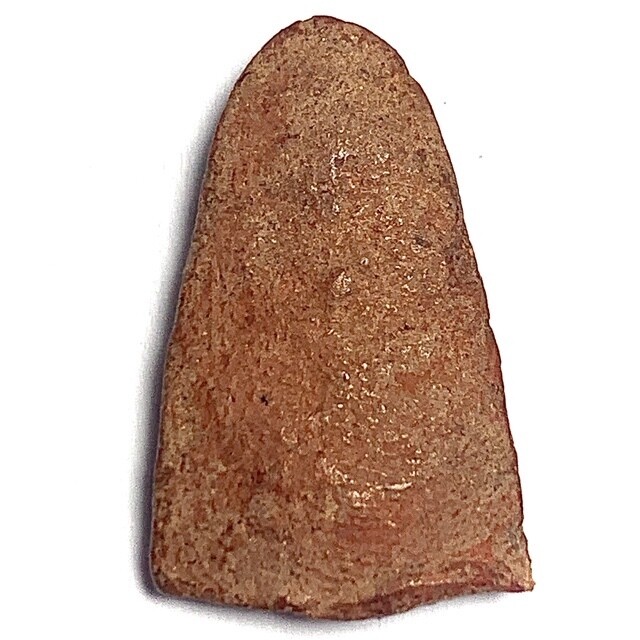
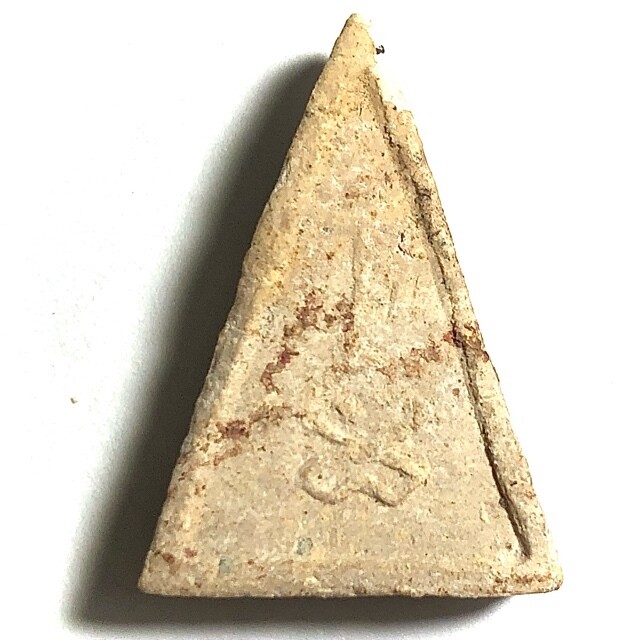
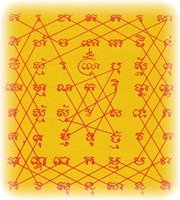
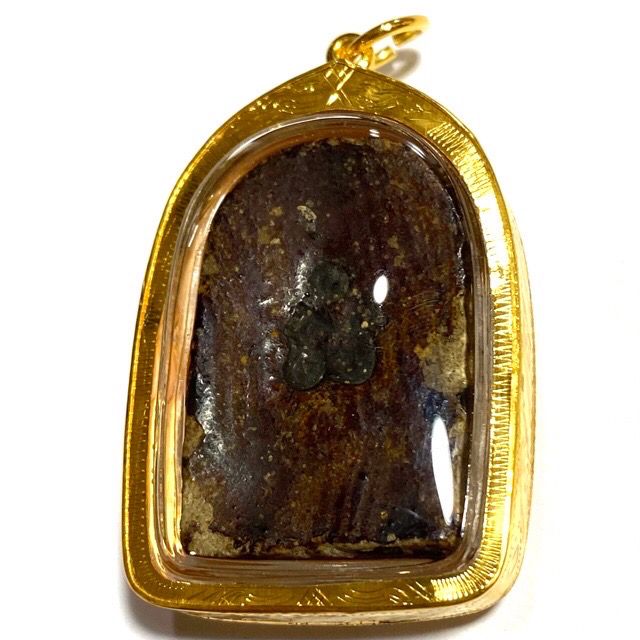
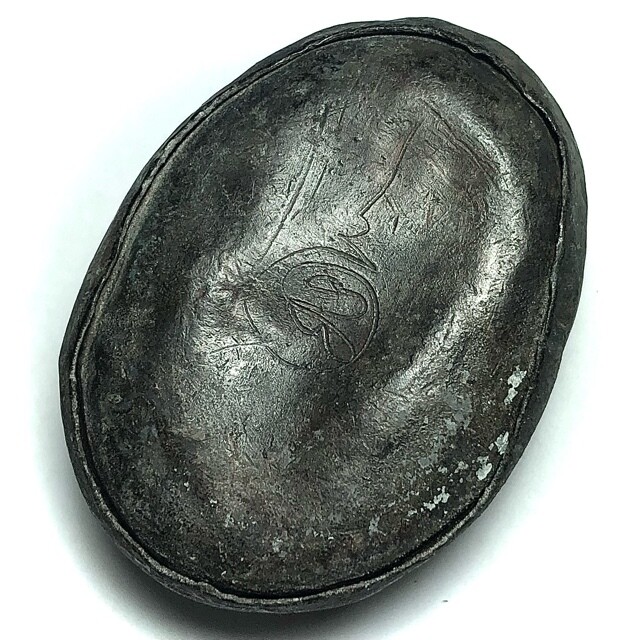
Sacred Yant is hand inscribed on the rear face of the amulet
Ajarn Tong Tao is the Boromajarn root Lineage Master of the world famous Khao Or magical tradition of South Thailand. This is said to have been the most powerful magical lineage of Masters in all Thailand, of all time. Especially in those days, the Lineage and the Samnak was one single Lineage, and extremely powerful.
These amulets were empowered and blessed during the famous Wat Tham Khao Ngern Sadej Glab Buddha Abhiseka and Taewa Abhiseka Ceremonies, which is one of the most revered, and famous ceremonies and editions of powerful amulets of all the ceremonies attended by Ajarn Kong and Ajarn Chum in that Era, including the Great 2483 BE Indochina War Edition.
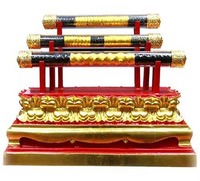
One part of the ceremony that stands out is the immersion of the amulets in the river, and letting them drift away, and then, setting up a ‘Sala Baram Piti‘ (a sort of small pedestal with a roof on high legs, above water level), which is dressed with white cloth.
Then Ajarn Chum would perform the incantations and prayers, to ask the Devas to bring the amulets back (‘Sadej Glab’, is high speech for high ranking persons or Deities, and means ‘To travel back’). The amulets all returned back one by one with the streamflow, and came to rest at the Sala Baram Piti.
Ajarn Chum Chai Kiree often performed this method of empowerment in various parts of Thailand at various temples, and every time the amulets would return to their originator, or owner without a single piece missing. Sometimes the distance between the place the amulets were thrown in the river, and where they were received, was up to 30 Kilometers away.
The Buddha Abhiseka fiinal Blessing after Ajarn Chum Chai Kiree’s Impressive Miraculous Empowerment, was performed with one of the largest assemblies of devotees of the various Khao Or Sorcery Lineage Temples of all Ceremonies, and is accepted that the Wat Tham Khao Ngern Sadej Glab Ceremony is of the most Sacred and Important of all Ceremonies performed by the Dtamnak Dtak Sila Khao Or Southern Academy of Sorcery.
Important Names Present Were; Pra Ajarn Nam (Wat Don Sala), Pra Ajarn Parn (Wat Khao Or), Luang Por Hmun (Wat Khao Daeng), Pra Kroo Palad Puang (Wat Prasat Nikorn, in Hlang Suan in Chumporn), Luang Por Tan Kloi (Wat Tham Khao Ngern in Chumporn), and of course Luang Por Kong, and Ajarn Chum Chai Kiree.
Below, famous ceremony and show of magic by Ajarn Chum
Below; Ajarn Chum, Khun Pantaraks Rachadej (creator of the Jatukam Ramathep amulet), and other masters performing amulet blessings and empowerments (We recommend to turn sound down because of loud volume in below clip)
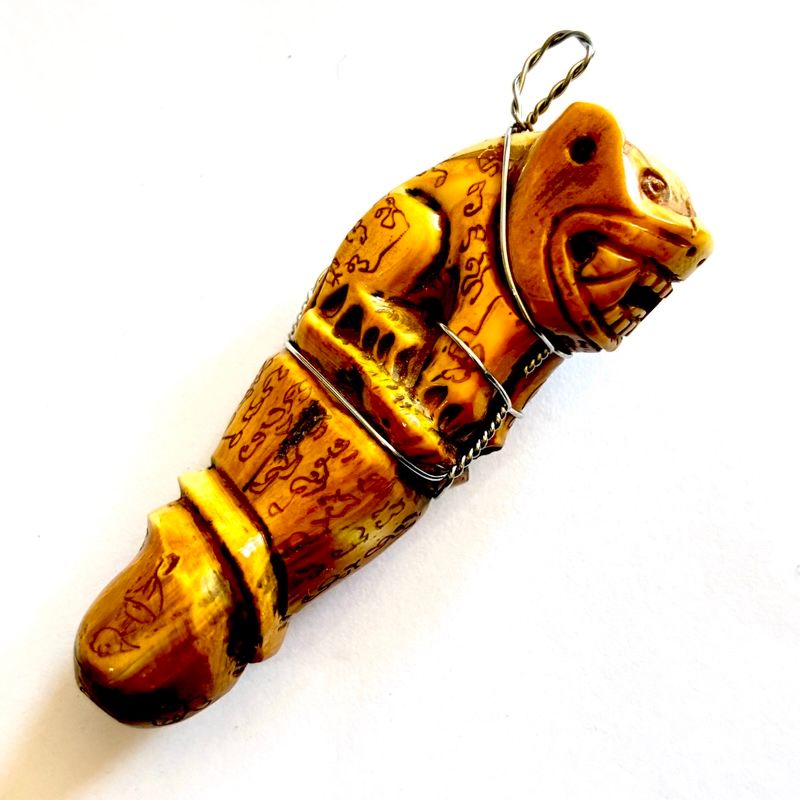
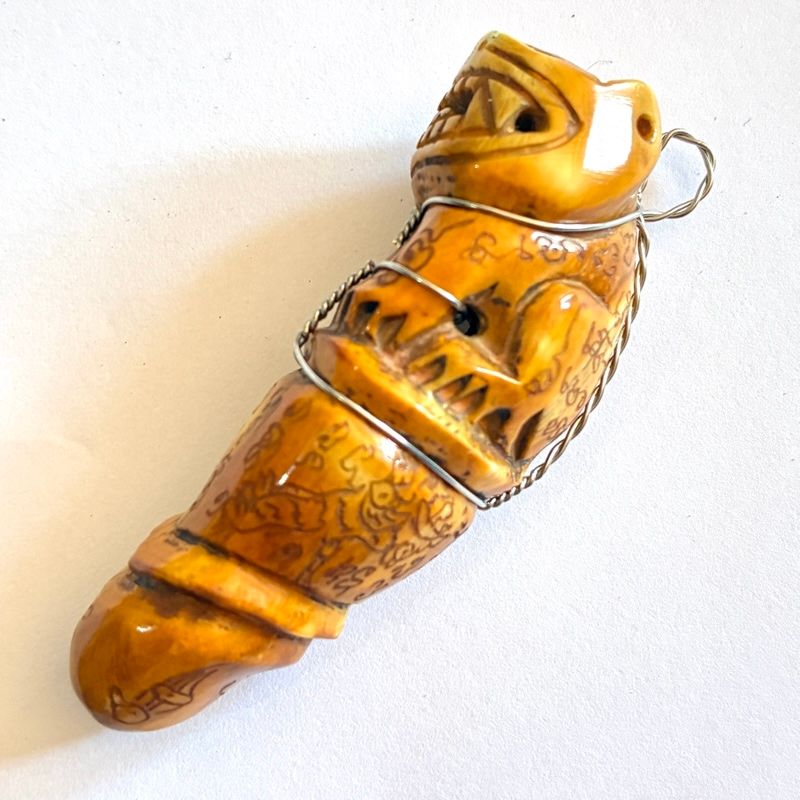
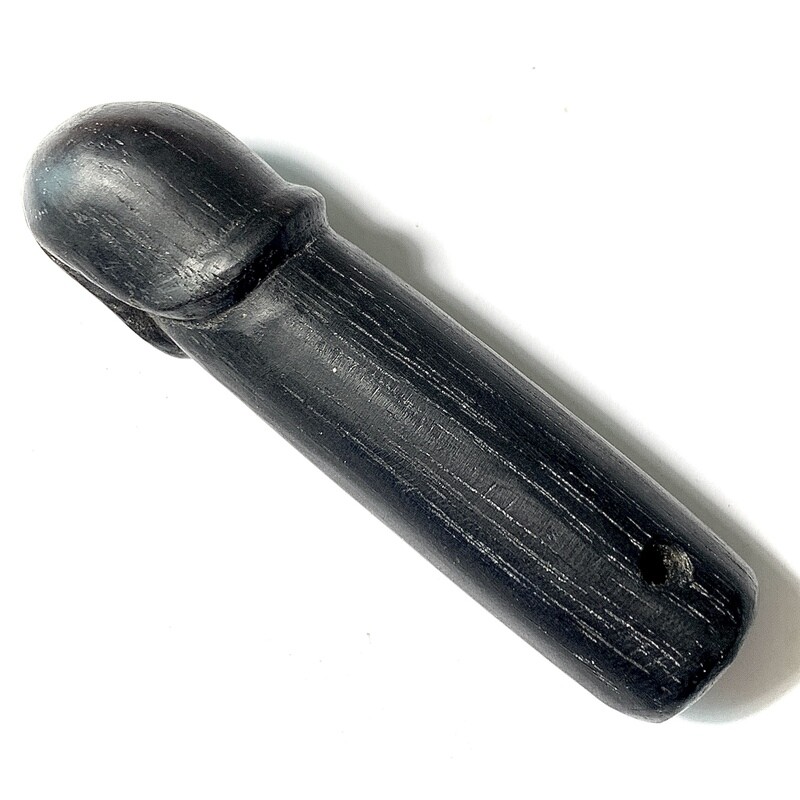
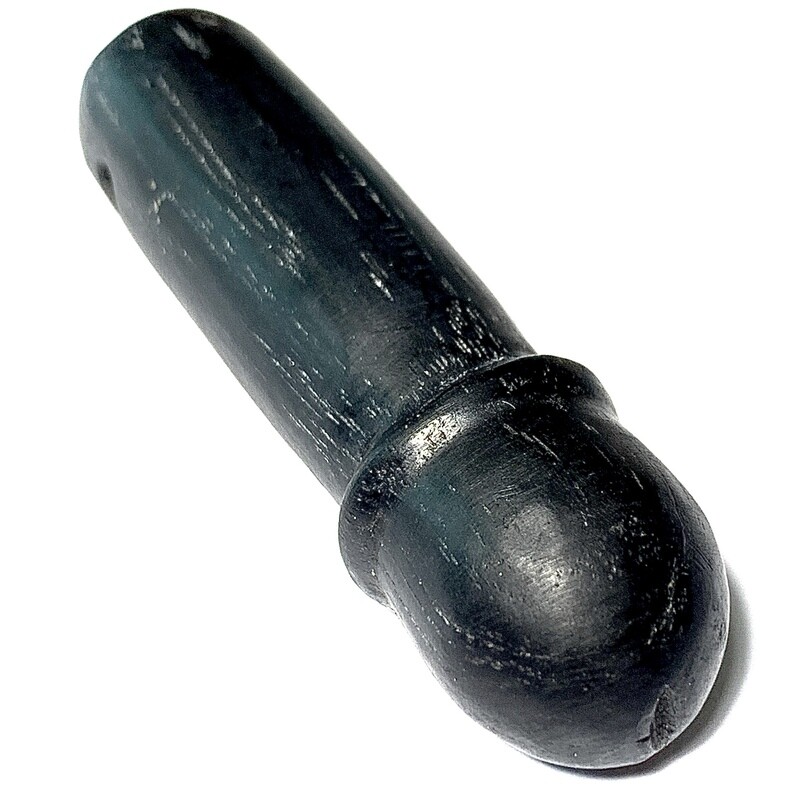
A large size 5 Inch Long 1 Inch Thick pristinely well carved design model, of one of the Most Famous Palad Khik amulets of all time, and in one of the rarest and most sought after materials; The Palad Khik Hua Chamot Mai Gae carved Palad Khik of Luang Por Pina (Wat Sanom Lao), in Nuea Nga (Ivory/Elephant Bone), with gemstone eyes, Muan Sarn inserted within the interior, and a most expertly and exquisitely carved design from a Master Artisan of Luang Por Pina. The Palad Khik is completely covered with hand inscriptions of the Sacred Yant Na Ok Dtaek, and the invocation of the four elements, and other Buddhist Prayers and Formulas of Sacred Geometry, such as the special Na Metta of LP Pina.
These amulets are highly regarded for their power to invoke the power to attract others, treasured possessions, and ward off black magick. They are also full of Metta Mahaniyom, Maha Lap Klaew Klaad and Maha Pokasap Powers as well as the obvious Power of Serm Duang ability to improve fate and destiny.
The Palad Khik is in truth symbolic of the Shiva Lingam; The belief in the Shiva Lingam, or ‘Leungk’ (Thai pronunciation) phallic energy of the Palad Khik, is derived from the Brahman influence which has been inflected on Thai Theravada Buddhism, since both belief systems came to Siam more than one or two thousand years ago. It is believed that the Palad Khik Lingam energy is the source of all life forms in the Universe. This is the root of the act of reverence (Bucha/Poojah) to the Palad Khik as a Shiva Lingam, which honors Shiva as the Lord of the World.
In India, not only is the Shiva Lingam worshiped, bit there exists also a
cult which reveres the female sex organ, which is called the ‘Yoni’(Vulva, female counterpart). The same thought is applied as that used to revere the Palad Khik Shiva Lingam, that is to say, that all created things must spring out of the Yoni instead of the Lingam.
Below; hand scratched etchings of Luang PorPina’s Famous Sacred Na Ok Dtaek Heart-Breaker Spell Yantra Inscription on the side of the Palad Khik, which is an essential part of Wicha Palad Khik
The practice of making Palad Khik as a portable amulet, for ‘Bucha Siwalingk’ (praying to Shiva Lingam phallic Deity), entered Siam with the influence of the Khom race, whose language and alphabet the Thais absorbed and adapted into their own personalized fashion.
Some have said that the integration of Pre-Buddhist beliefs and traditions, into the Thai Theravada Buddhist practice of the common Folk, such as worshiping amulets like the Palad Khik, is not in contradiction to the practice of Buddhism and presents no obstacles. In fact it is believed that since Buddhism sprang out of the roots of
Brahman Cosmology, and that the people of Siam adopted Pre-Buddhist
Brahman traditions and incorporated them, that this is even a benefit to
the preservation of ancient knowledge, and of Thai history and
tradition. Most of these ceremonies do not come into any kind of dispute
with Buddhist thought. In fact, Buddhist Thought bases itself on many
concepts found in Hinduism, and in Thailand, the two Belief Systems can
hardly be separated.
This amulet is ‘Doo Ngaay’ (easy to see it is real), for its clearly recognisable from its inscriptions and appearance. It is hence considered Ongk Kroo (usable as a teacher), as a reference model for further study to increase the powers of recognition of authenticity of the top preferred Palad Khik amulets of Luang Por Pina. However, the Pantheon of amulets of LP Pina is one of the more difficult genres to study, for many were hand made, each individual, and only a small percentage of all the amulets he made has been officially documented to date.
This is for its easily recognisable features, which allow one to easily distinguish the authenticity of any other exhibit when held side by side for comparison, making it a Master Key for teaching the eyes to recognize Luang Por’s famous amulets, as well as the effects of aging over the years (especially important with Sacred Powder amulets)
Luang Por Pina is the deceased Abbot of Wat Sanom Lao in Sra Buri and was said to have possessed Abhinya Powers, and to have Mastered the 10 Kasina Powers of Elemental Magical Dominion. Below you can see another Sacred Amulet from this Master, the Famous Pra Pim Tao Wua Luang Por Pina.
It is said that Luang Por Pina was able to read the minds and intentions of other Humans, and bring amulets to life with is Empowerment Methods, and that his amulets were able to give signs, and also can be beseeched and prayed to, for wish fulfillment (Sarapat Neuk). There are many stories of Miraculous Events occurring through his amulets, which have been recounted around the country over the years, which have also brought his name to the ears of people around the world.
Luang Por Pina is known to have performed strange Magical feats in front of the eyes of his disciples many times, especially when devotees would ask him for an amulet. He would ask the devotee to lay down and open their eyes, and would take a handful of sand and pour it over their face, as they would hold the amulet in the hand.
But the sand would bounce back before it hit their eyes, and no matter how much was poured on the face, not a single grain of sand would be able to enter the eyes of the devotee, becoming repelled as if by a force field before it touched the eyes.
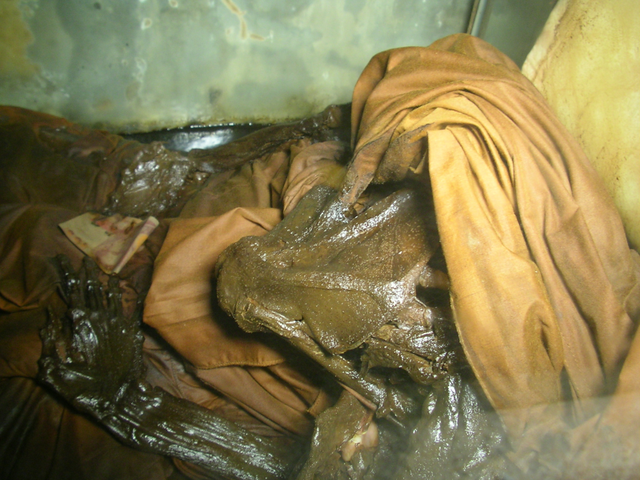
Above Pic; The corpse of Luang Por Pina which was found in meditation posture, dead since over 12 Hours, but was still warm, and not stiff, to the immense surprise of those who found him. The surprise was because a corpse that is dead for over 12 hours, should be stiff as a board and cold.. his body was not mummified or given any special treatment according to his wishes and placed in his mausoleum.
Below; Silver Takrut spell as tongue of the Chamot Civet Cat, and reat teeth tips are visibly inserted into the mouth of the Palad Khik Hua Chamot of Luang Por Pina, revealing an attention to detail and adherence to the Ancient Wicha of Empowerment of the Palad Khik Hua Chamot, that is both impressive, and faith instilling in its certain magical power.
Kata Luang Por Pina
Light 5 sticks of Incense, and chant the Maha Namasakara 3 times before chanting the special Kata for Luang Por Pina Bpiyataro
Namo Dtassa Pakawadto Arahadto Sammaa Samputtassa
Namo Dtassa Pakawadto Arahadto Sammaa Samputtassa
Namo Dtassa Pakawadto Arahadto Sammaa Samputtassa
Below; the Sacred Yant Na Metta spell inscribed on the Palad Khik, which is an essential aspect of the true Wicha Palad Khik of the Dtamra Saiyasart Thai Grimoires of Sorcery
Then chant the Kata for Luang Por Pina (3 times);
Ahang Sukhadto Pina Bpiyataro Naamadtae Aajaariyo Ma Pandtae Hohi
Kata Pluk Khong (Call the power within the amulet)
Puttang Gandtang Saranang Haa
Puttang Gandtang Saranang Hae
Puttaaa Namo Ya
Kata Pra Som Hwang (Fulfilment of Wishes)
Chant the following for as many repetitions as your age (for example, if you are 35 years old, then chant the Kata, repeatedly for 35 times)
Nadtae Sudtae
The last repetition, change the words to
Mahaa Sudtae Nachaa
As an example, let us pretend a four year old were to recite the mantra, which would result in four lines like this;
If you wish to know more about another famous amulet of Luang Por Pina, then you can listen to the three quarter of an hour talk and explanation of the Sacred Daw Aathan along with a short Biography of Luang Por Pina, recounted and narrated by Amulet Expert Ajarn Spencer Littlewood in the below Podcast. In the podcast, You will be amazed to learn about the very deep meanings contained within the Daw Aathan Hnun Duang Lucky Star amulets of Luang Por Pina.
Please Enjoy the Biography, and Explanation of another very famous Amulet of Luang Por Pina, revealed; Perd Dtamnan Daw Athan Hnun Duang, and increase your knowledge of the amulets of Luang Por Pina.
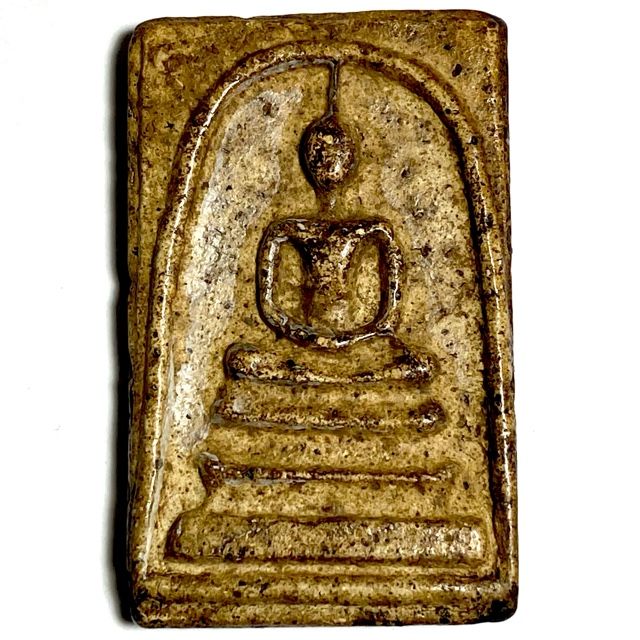
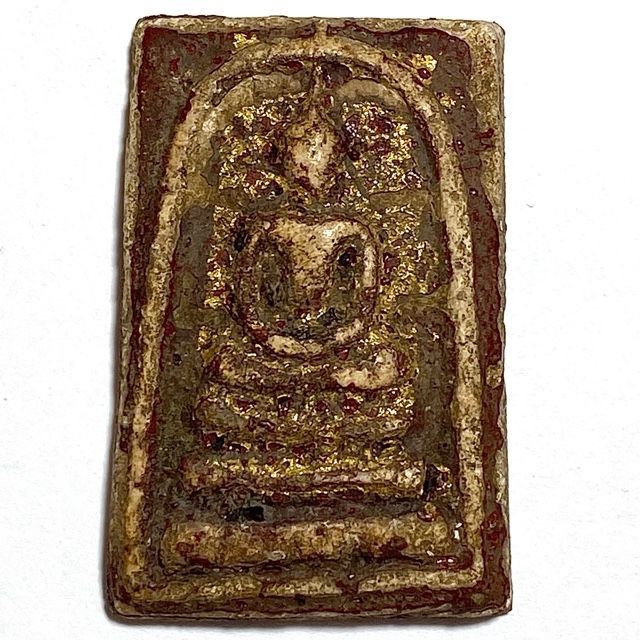
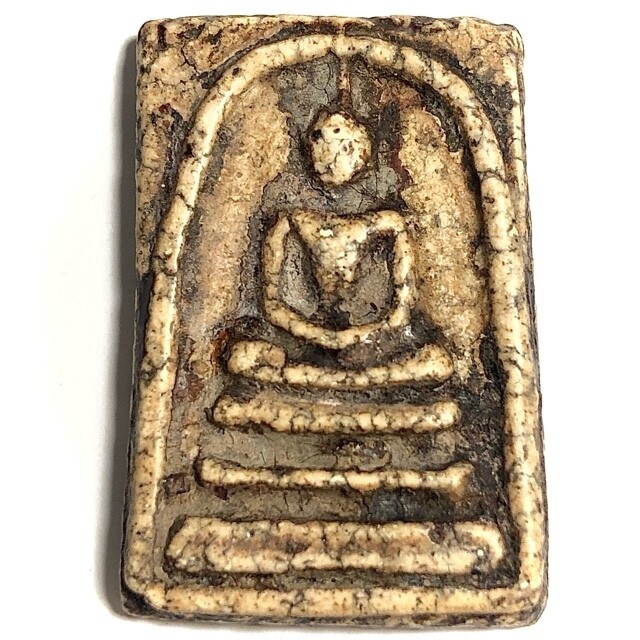
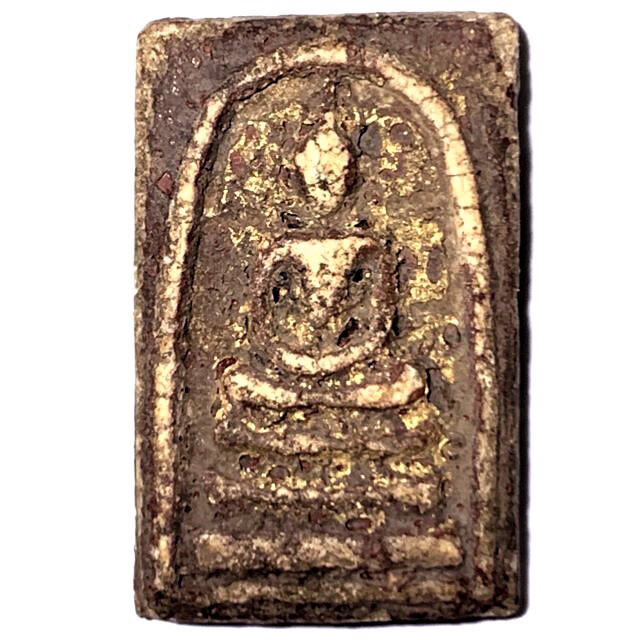
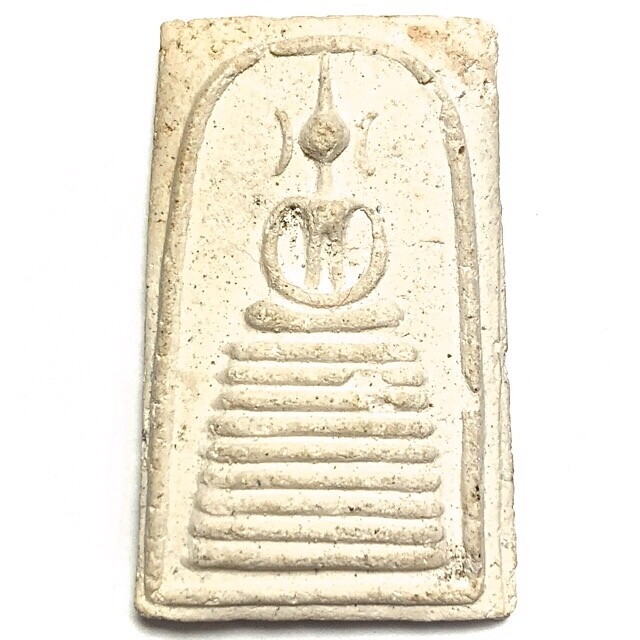
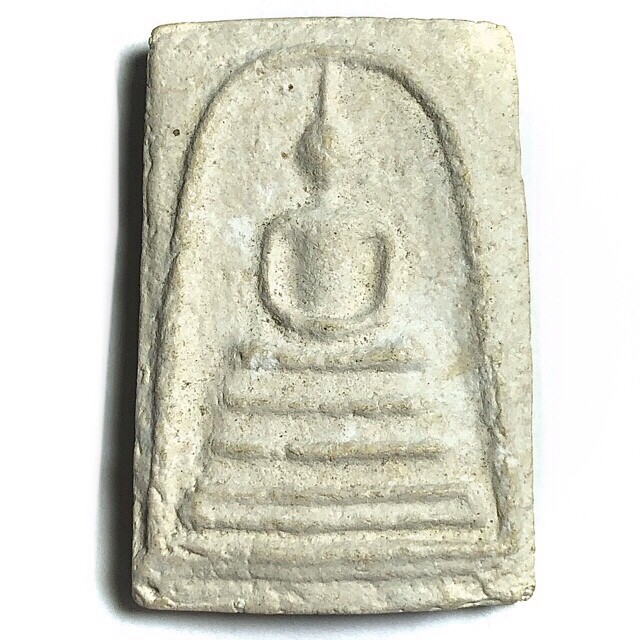
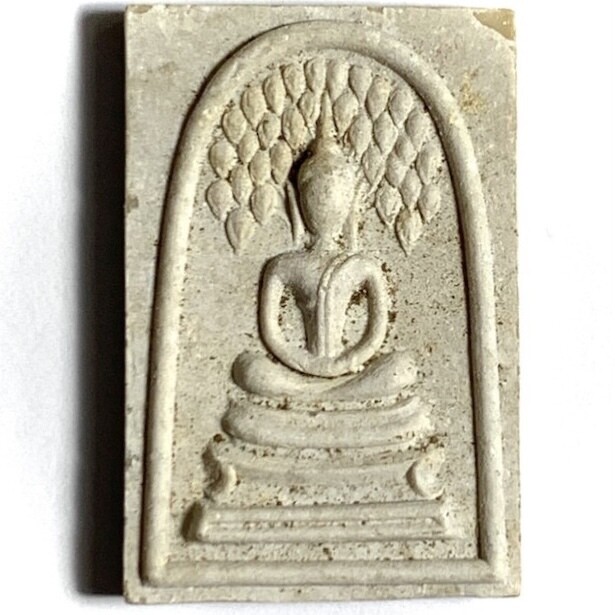
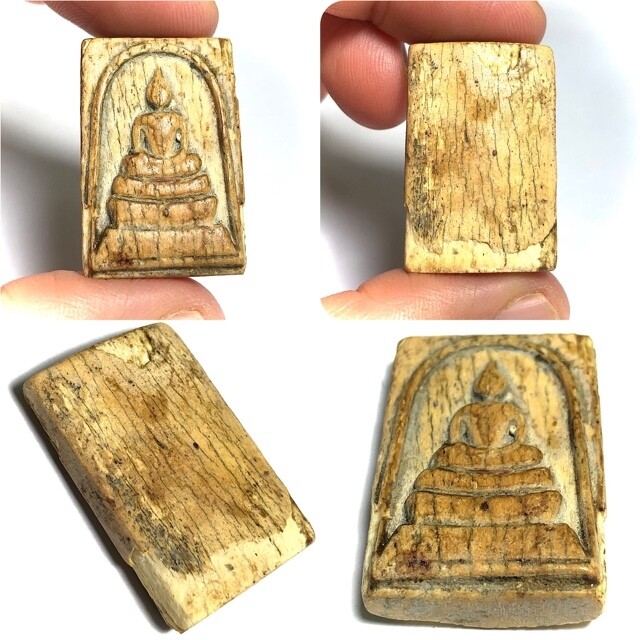
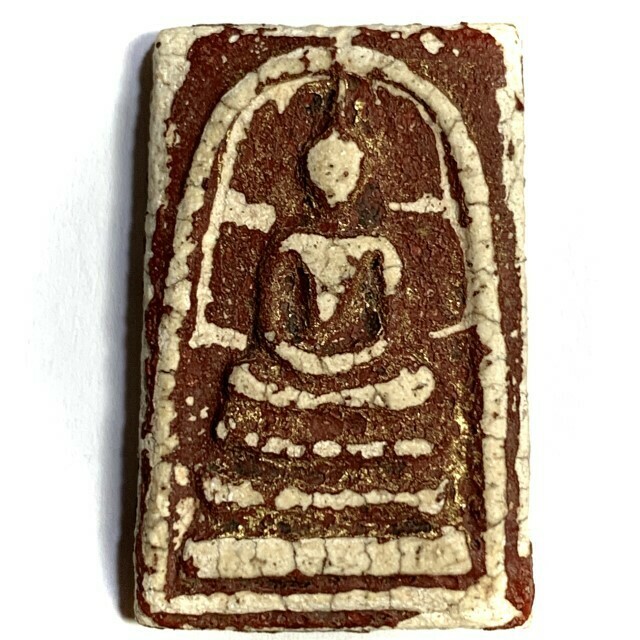
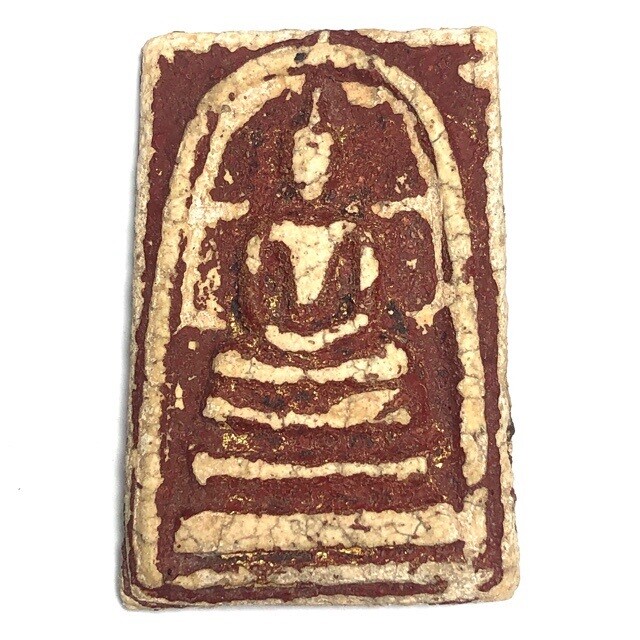
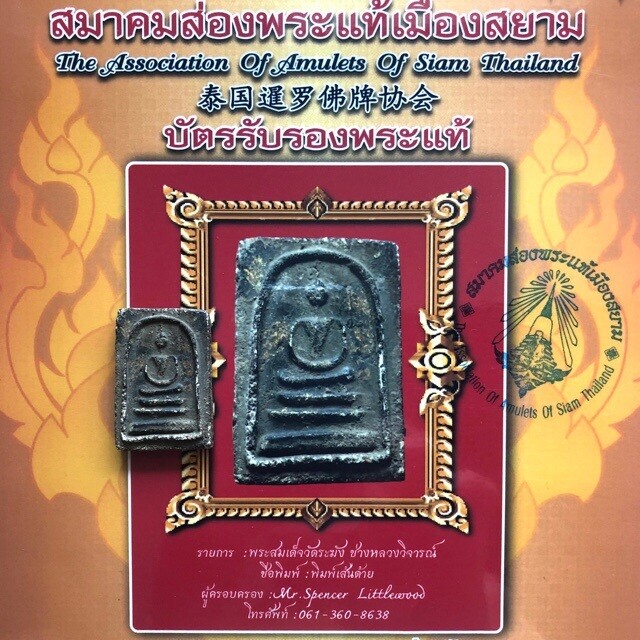
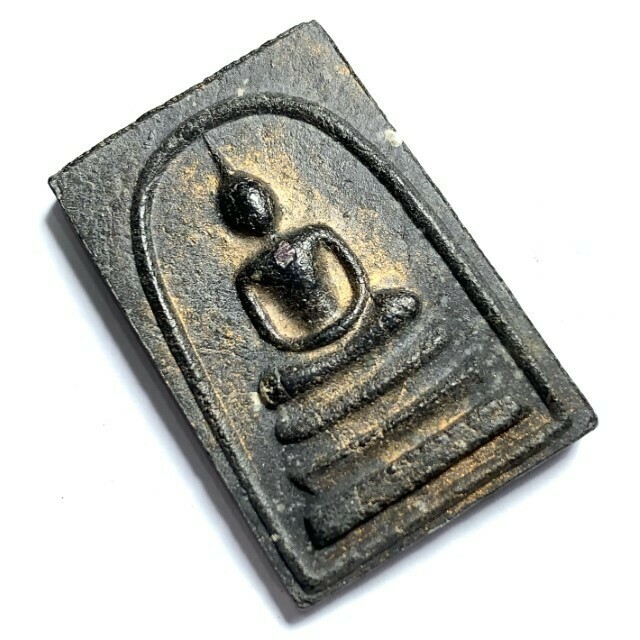
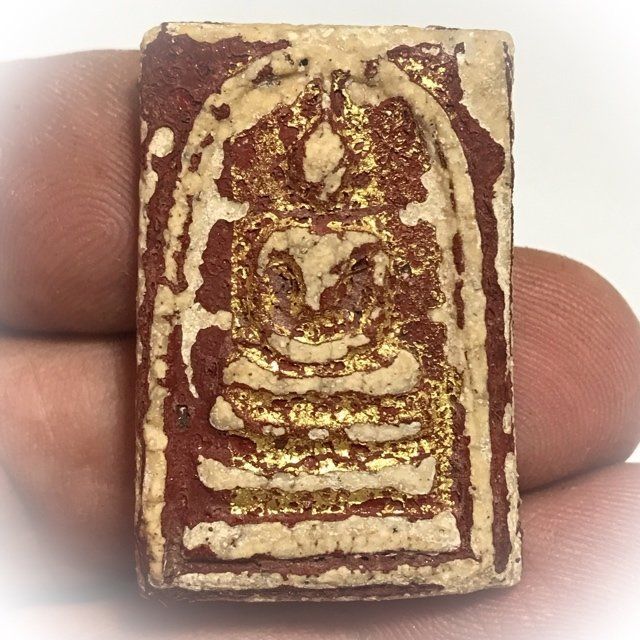
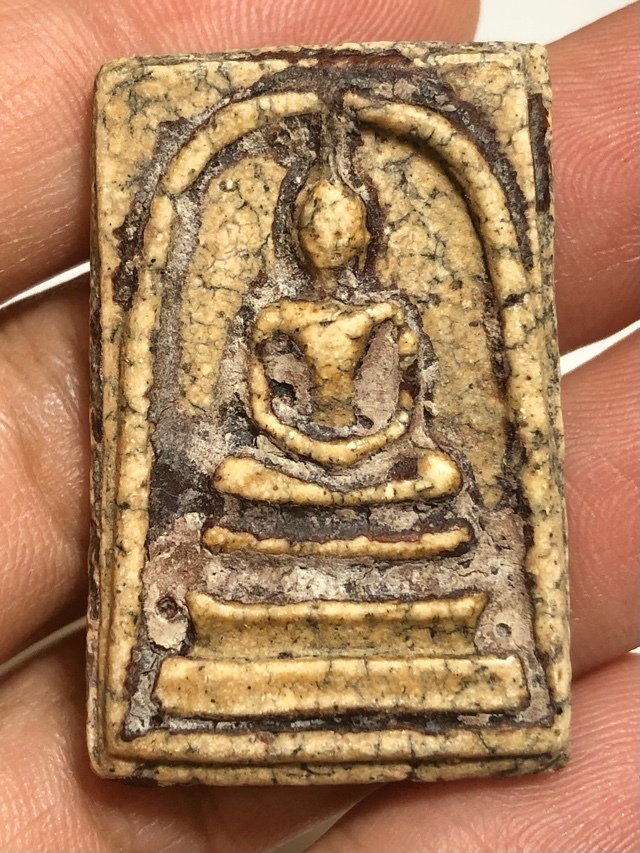
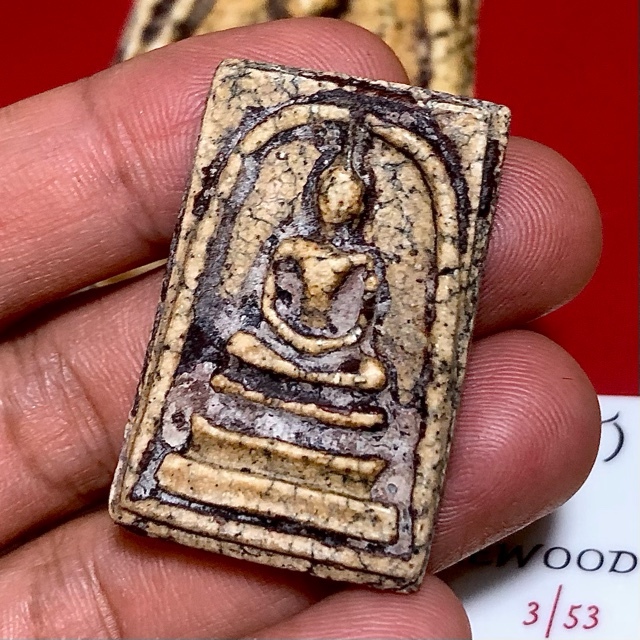
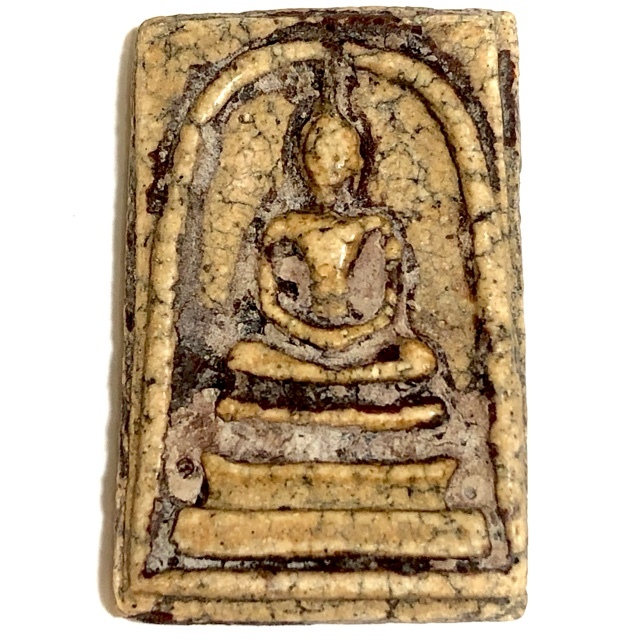
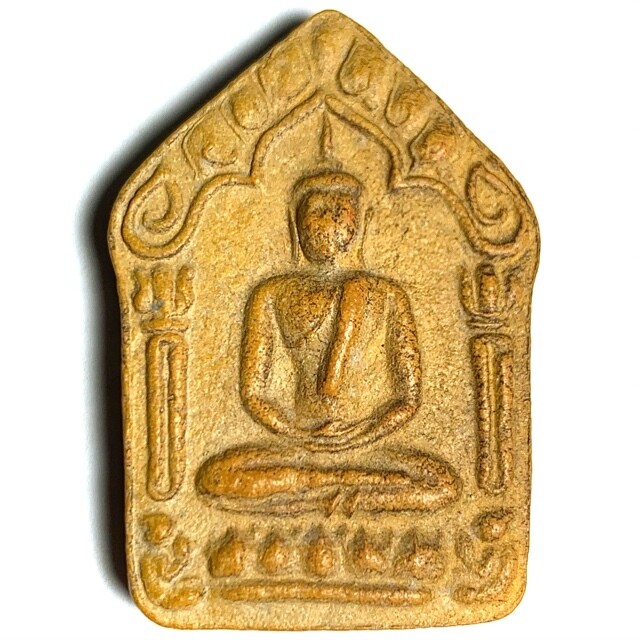
A most Exquisite and Officially Certificated Authentic Pra Somdej Wat Rakang Pim Gae Talu Sum Block Chang Luang Wijarn of Somdej Pra Puttajarn (Khrua Dto) Prohmrangsri, the Great Master of Wat Rakang, with Red Lacquered Surface, and all the classic features of an Ongk Kroo Model of this All Time. This particular exhibit is Extremely attractive to the eye, with its perfect balance of lacquer and open surface. The Pra Somdej Wat Rakang Kositaram of Somdej Pra Puttajarn (Dto) Prohmrangsri is the No. 1 Pra Somdej amulet of all time, and the most eminent member of the five regional top amulets within the Benjapakee Pantheon of Classic Thai Buddhist Amulets. On can also say it is perhaps the most famous of all Thai Amulets.
A Master Class ancient amulet of the Benjapakee Immortal Classic Family, the Pra Somdej Wat Rakang Pim Chang Luang Wijarn, with Rak Chart (ancient red lacquer), of the great Somdej Pra Puttajarn (Dto) Prohmrangsri of Wat Rakang Kositaram, this model is an extremely attractive Pim Niyom model of the ‘Chang Sip Moo’ Artisan Chang Luang Wijarn. This amulet comes with free solid silver casing if desired and selected in the encasement options (Please note; the custom casing can take from 3 – 10 days to custom encase). The Silver Frame is enhanced with waterproof acrylic sealed windows to protect the amulet from the weather). You can order solid gold casing at extra price if desired too and we wil invoice you according to current spot prices.
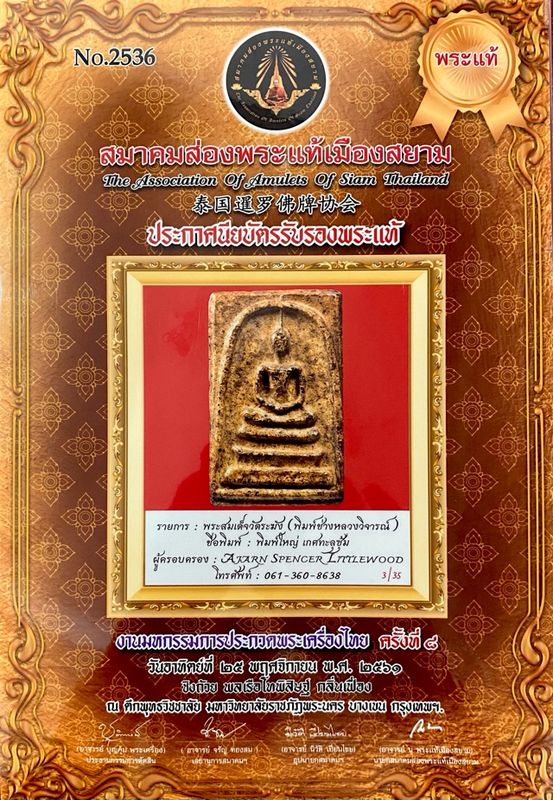
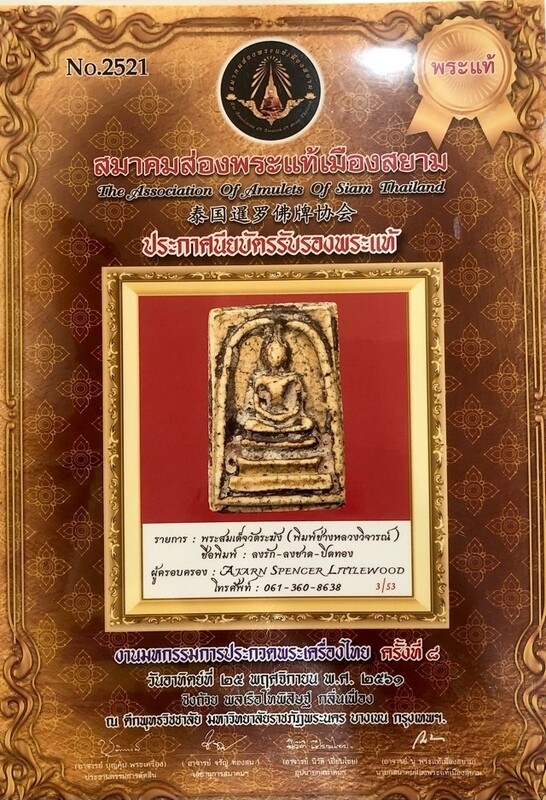
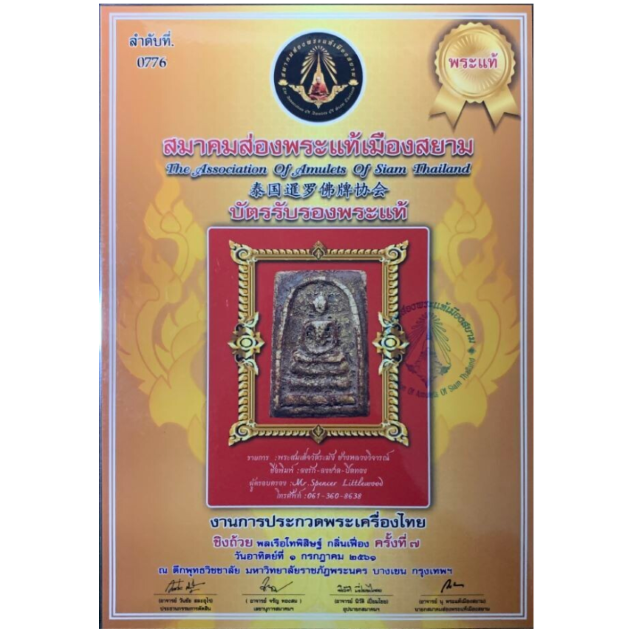
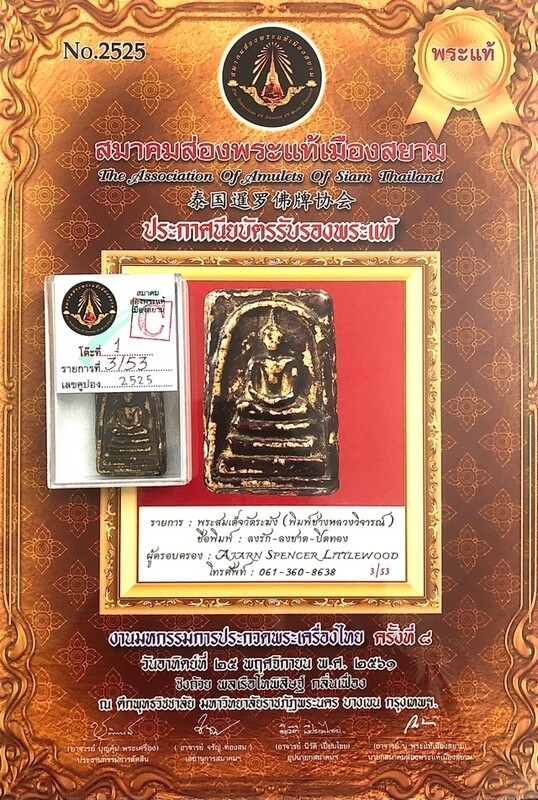
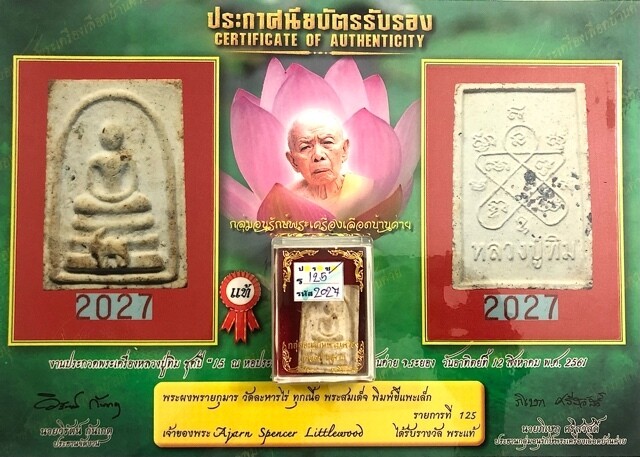
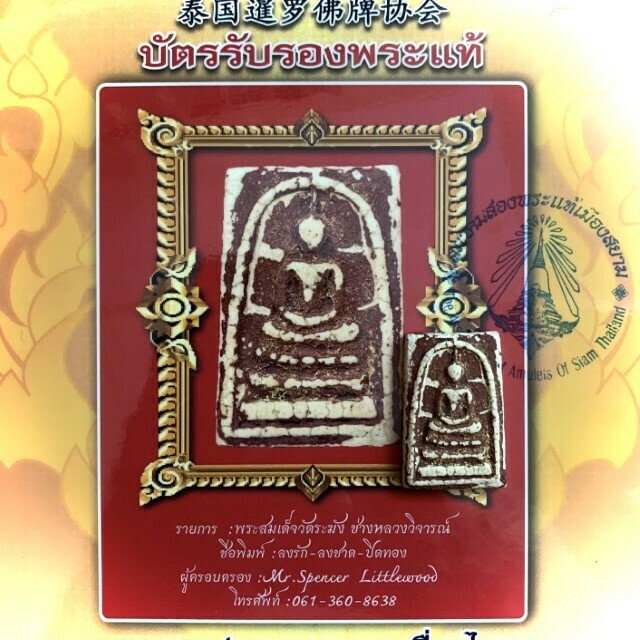
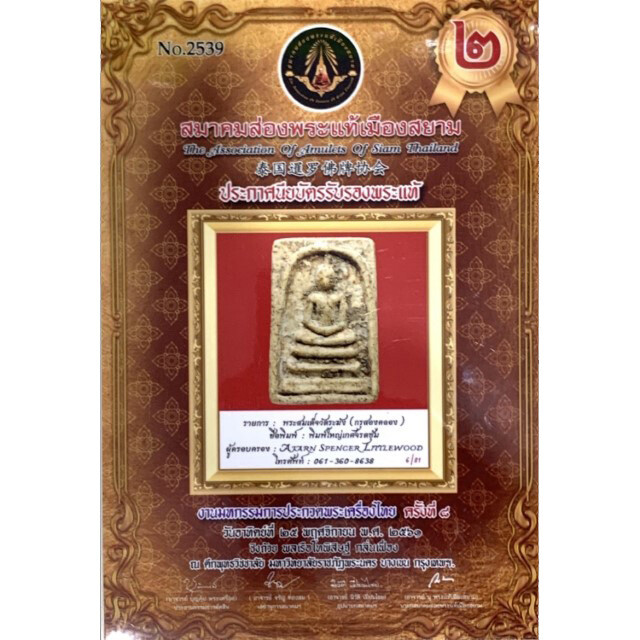
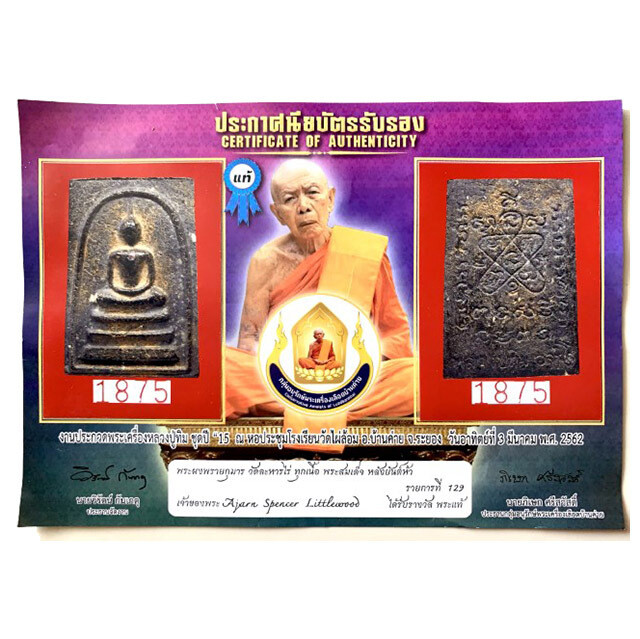
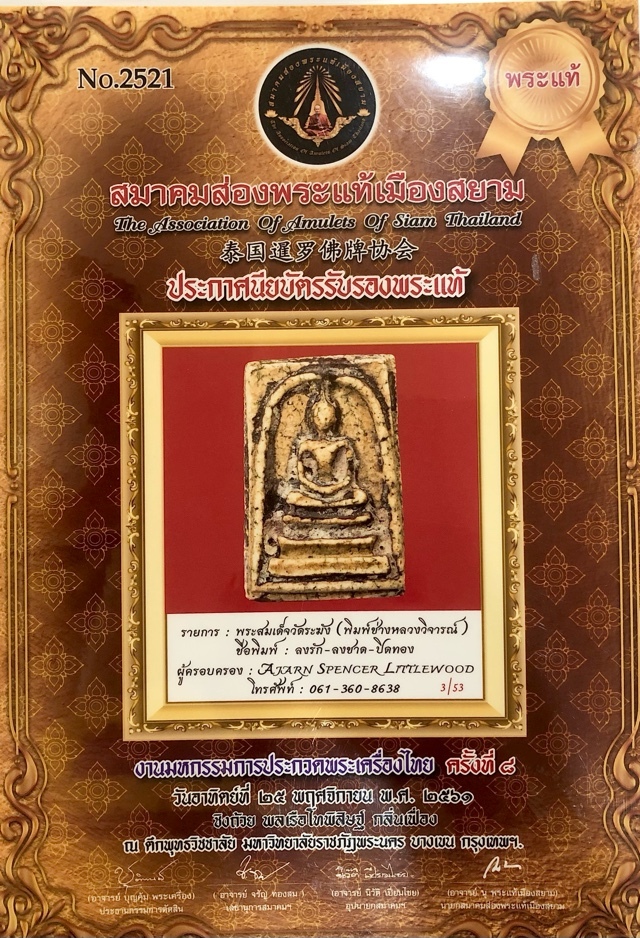
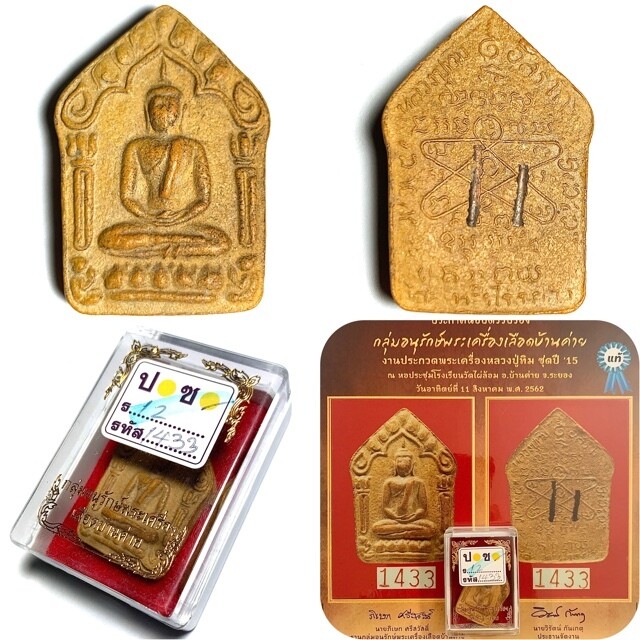
The Pra Somdej Wat rakang Comes with A4 Size Plasticized Authenticity Certificate issued by the Association of Amulets of Siam Thailand, and comes with Free Express shipping, and Free Solid Silver Casing Included in the price. Please choose the free silver casing option to take advantage of this free offer. Free express registered shipping is worldwide and included automatically.
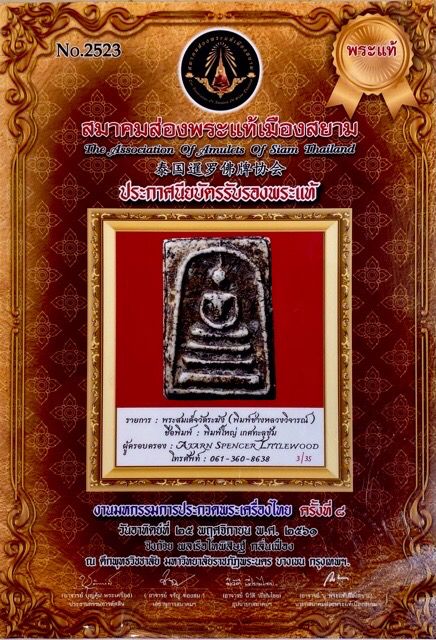
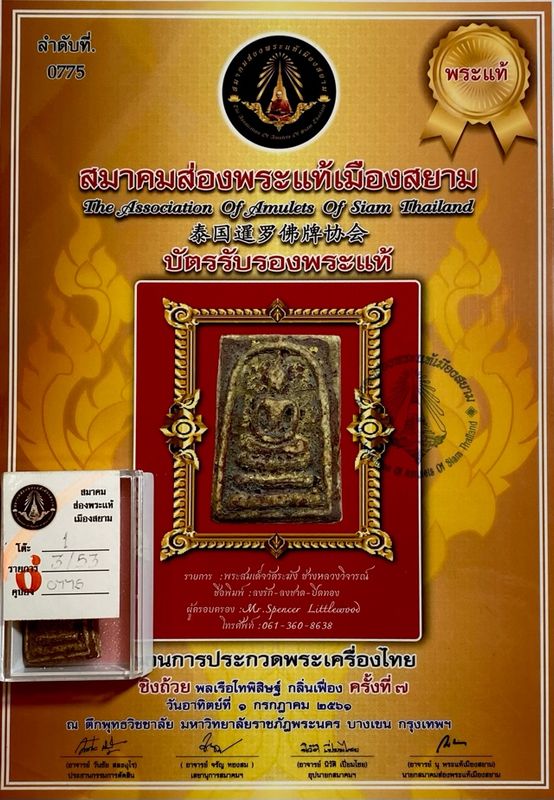
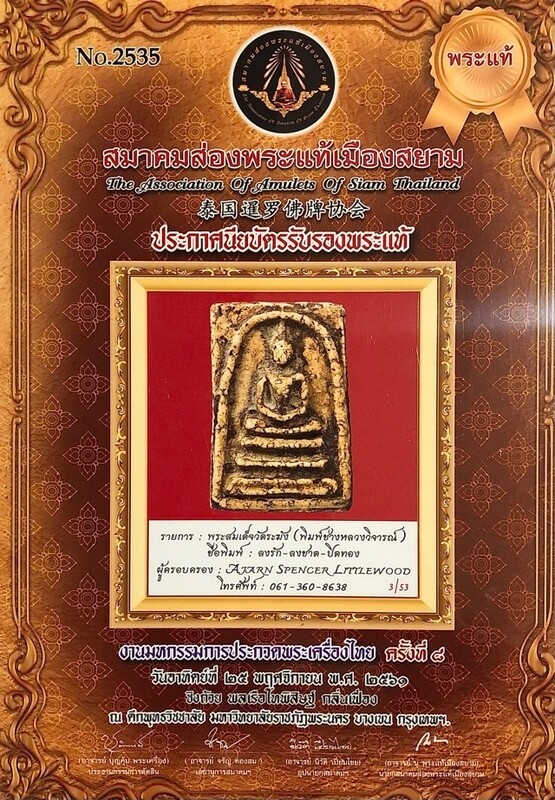
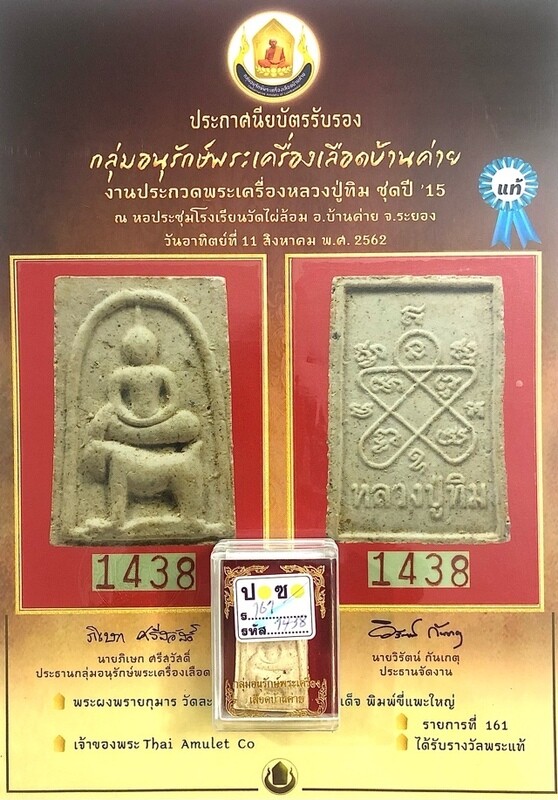
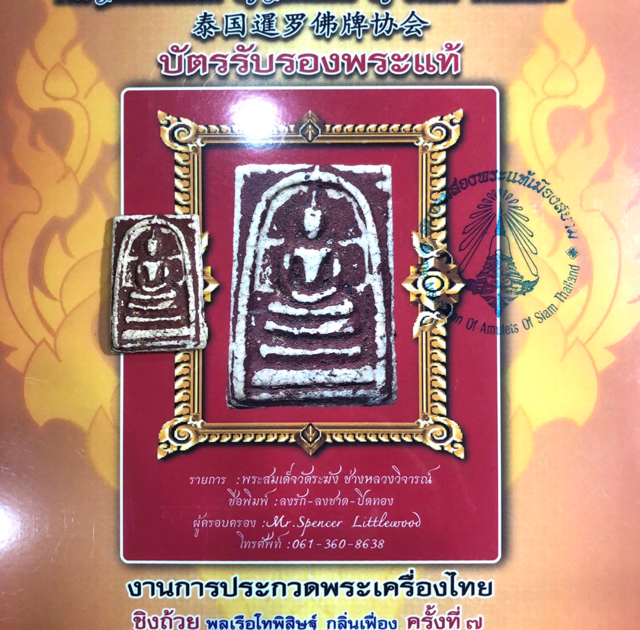
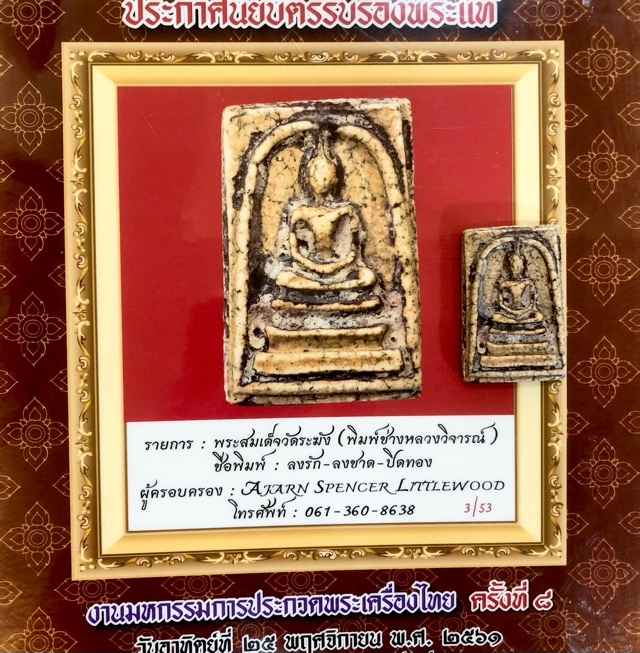
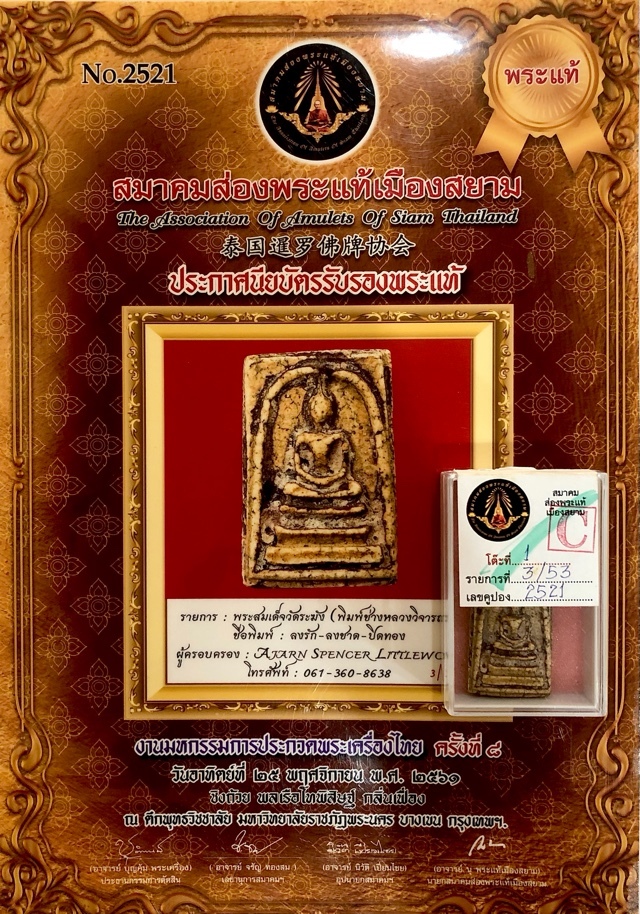
Below, A4 sized certificate of authenticity of this Pra Somdej Wat Rakang Long Rak Chart Pim Gaes Talu Sum Block Chang Luang Wijarn, The Artisan Chang Luang Wijarn was the Kroo Ba Ajarn (teacher) of all the other artisans of the Chang Sip Moo artisans, including the great Chang Luang Sittigarn and Chang Luang Wijit.
Below, is an 11 minute long video with full views and 12 x Macro closeups of the Muan Sarn Powders, wth Narrative from Ajarn Spencer Littlewood to enlighten the student on the various aspects of authenticity of a different exhibit which was also a lacquered version, and displays similar characteristics to this exhibit, with highly informative narrative by Ajarn Spencer, explaining various aspects of the studt, perusal and inspection of this tyupe of amulet, and some revelatory information about the amulet itself and the history of its making, and the Sacred Muan Sarn Content. This helps the student to understand and increase their expertise in recognising authentic Pra Somdej Wat Rakang Kositaram amulets of this model and type.
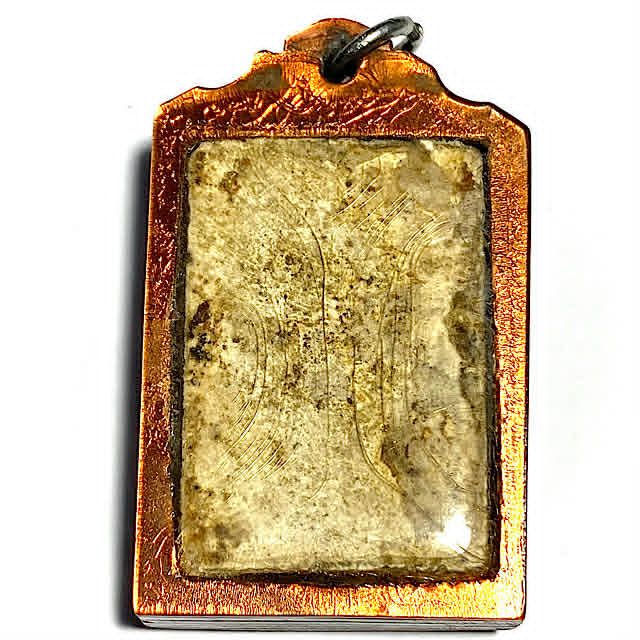
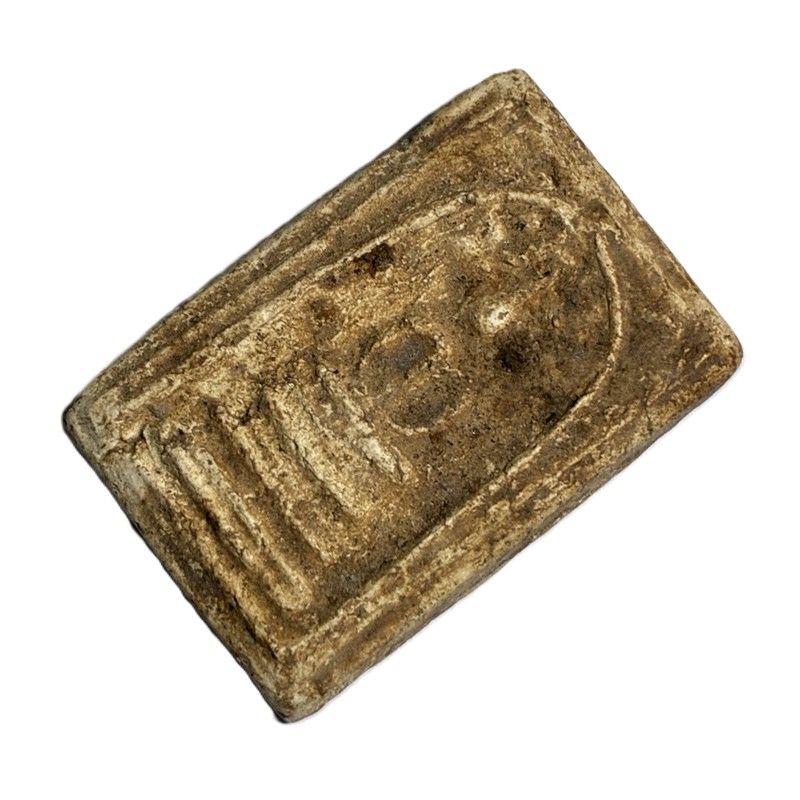
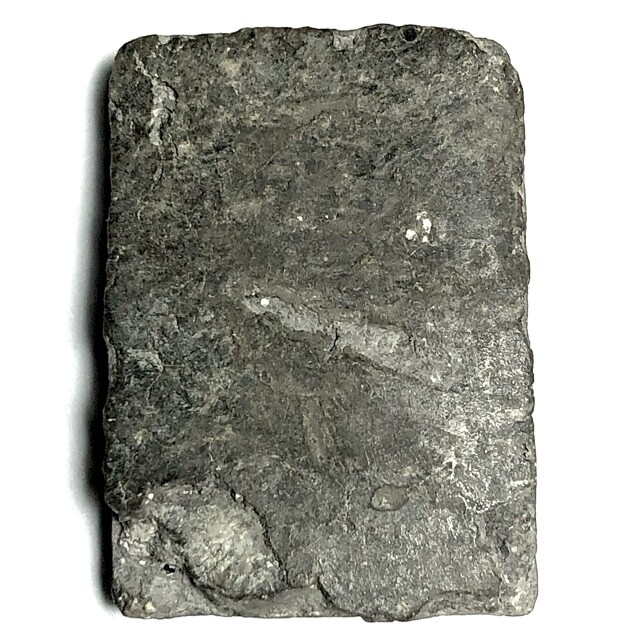
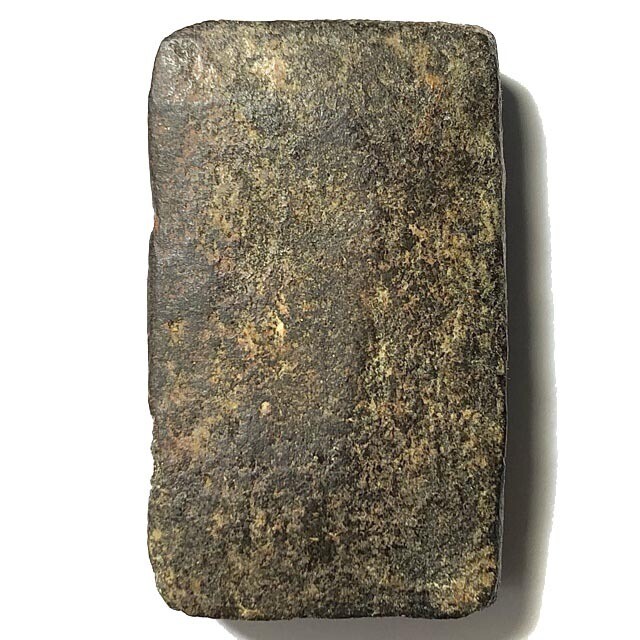
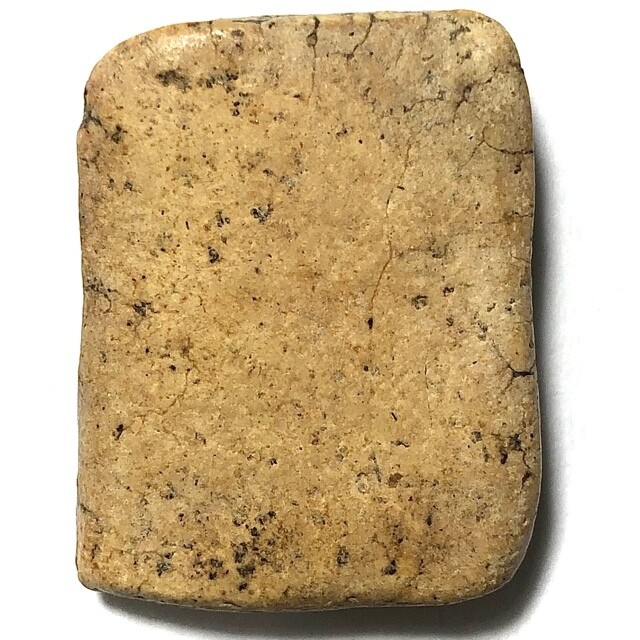
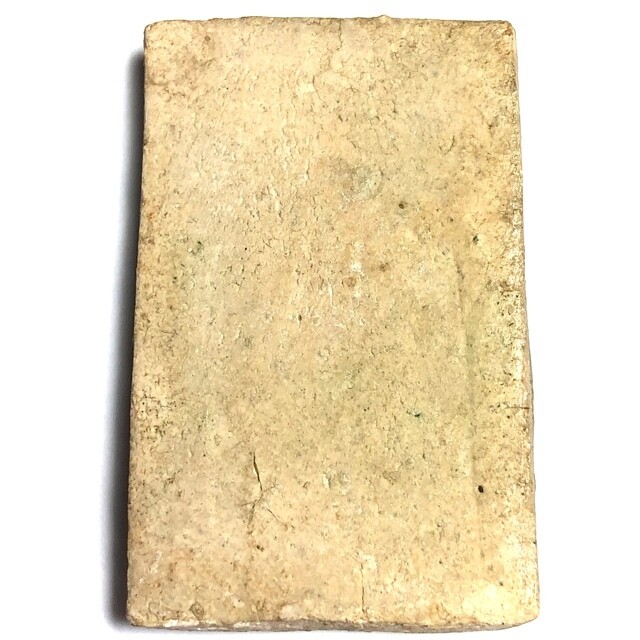
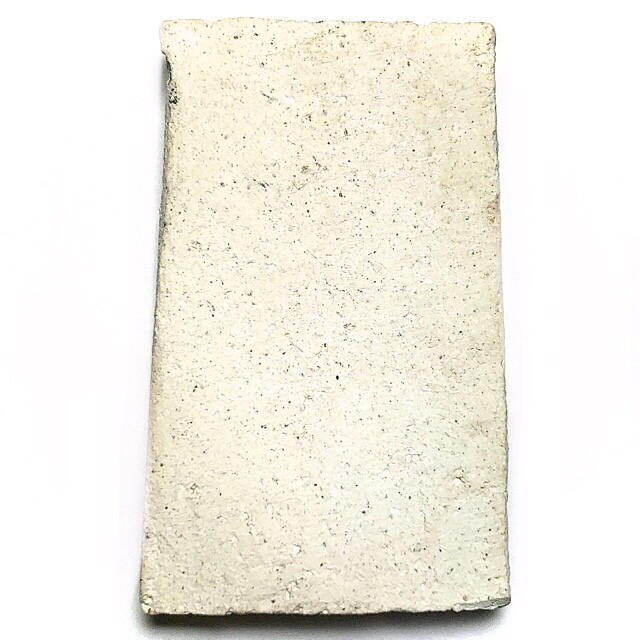
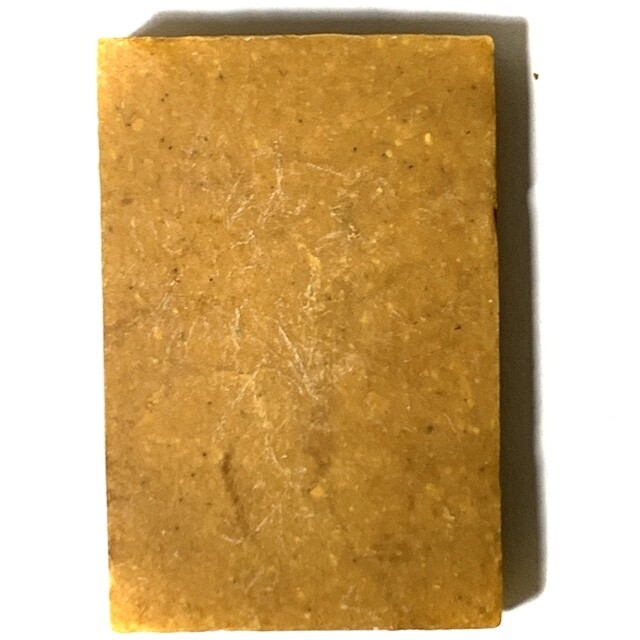
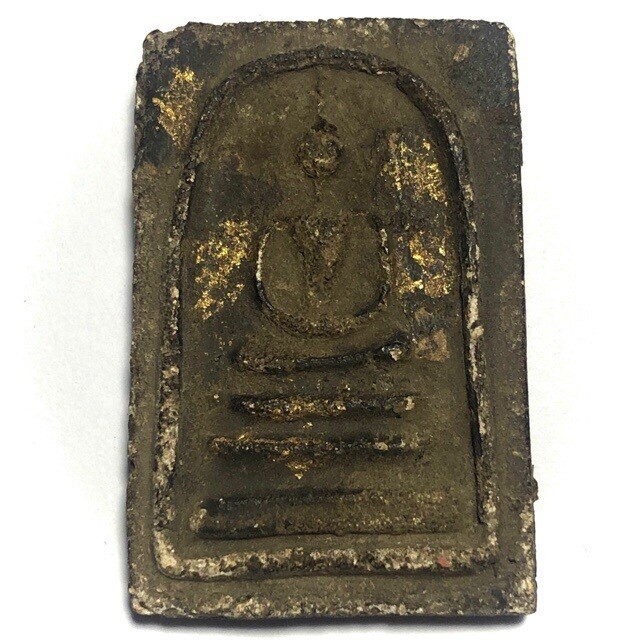
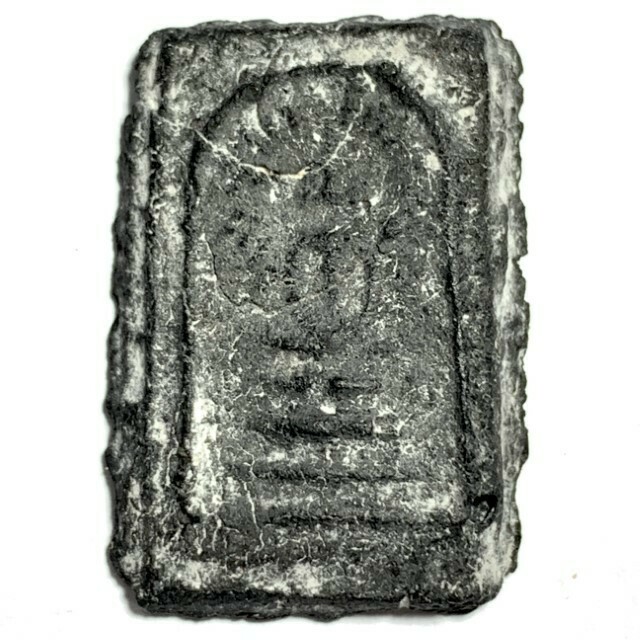
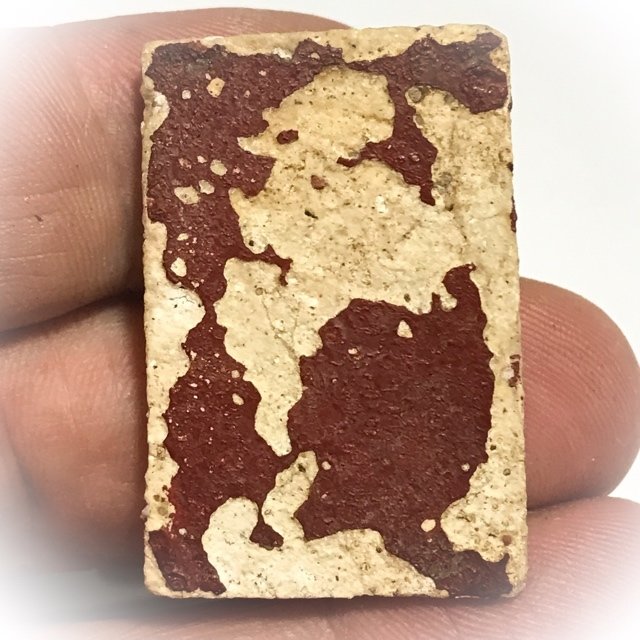
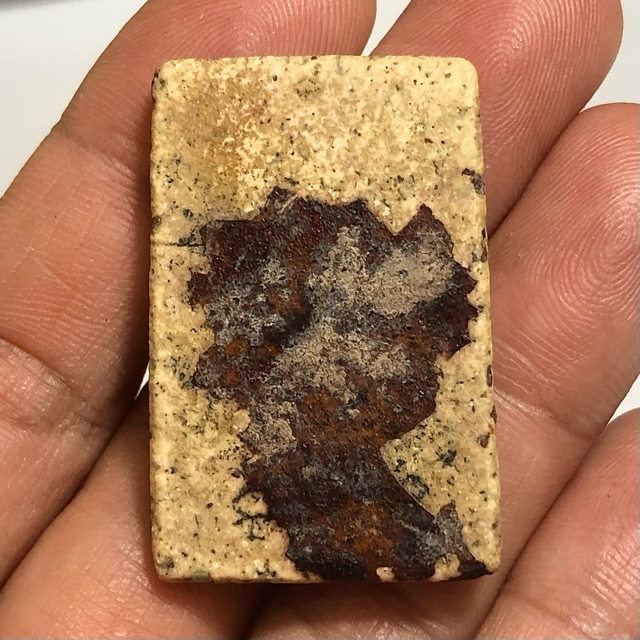
A truly ancient amulet made Circa 2390 – 2396 BE. The rear face of this exhibit is inimitable and has immensely beautiful markings, of a classic Pra Somdej Wat Rakang. Various exhibits display different textrures on the rear faces, for they were laid on various surfaces to sun dry, ranging from marble stone, wood, metal, and other surfaces, resulting in textures ranging from stone-like fossilized effect, granular, crackled, to the fine scratches on the rear face of some, which come from laying them to dry on mai gradan wooden boards.
In truth, no two Pra Somdej Wat Rakang are the same, and each amulet has its own individual character, which is of course one of the many aspects which form part of what makes the Pra Somdej Wat Rakang the title holder of the ‘King of Thai Amulets‘.
The amulet comes with the A4 size certificate of authenticity as a Pra Somdej Wat Rakang Long Rak Pid Tong of Somdej Pra Puttajarn (Dto) Prohmrangsri, with definition of the preferred artisan as authentic issued from the Pra Tae Mueang Siam Amulet Association.
An Immortal Classic and one of the most famous Thai Buddhist Amulets of all time, as well as being amongst the top preferred amulets of the serious devotee and wealthy collector of the accepted amulets of Somdej Pra Puttajarn (Dto) Prohmrangsri, of Wat Rakang Kositaram, whose Pra Somdej are the number one amulets of all time, be they from Wat Rakang, Wat Bang Khun Prohm,or Wat Gaes Chaiyo.
Made almost 2 centuries ago, the Pra Somdej Wat Rakang can be considered the number one amulet of all time in Thailand for its historical fame and legendary, and thae reputation of its maker to be the number 1 in all Thai History for Pra Somdej Amulets.
The Pra Somdej Amulets of Somdej Dto, are officially recognized as coming from one (or all) of four Royal temples Classed as three, because Wat Bang Khun Prohm Nai and Wat Intra Wiharn Bang Khun Prohm, are both located within the same temple boundary). Namely; Wat Intra Wiharn (Bang Khun Prohm Nai), Wat Gaes Chaiyo, Wat Mai Bang Khun Prom, and of course last but not least, Wat Rakang Kositaram. Most of these amulets are given a Puttapisek blessing ceremony in the temple where they were made, but then travel to at least two or three of the other temples to be laid under the ‘Pra Pratan’ (main Buddha statue in the shrine), and absorb the prayers of the Sangha (Monks), for further sacredness and power.
The Pra Somdej amulet, is one of the ‘Benja Pakee’ official set of five national amulets of Thailand seen as the most sacred, desirable and representative of every region of Thailand. In recent decades various Kru hiding place finds have been discovered in temples where Somdej Dto built statues and traveled, such as the Kru Wat Kanlayanamit, and Kru Wat Sadter finds.
This amulet comes with its certificate of authenticity in form of a A4 sized plastified certificate photo of the Chomrom Pra Tae Mueang Siam Amulet Appreciation society of Siam Thailand, and complimentary box with authenticity confirmation sticker. We offer free Solid Silver, Stainless Steel, or Waterproof Casing with this amulet (or gold at extra price), whichever you prefer. Free Express Shipping is also included in the price
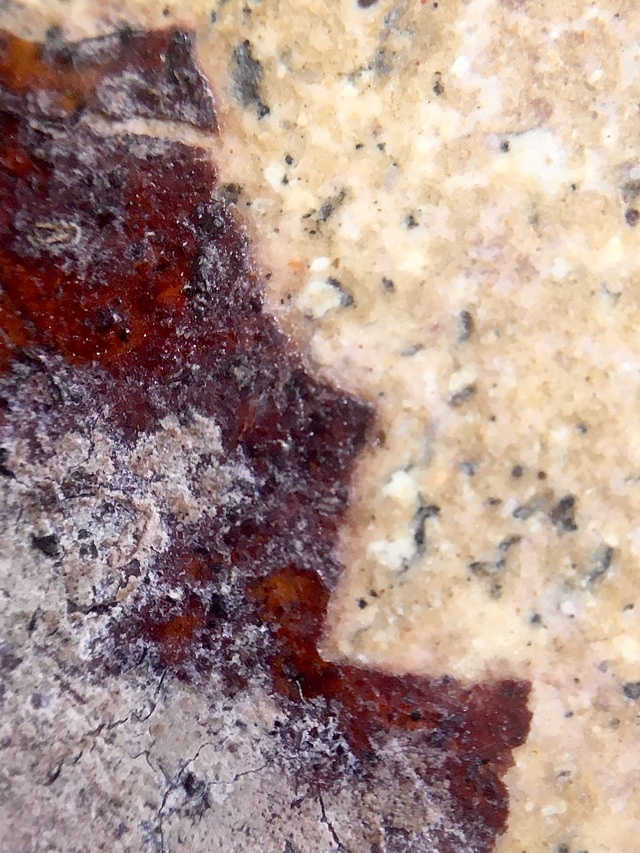
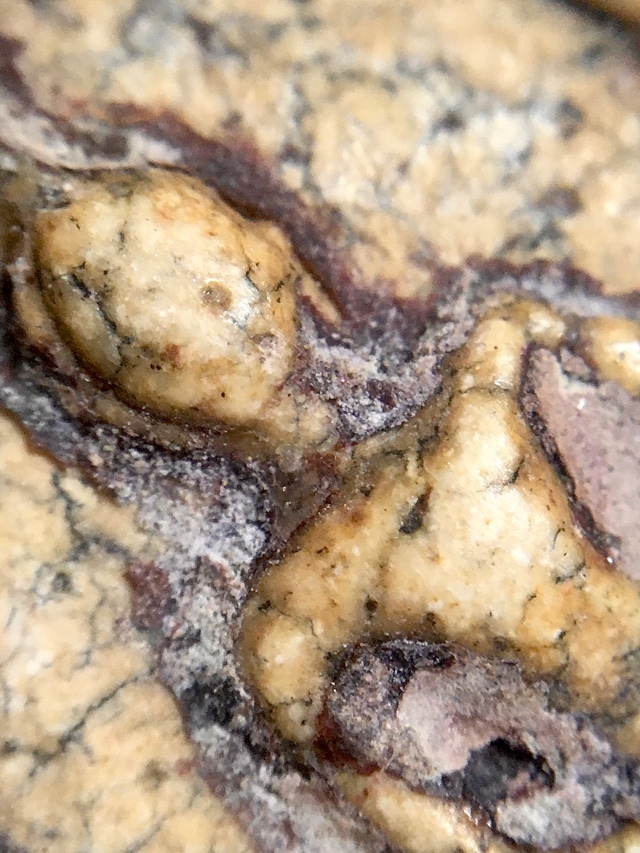
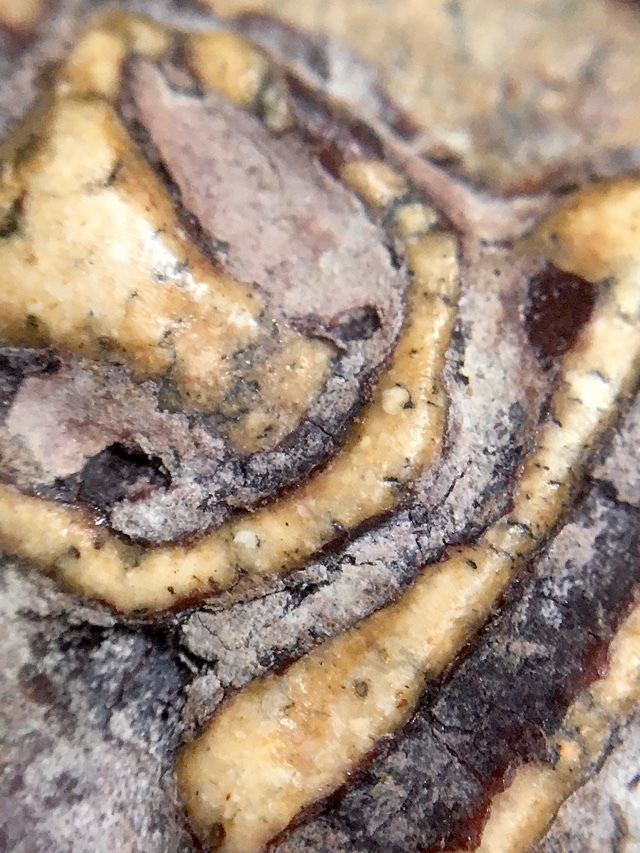
The rear face shows the presence of all the classic features and muan sarn ingredients of a true Pra Somdej Wat Rakang of Somdej Dto, with a beautiful lined pattern resulting from shrinkage and drying over almost two centuries of ageing, and which has added to the character and increases the ease of authentication. This kind of rear face pattern is highly preferred amongst aficionados and serious devotee-collectors, for its classic aged appearance.
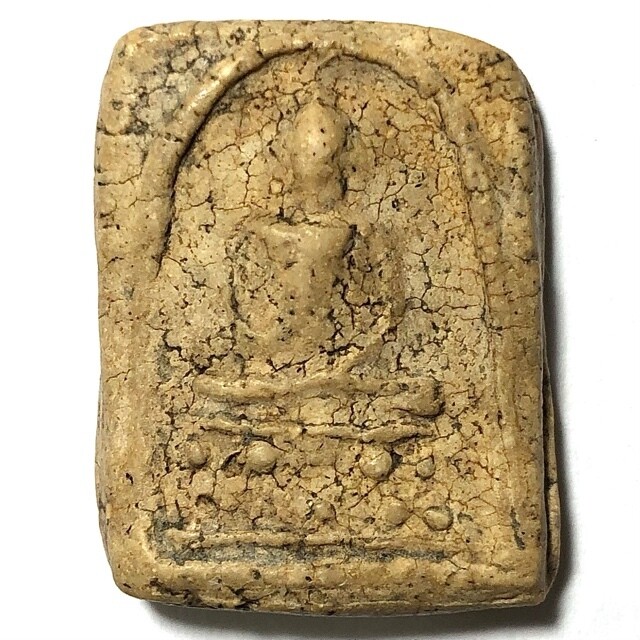
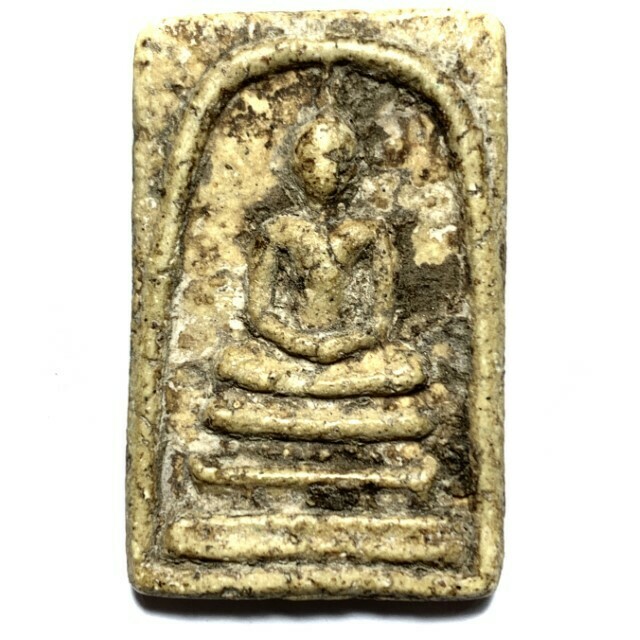
The contents of the Muan Sarn Sacred Clay reveal the necessary aspects and content expected from an authentic Pra Somdej Wat Rakang. The design of the front face is exquisite, as were all the block presses carved for Somdej Dto by the artisan Luang Wijarn, one of the royal artisans of the Chang Sip Moo group of artisans.
Pra Somdej Wat Rakang is one of the classic Pra Somdej amulets of Somdej Dto available, along with Pra Somdej Wat Gaes Chaiyo, and the Pra Somdej Wat Bang Khun Prohm amulet as far as popularity, beauty, sacredness of Puttapisek ceremony and price range.
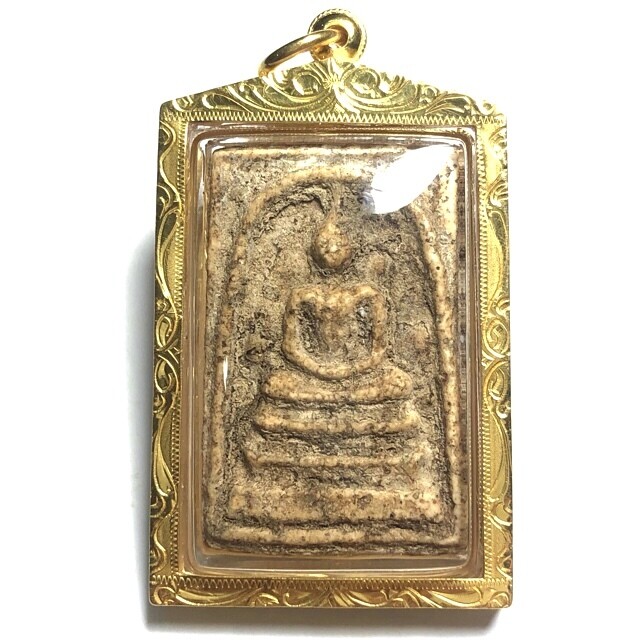
The Pra Somdej Wat Rakang amulet is the Keystone and Master amulet (Ongk Kroo) for all other Pra Somdej amulets. It is an image in the likeness of the Buddha sitting on a Dais, which was essentially created by Somdej Pra Puttajarn (Dto) Prohmrangsri, of Wat Rakang Kositaram. There are various different ‘Pim’ (models) with varying design features.
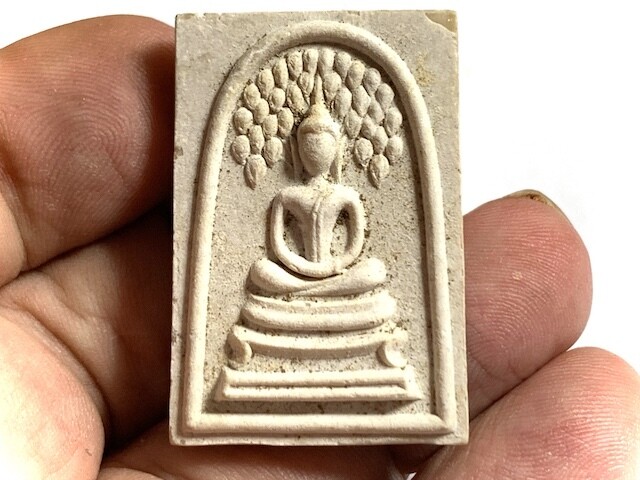
The Pra Somdej Wat Rakang, are considered to have extremely powerful Buddha magic in them due to the richness of sacred powders and powerful blessings contained within from great master Somdej Dto. Its general appearance is that of an oblong about 2.4 cm wide up to 4 cm high (varies between these sizes), made from white sacred powders mixed together.
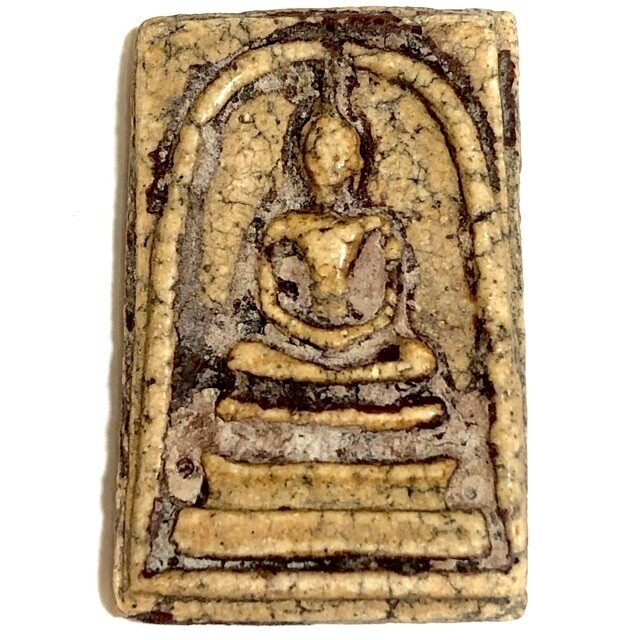
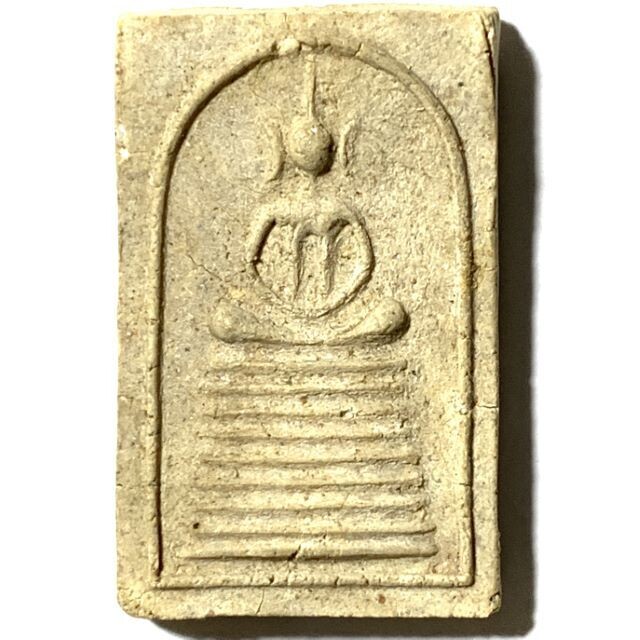
The Pra Somdej Wat Rakang Kositaram Pim Gaes Talu Sum is Similar to the Pra Somdej Pim Pra Pratan, but has the ‘Pra Gaes’ Topknot piercing the arch at the top of the amulet. The Pim Jarod Sum touches the arch or approaches it.
The main Ingredients of the amulets (Muan Sarn Samkan) were made from a base of sea shells, dried rice left from alms round, the five sacred magic powders of Somdej Dto, and ‘Nam Man Dtang Iw’ (special oil for mixing). Nam Man Dtang Iw, or Tung Oil in English, is a preferred oil for mixing and curing amulets with, for it is superior to any other oil as far as water resistance is concerned (one reason why Pra Somdej amulets can be soaked in water without going soft). The oil is much more resistant to mold than its derivatives, such as linseed oil.
The Dtamra must be made by creating exactly 84,000 amulets, equal to the number of Suttas of the Tripitaka. There are different Pim Song (shapes and sizes) of Pra Somdej Wat Rakang, but those which are officially recognized and listed by the ‘wongarn Pra Krueang’ as far as Somdej Wat Rakang amulets are concerned, basically consist of the following officially recognised Pim of Pra Somdej amulets; Pim Pra Pratan, Pim Yai Niyom, Pim Chedi, Pim Prok Po, Pim Gaes Bua Dtum, Pim Gaes Talu Sum, and Pim Thaan Saem.
Somdej Wat Rakang amulets have various surface textures, categorized as ‘Nuea Laiad’ (fine texture cement mixture), ‘Nuea Hyaab” (rough textured cement mixture), ‘Nuea Gae Nam Man Dtang Iw’ (old looking textured cement mixture), otherwise known as ‘Nuea Sangkhayaa’, and ‘Nuea Gae Bpoon’ (old cement mixture).The basic structure of the design of the classic Somdej, (and almost all Somdej amulets from other temples too), is that of the Lord Buddha sitting inside a Bell (the word ‘Rakang’ means ‘Bell’ – ‘Wat Rakang’ means ‘Temple of the Bell’).
This is the primary importance of the Somdej amulet in the sense that Somdej from most temples depict the Buddha sitting within a bell which is represented by the arch. The arched structure in amulets is called a ‘Sum’. Although these rules do not necessarily always apply (there are a lot of Somdej which are in circulation which are most certainly authentic, but which are not preferred in the collector scene)
There are many less preferred editions which do not fulfill these standard rules of recognition, which is of course one of the reasons why some Somdej Wat Rakang amulets are able to sell for high prices and enter competition, get certificated etc, and why some are not, despite their most probable authenticity.
The difference in the various mixtures made for each ‘Pim’ have led to differing textures and appearances in the Pra Somdej collections, which provides for a varied and fascinating niche interest, which one can verily spend a whole lifetime studying and accumulating experience and knowledge about this, the King of all amulets.
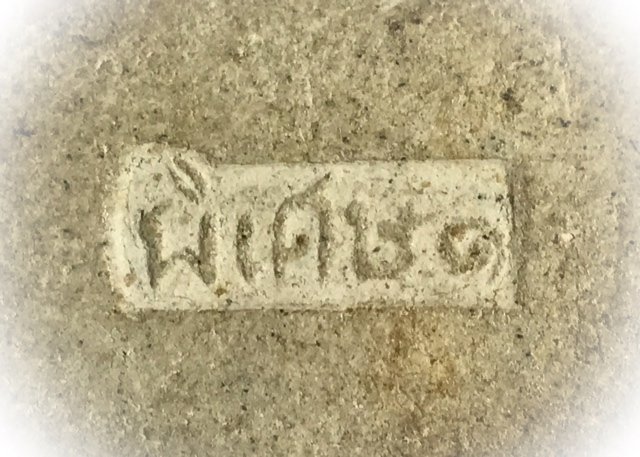
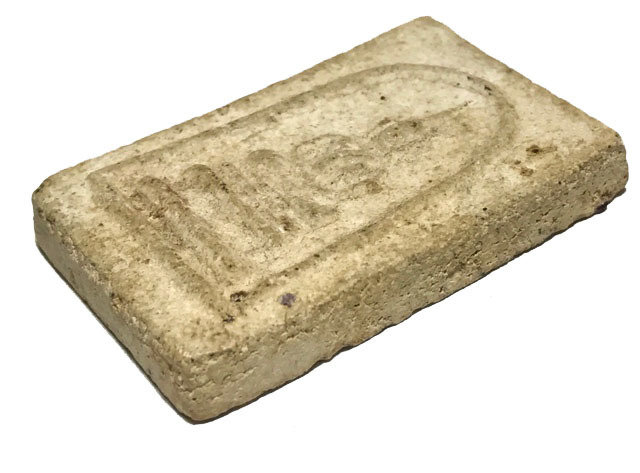
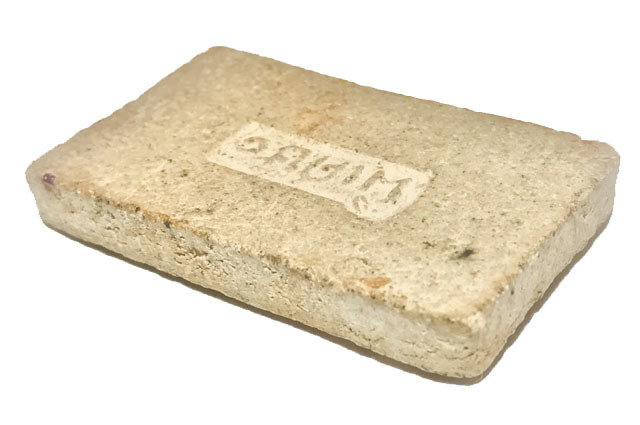
Pra Somdej Pim Yai Pised (large special version) in Nuea Pong Wised concentrated Puttakun Powders, from the ex Abbot of Wat Sutat Jao Khun Sangiam, released in the Year 2516, with extra special blessing and empowerment from the great Luang Phu To of Wat Pradoo Chimplee.
It is said that the amulets were made from Muan Sarn Sacred Powders collected by Pra Ajarn Sangiam, Somdej Pra Sangkarach (Pae), Tan Jao Khun Tip Gosa, and Jao Khun Sonti (Wat Sutat). The powders were blessed in multiple cer
emonies, including the presence of Luang Phu To, and Luang Por Nueang, of Wat Jula Mani, as well as many other Great Master Monks of that Era.
Pra Ajarn Sangiam then took these Muan Sarn Sacred Powders to make this edition of amulets, and mixed them with Old broken Pra Somdej Wat Bang Khun Prohm, and broken powders of Pra Kru Wat Sam Plerm.
The amulets were pressed with the block press molds at Wat Sutat, and Pra Ajarn Jao Khun Sangiam then blessed the amulets in solo nightly empowerment for a long time until the year 2516 BE, when he invited 49 Monks to come and assist in the Buddha Abhiseka Blessing Ceremony at Wat Sutat.
Amongst the many Masters present were; Luang Phu To (Wat Pradoo Chimplee), Luang Por Pae (Wat Pikul Tong (Singhburi), Luang Por Nueang (Wat Jula Mani) Luang Por Tiam (Wat Kasatrirach), Luang Por Horm (Wat Sak Hmak), Luang Por Thin (Wat Pha Lelai), and Luang Por Tong Yoo (Wat Nong Mai Pa-Ong.
The rear face of the amulet has the Khom letters ‘Sa’ and ‘Ta’ (for ‘Wat Sutat) embossed, which is a standard feature seen on the rear face of many amulets from Wat Sutat (but not all).
Use the Traditional Thai Buddhist Method for Bucha;
1. Chant Maha Namasakara (3 Times)
2. Chant the Trai Soranakom (3 Times)
3. Chant Kata Aaraatanaa Pra Krueang (3 Times)
Kata Maha Namasakara
Namo Dtat-Sa Pakawa-Dto Araha-Dto Sam-Maa Sam-Put-Dtat-Sa
Namo Dtat-Sa Pakawa-Dto Araha-Dto Sam-Maa Sam-Put-Dtat-Sa
Namo Dtat-Sa Pakawa-Dto Araha-Dto Sam-Maa Sam-Put-Dtat-Sa
Kata Aaraatana Pra Krueang
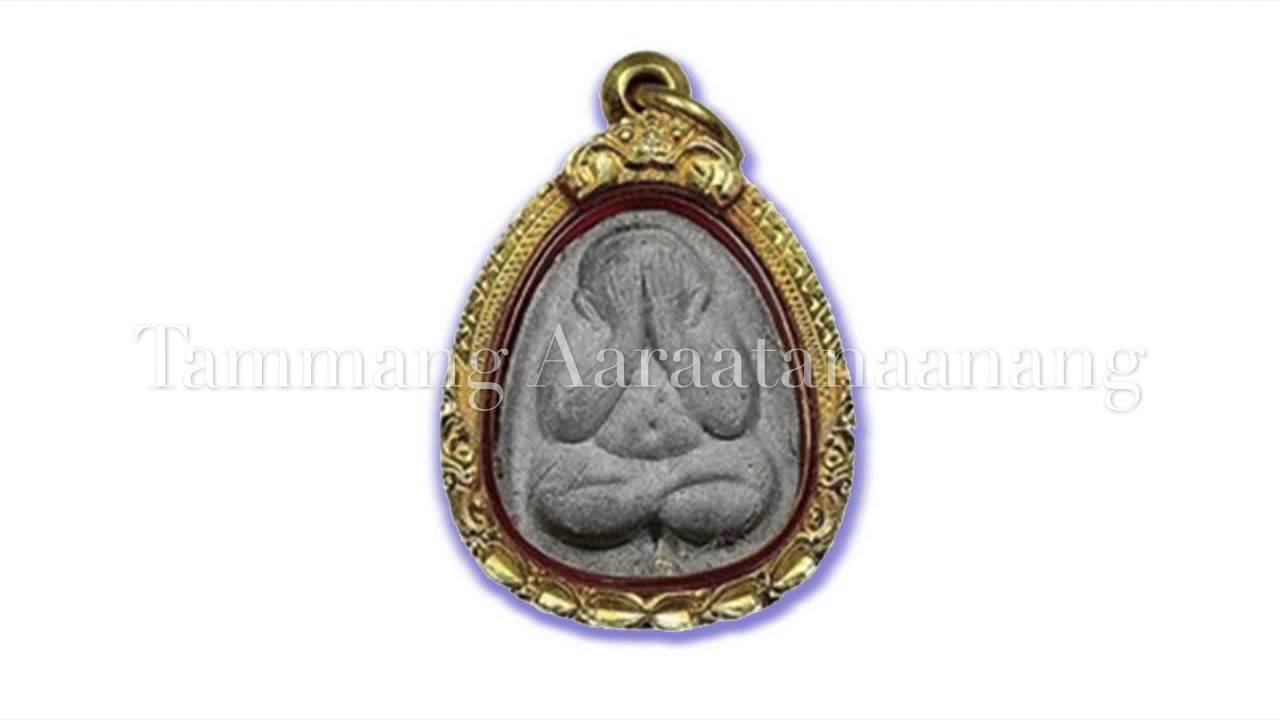
Puttang Aaraatanaanang
Tammang Aaraatanaanang
Sangkang Aaraatanaanang
Puttang Prasittimae
Tammang Prasittimae
Sangkang Prasittimae
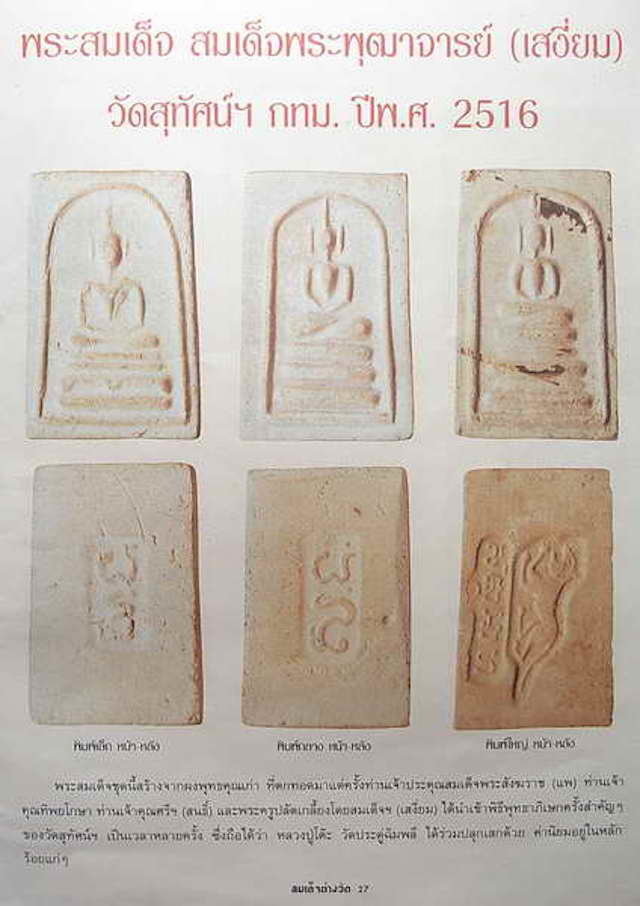
Below; Amulet Publication showing three different models of Pra Somdej released by Kao Khun Sangiam in the 2516 BE Ceremony.
Somdej Kha Dto Fang Takrut Ngern Ongk Kroo Jumbo size model early era amulet, by Luang Por Seng Jantasaro – Wat Bang Na (Pathum Thani), with triple Takrut magic spells inserted into the base. One of various models of Luang Por Seng’s amulets made, in this rare early edition series amulet. This model is the Pra Somdej Pim Kha Dto Hlang Yant Glom Votive Tablet, with sacred Yantra spell on rear face. Released in different design models (Pim, such as the Pim Kha Dto, and Pim Pra Pratan) and sizes, such as Pim Yai, Lek, and Jumbo. The amulets were released after Buddha Abhiseka Empowerment Ceremony, in the year 2512 BE. A very rare early era amulet, and attractive model, for devotees of the amulets of the Great Luang Por Seng.
Pra Somdej Kha Dto LP Seng Wat Bang Na Detail 1
This exhibit is ‘Nuea Graeng’ (hardened dry surface clay), and possesses great beauty within the features of the Muan Sarn Sacred Powder Clay Admixture, revealing immense character, and detailed relief in the details of the design of the Buddha and Dais. The ageing characteristics of this incredibly beautiful amulet, are easily recognizable, as is the authenticity of the drying and contraction of the Sacred clay over the many decades of time. The rear face has the Sacrted Yant Glom of LP Seng, with the Khom Agkhara Letters
Pra Somdej Kha Dto LP Seng Wat Bang Na Detail 2
Free Registered Air Parcel Worldwide Shipping is Included with this Amulet
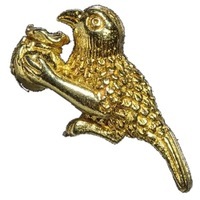
Below; A Solid Silver Takrut Nok Sariga is inserted into the base of the Pra Somdej), increasing Metta Maha Niyom great preference mercy charm, Maha Sanaeh power of attraction, Kaa Khaay selling power, and Maha Lap lucky fortunes. This model being Pim Jumbo is hence, an ‘Ongk Kroo’ Masterpiece model, with solid silver Takrut with the Sariga Mercy Charm Invocation inserted into the base. The Nok Sariga ‘Celestial Magpie’ spell, is perhaps one of the most famous and preferred animist deity spells of the Metta Maha Niyom Mercy Charm Wicha, within the Thai Buddhist amulet pantheon.
Pra Somdej Kha Dto LP Seng Wat Bang Na Detail 4
About the Sarika/Salika spell;
The Nok Sariga (or, ‘Salika’) is a Golden Tongued Heavenly Bird which is attributed with immense Metta Mahaniyom and Maha Sanaeh qualities, and is along with the Hongsa Bird, one of the Best Devas to seek assistance in ‘Jerajaa’ magic. Jerajaa means ‘Discussion’. The Golden Tongued Sariga bird enchants and charms the listeners of he who possesses the Wicha, bringing a hypnotic and charming effect, to influence and convince, making people see things your way.
Pra Somdej Kha Dto LP Seng Wat Bang Na Detail 5
The amulet is made from Nuea Pong Puttakun, with Pong Ittijae, and Pong Wan magical herbal powders. Blessed in special ceremony by the Great Luang Por Seng, at Wat Bang Na, the amulet features a Buddha Image seated upon a 3 tiered dais, above a decorative dais, with ‘Kha Dto’ (table legs) style, also sometimes called ‘Thaan Singh’, and ‘Thaan Kha Dto’, depending on the devotee. The rear face has a round Sacred Yantra embossed upon the surface, with four Sacred Khom Agkhara letters. Luang Phu Seng Jantarangsri, or lovingly known as ‘Taep Jao Chaw Raman’ (The Raman Mong Tribe Angel and Lord), of Wat Bang Na, in Amper Sam Koke in Patum Thani, was one of the Great Thai Buddhist Master Monks of the the late 24th and early 25th Century BE.
Pra Somdej Kha Dto LP Seng Wat Bang Na Detail 6
The temple of Wat Bang Na, was always a large and popular temple in Patum Thani, for there were many people whose children ordained there, and the families would visit to pay reverence and offerings almost every day. Many monks would school there, and the temple was popular for local folk from near and far to come and make merits there. But it was only when the Great Luang Por Seng arrived, that amulets were made at Wat Bang Na.
Wat Bang Na Temple Pathum Thani
Before Luang Por Seng, no monk had previously made an edition of amulets. This means then, that Luang Por Seng was the Master responsible for the act of ‘Berk Dtamra’; the Opening and Beginning of a Temple Master Lineage in amulet creation and empowerment. So began the Dtamra Pra Krueang (Amulet Legend/History) of Wat Bang Na, and became immortally embedded into Thai amulet history forever.
Pra Somdej Kha Dto LP Seng Wat Bang Na Detail 8
Luang Phu Seng was also the first ever Monk of Wat Bang Na to receive Honorary status awarded from the Royal State Sangha Commission, Luang Por Seng was born in 2444 BE in the nearby vicinity of the temple of Wat Bang Na, and grew up near the temple. He never really told anybody more details than his year of birth, so this is about all that is recorded of his birth. It is also known that he was the only surviving child of a total of 7 siblings, who all died early age.
Pra Somdej Kha Dto LP Seng Wat Bang Na Detail 9
In those days, most people of the area of Wat Bang Na were farmers, many of the Raman Mong people who had come down the Mekhong from the Border Mountains. Many would farm the fields or make bricks, or would farm sugar beets. As to Luang Por Seng’s father, who was also a Raman (Mong Hilltribe) named Ju, who had come down the Mekhong in a boat, he was the owner of a small groceries and sundries shop. His Mother was also a Raman who went by the name of Khem.
Luang Por Seng was ordained in the year 2465 BE with Por Kroo Nantamunii of Wat Bang Luang, as his Upachaya Ordaining Officer. Luang Phu Tian, of Wat Bote, was his Pra Gamma Waajaajaarn, and Luang Phu Tat Sahulo, who was also Luang Por Seng’s Uncle, and the Abbot of Wat Bang Na, as his Pra Anusawanaajaarn witness.
Pra Somdej Kha Dto LP Seng Wat Bang Na Detail 11
Luang Por Seng mastered both the Raman language, and the Khom Pali Sanskrit Agkhara texts, and Wicha Akom (Sorcery). Luang Por would absorb as many Wicha from as many Masters as possible, and became extremely well versed in Sorcery and Khom Pali over the years, until, in the year 2486 BE, the Abbot of Wat Bang Na passed away (Marana Bhava), and Luang Por Seng was elected to become the new Abbot. He was Inaugurated as Abbot in 2487 BE by the Temple Comittee. Luang Phu Seng then conducted his duties extremely well and gave very many great Dhamma Sermons and performed great works.
Then in the year 2489, the State Sangha Comission of Thailand elected him unofficially to the status of Abbot with all full regalia and honors. Luang Por Seng was then empowered to perform the great work of finishing the Uposadha Shrine Room building begun by his predecessor Luang Phu Tat, and developed the temple in many ways. Each year, Luang Phu Seng would adhere to the practice of spending some time performing Boriwasagam (Tudong Forest Wandering). In these times and when he was not busy with the worldly facets of temple administration, he would practice kata Akom and Sorcery Spells using his Prakam rosary to count out formulas and memorize them. He became extremely proficient over the decades with repertoire of Magical incantations.
Pra Somdej Kha Dto LP Seng Wat Bang Na Detail 13
Luang Por Seng was a meek and humble monk who did not speak much at all, and would remain in stillness and silence most of the time. He performed diligent work for the temple and practiced his own Magic during Tudong forest wandering, until at the age of 65, Luang Por Seng produced the first ever edition of amulets at Wat Bang Na. The first edition was released in 2510 BE, and was the Pra Somdej Sam Chan Buddha on a 3 tiered dais in sacred powders. Later the very same year, his first edition Monk Coin amulet, the Rian Sema Kwam’ was also released, which is now a highly sought after edition, and is very rare to find.
Pra Somdej Kha Dto LP Seng Wat Bang Na Detail 14
After the first edition in 2510 BE, Luang Phu Seng would release amulets every year without fail, right up to his passing in the year 2530 BE
The first edition Pra Somdej featured a Buddha on a 3 tiered dais, with the words ‘Pra Kroo Seng’. There were 2 versions; some models had ‘Pra Kroo Seng Jantarangsri’ embossed too. The words are embossed below the dais of the Buddha. Some of the amulets had the words embossed by the block press of the amulets, some were inscribed by the hand of Luang Por Seng by hand (Very Rare).
Pra Somdej Kha Dto LP Seng Wat Bang Na Detail 15
Luang Phu made the first edition Somdej amulets in five different colored powders; Black, Red, Green, Yellow, and White. It is said that many of the 1st edition Pra Somdej he made, have a secret Takrut Nok Sariga inside them, inserted within the amulet, as seen more visibly in subsequent editions, such as this 2512 BE series Ongk Kroo Model.
Pra Somdej Kha Dto LP Seng Wat Bang Na Detail 16
Once he had pressed the amulets and all were ready, he would then perform empowerments, and hand the amulets out distributing them to the local devotees. Many devotees wore his amulets and survived deadly accidents, and so his amulets became the talk of the folk, and they began to appear ever more rarely, as Devotees began to hunt and collect them for their own use and protection.
Pra Somdej Kha Dto LP Seng Wat Bang Na Detail 17
This began after the popularity of his first edition Pra Somdej due to the miraculous stories of survival, Luang Phu had to quickly make the second ever release of amulets, this time his first edition coin, the Rian Sema Kwam. The coin was made in three different sacred metals; Galai Tong, Galai Ngern, and Nuea Tong Daeng. The coin has a bust image of Luang Phu Seng, and the words ‘Ajarn Seng’ underneath the image on the lower part of the front face of the coin. The rear face had a Sacred Yant emblazoned on it, below which are the words ‘Wat Bang Na’, and the year of issue ‘2510’.
Pra Somdej Kha Dto LP Seng Wat Bang Na Detail 18
Up to the year 2512 BE, Luang Phu Seng performed empowerments of the amulets in solo in the Uposadha Shrine, except for the first edition coins he made, where he invited a number of monks from surrounding temples, to come and perform full Buddha Abhiseka blessing. As of 2512 BE, Luang Phu always performed full Putta Pisek (Buddha Abhiseka) ceremonies on all editions, with a full cast of Monks to perform the chanting of the Opening of the Eyes of the Buddha, making this edition the first to have multiple Master Monks empowering the amulets.
Pra Somdej Kha Dto LP Seng Wat Bang Na Detail 19
One of Luang Phu Seng’s most famous and preferred amulets, is the world famous Palad Khik Ling Jab Hlak, Vanora Monkey grabbing a phallus animist charm, and the Pra Somdej Khee Moo Buddha riding Wild Boar amulet, which was released in various years and editions/versions. The Khee Moo Pra Somdej amulets were always made with the assistance by the Devotees of Luang Phu Seng and given to him for empowerment, and is one of the most sought after of all his amulets by his extreme devotees. The Pra Somdej Khee Moo is also a preferred amulet of his Pantheon, with serious speculative amulet collectors and appreciation societies.
Devotees pay reverence to luang Phu Seng at Wat Bang Na
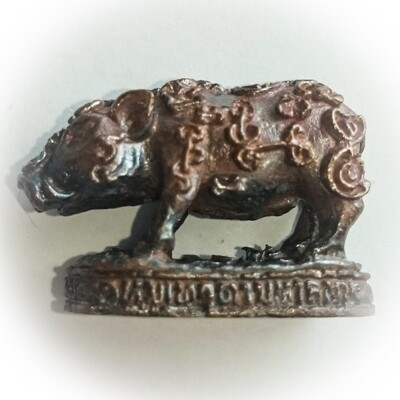
Another famous and highly sought after amulet of Luang Por Seng, is the Moo Tong Daeng Khiaw Dtan ‘Copper Pig with Solid Tusks’ Animist Charm Loi Ongk Statuette, made in 2521 BE, and released in 2522 BE. The legend of the Moo Tong Daeng Copper Pig with solid Tusks (not hollow – considered a Magical aspect of Kong Grapan Chadtri Magic), states that bullets shot from a gun cannot pierce the skin of a Moo Tong Daeng Khiaw Dtan. Luang Phu Seng then used this Dtamra Legend to inflect Kong Grapan Chadtri and Klaew Klaad into the amulets, and instill faith and peace of mind in their users.
picture of the Moo Tong Daeng Copper Pig amulet of Luang Phu Seng
Pra Somdej Kha Dto LP Seng Wat Bang Na Detail 22
As the Buddha Abhiseka for the Moo Tong Daeng Khiaw Dtan amulets was being performed, the Uposadha Shrine room was sealed off to the public as the monks performed their blessings and meditative empowerments. However, some devotees witnessed a sight; a Mirage of a load of boars and pigs, were seen running into the Uposadha during the ceremony. After the ceremony was over, one of the devotees entered the shrine room, and informed Luang Phu Seng of what had been witnessed. Luang Por Seng laughed, gave a smile but said nothing else.
Pra Somdej Kha Dto LP Seng Wat Bang Na Detail 24
After the release of the Moo Tong Daeng Khiaw Dtan amulets, they attained great popularity due to effective results with the Devotees. The amulets were made in Nuea Loha (sacred iron alloy), and was made in small and large sizes.
The left side of the body of the Boar has the words ‘Wat Bang Na Patum Thani 2521’ embossed, and the right side of the body of the boar has Khom Agkhara lettering embossed. The legs of the Boar have the four elements inscribed in Khom Sanskrit ‘Na Ma Pa Ta’.
Pra Somdej Kha Dto LP Seng Wat Bang Na Detail 26
In 2524, Luang Por Seng made for the first time the ‘Moo Tong Daeng Jet Hua’ – 7 Headed Boar – this was actually a Wicha Palad Khik, with 7 Palad extending out from the boars extremities; head, tail, feet (X4), sex organ. The end result was a Moo Tong Daeng Khiaw Dtan Solid Tusked Boar metallic statuette with penises on the ends of the legs, tail, head and sex organ (7 Palad Khik). Made from Nuea Tong Daeng Pasom Loha (Copper and Iron Alloy), the left side of the torso has the Year embossed (2524). Apart from this, Luang Phu Seng also released a Jumbo Size Bucha version (rare!)
Pra Somdej Kha Dto LP Seng Wat Bang Na Detail 28
The first edition of Moo Tong Daeng was made in a number of 2500 amulets only, making them very rare to find in the present day. They are known for powerful Klaew Klaad and Kaa Khaay Power. Lastly, one cannot speak of Luang Phu Seng without mentioning his famous Paya Krut Tong Daeng Garuda amulet. Perhaps the other most commonly seen amulet of Luang Phu Seng seen in High End Collector Club Magazines, is almost certainly the Paya Krut Garuda amulet.
Garuda amulet of LP Seng Wat Bang Na
The Paya Krut Garuda amulet of Luang Phu Seng, was blessed in Buddha Abhiseka with a further 10 Master Monks who Luang Phu Seng invited to assist in the empowerment. The Garudas were made in Nuea Tong Daeng sacred Copper Alchemical Alloy.
rear face Garuda amulet of LP Seng Wat Bang Na
The amulets were first released in 2522 BE. The rear face of Luang Phu Seng’s Paya Krut amulet has the words ‘Luang Phu Seng Wat Bang Na Patum Thani 2522’ engraved into the metal face, with Agkhara Khom Khmer Inscriptions interspersed. The amulet is now one of the most expensive and highly prized of all his pantheon of amulets.
The Paya Krut Tong Daeng had various miraculous news stories which made it popular as a Klaew Klaad and Kong Grapan Chadtri protective amulet, which has saved lives both on roads and on the ocean. The amulet is often seen in High End Collector Championships competing, and often winning not only in the Luang Phu Seng category, but also the Paya Krut category, and Loi Ongk category.
Pra Somdej Kha Dto LP Seng Wat Bang Na Detail 32
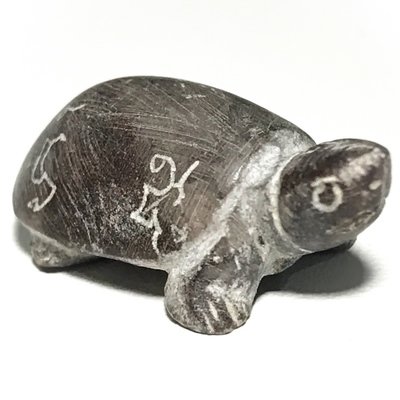
Apart from the above mentioned amulets, Luang Phu made a host of other forms of amulets including the Hanuman (In Galai Ngern and Galai Tong Daeng), then the Dtao Ruean turtle,, after which he created one set of silver and golden Hongsa Bird amulets, to remind people that Wat Bang Na, was built upon the sweat of the Raman People.
The Mong Raman (Ramen) people, are a hilltribe whose territory stretches from the Kanjanaburi district up to the borders of the Karen (Gariang Kor Ma) Horseneck tribe territory. Teir main population is within the borders of Myanmar, with a total population of 8 million, 114,000 of which are inside the borders of Thailand. Their Ethnic Origins come from Southern India.
Image: Devotees tend to the mummified mortal remains of Luang Phu Seng
Luang Por Seng’s corpse remains miraculously undeteriorated without mummification, on show at the temple of Wat Bang Na in a glass coffin, and is prayed to by masses of devotees who visit each day, to beseech his blessings.
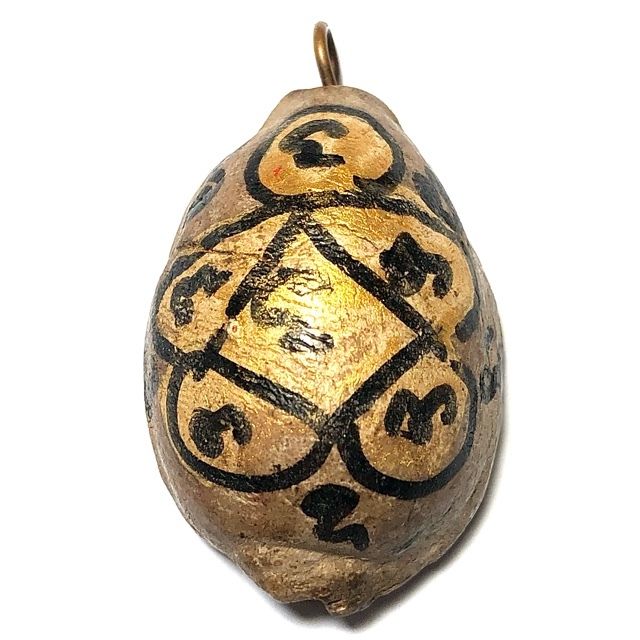
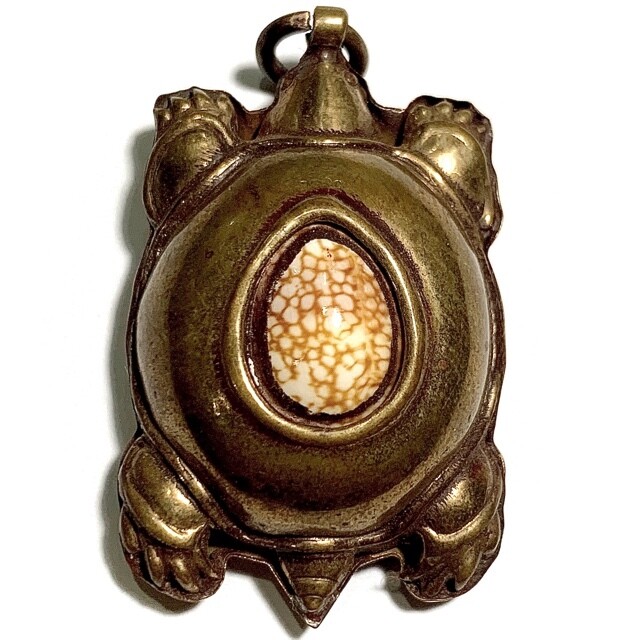
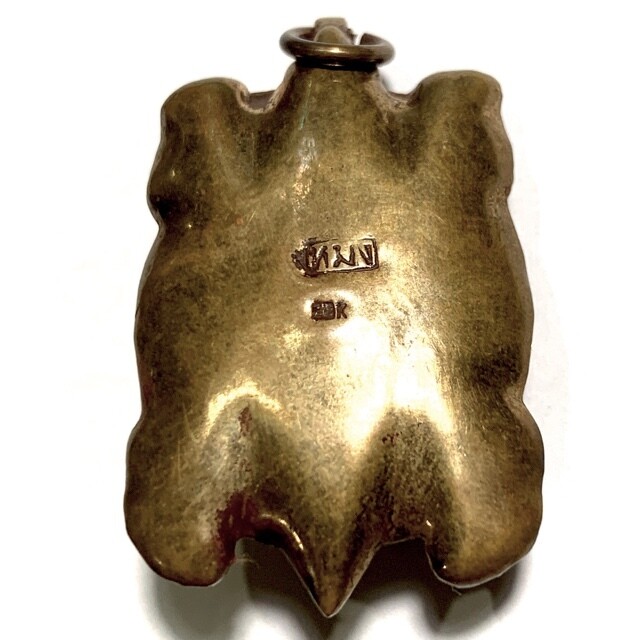
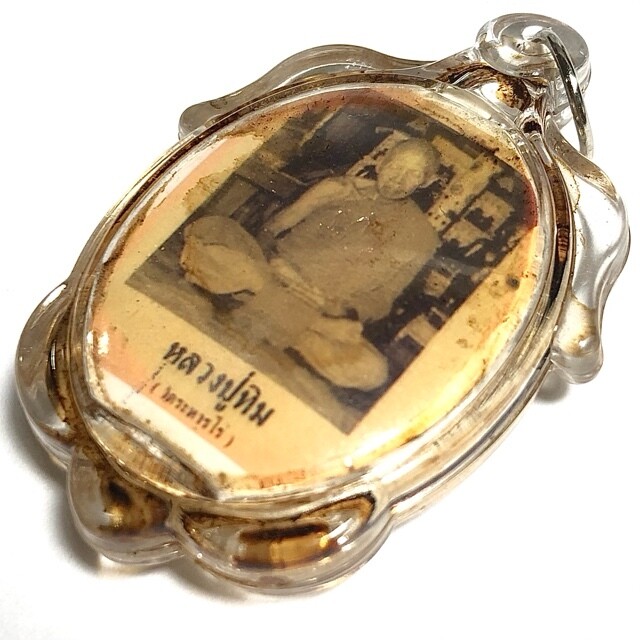
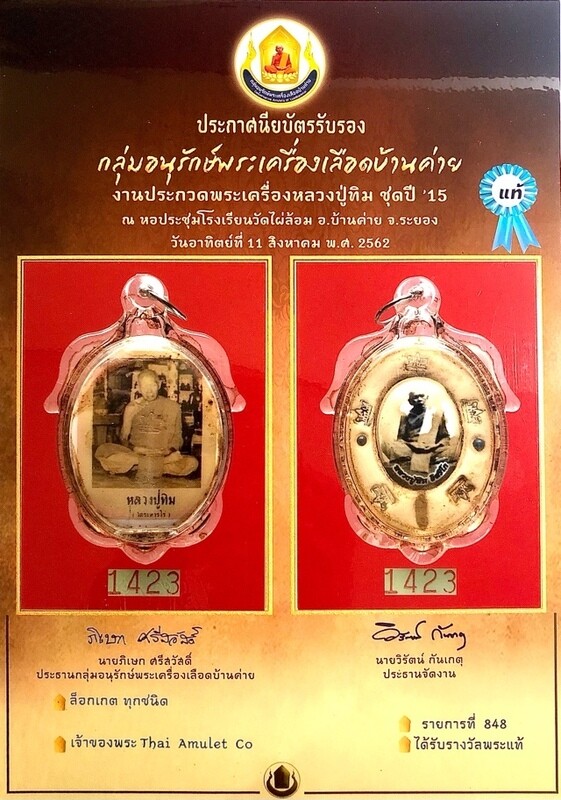
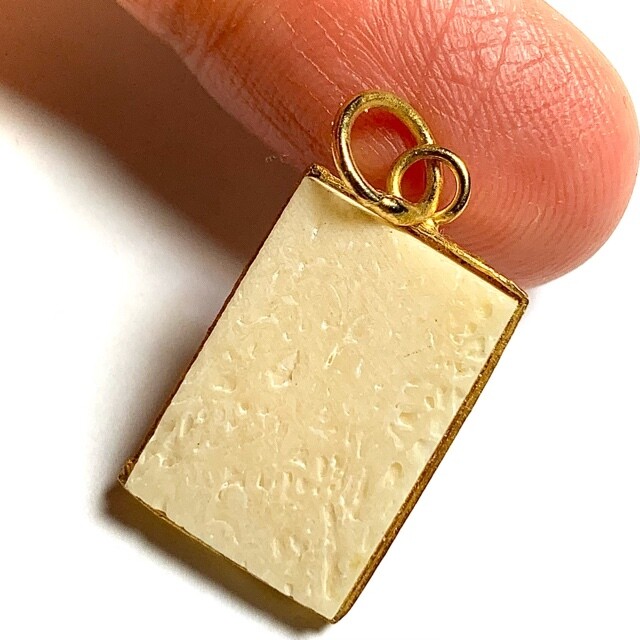
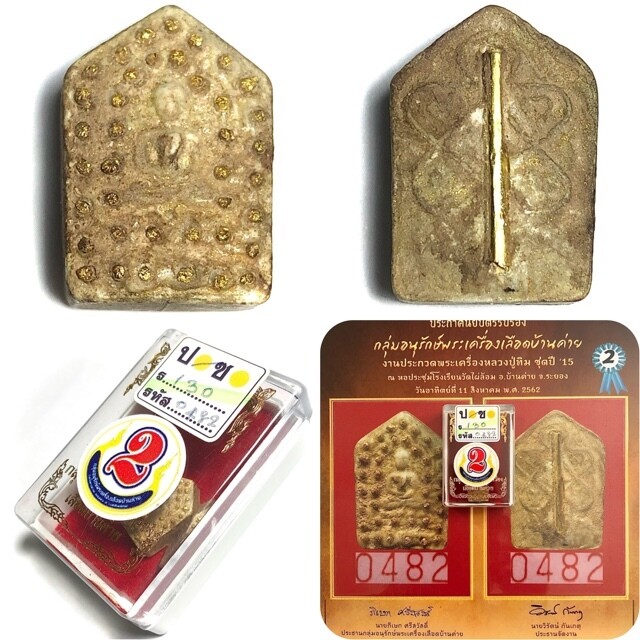
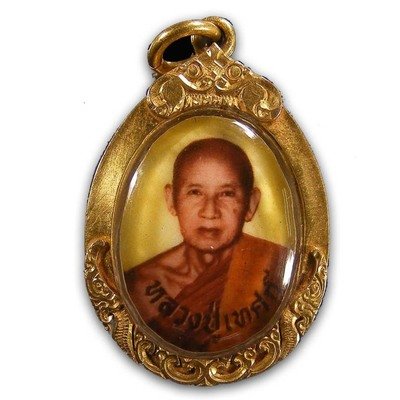
Pim Yai large size Photographic Guru Monk Locket, encased in a Tao Ruean Turtle shaped frame, in the image of Luang Phu Tim with A4 size Certificate of Authenticity, filled with Pong Prai Kumarn Muan Sarn Powders, with 2 Met Chanuan beads, 1 Met Khaw Sarn sacred Rice Grain, 4 Code Sala stamps, and a miniature Roop Tai photograph of Luang Phu Tim (hand inscribed).
Free Express Airmail Shipping Worldwide is Included. The Lockets were released in varous forms around 2515 BE, in the now famous and most preferred and accepted ‘Chud Pi 15’ series, 2 years before the monopolist financed 2517 BE series of amulets, which are now of much less popularity than the Chud Pi 15 series, due to new information resurging over the years between 2558 BE and 2560 BE, which revealed the true history of the amulets of Luang Phu Tim, dating from around 2495 BE to 2515, and opened up the doorway to the documentation of almost the full pantheon of amulets of Luang Phu Tim.
The rear face of the Locket is full of Pong Prai Kumarn with Yantra Powders. The Sacred Pra Pong Prai Kumarn of the Great Luang Phu Tim of Wat Laharn Rai is one of the most famous amulets of all time, and highly renowned for its true power to bring prosperity and good business, power of attraction and mercy charm to the wearer.
The Sacredness of the Pra Pong Prai Kumarn is legendary and unquestioned in Thailand, and its magical power is commonly accepted by all, and are considered to be amongst the most powerful powders in existence. Luang Phu Tim, is Internationally Acclaimed, for his famous Pra Kring Chinabanchorn, his Pra Khun Phaen Pong Prai Kumarn, and Look Om powder balls. As to the classic ‘Rian’ Monk coin Image amulets which have become all time favorites, and eternally, world famous classic amulets of the high end variety.
Luang Phu Tim Issarigo, is of course not only one of the most highly acclaimed and sought after Guru Monks for his amulets, he is the holder of the highest esteem in Thai Buddhist amulet history for Pong Prai Kumarn powders.
We of course guarantee authenticity with this item, as we do with all amulets in our showroom. Luang Phu Tim Issarigo, is of course not only one of the most highly acclaimed and sought after Guru Monks for his amulets, he is the holder of the highest esteem in Thai Buddhist amulet history for Pong Prai Kumarn powders.
The reason the Pong Prai Kumarn amulets of Luang Phu Tim became so world famous and popular, even in the time when Luang Phu Tim was still alive, is because everybody who owned one, recounted that business and personal success and prosperity had increased constantly and steadily since wearing the amulet.
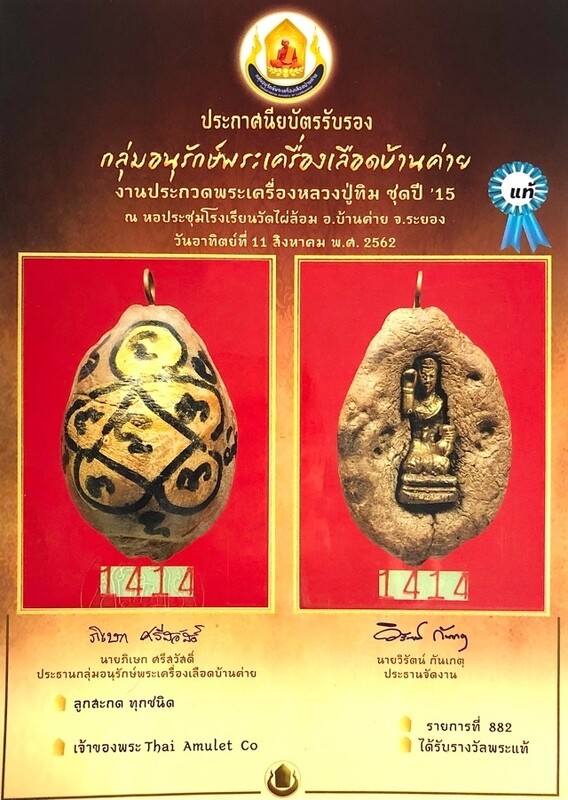
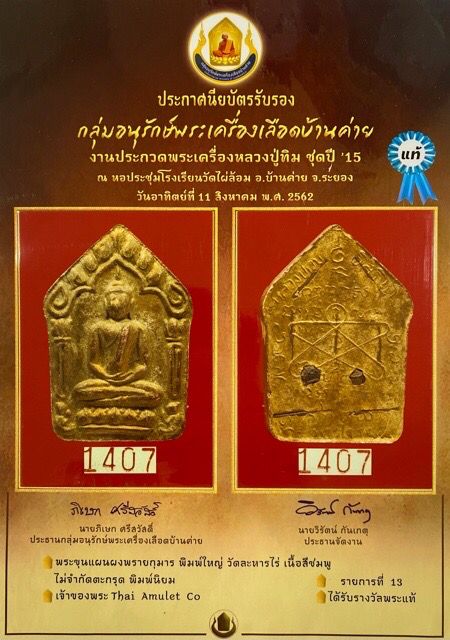
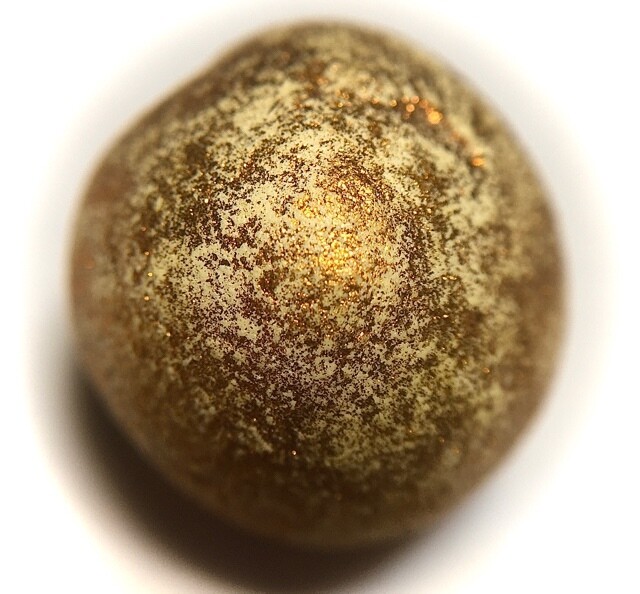
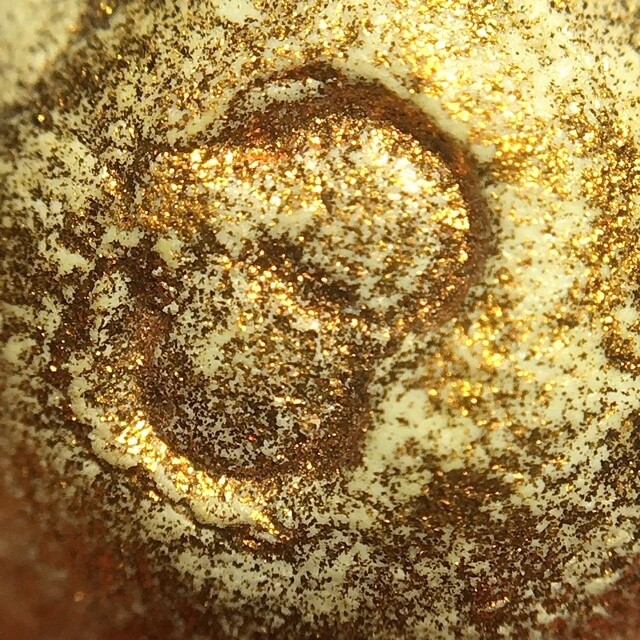
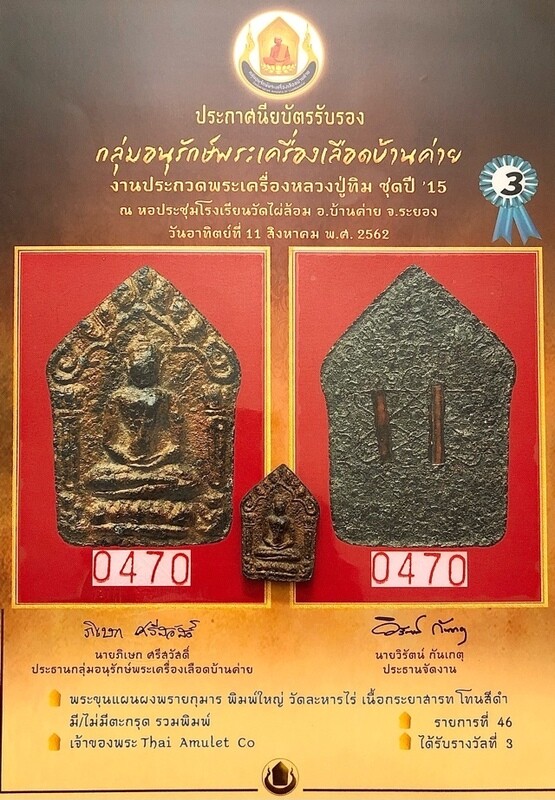
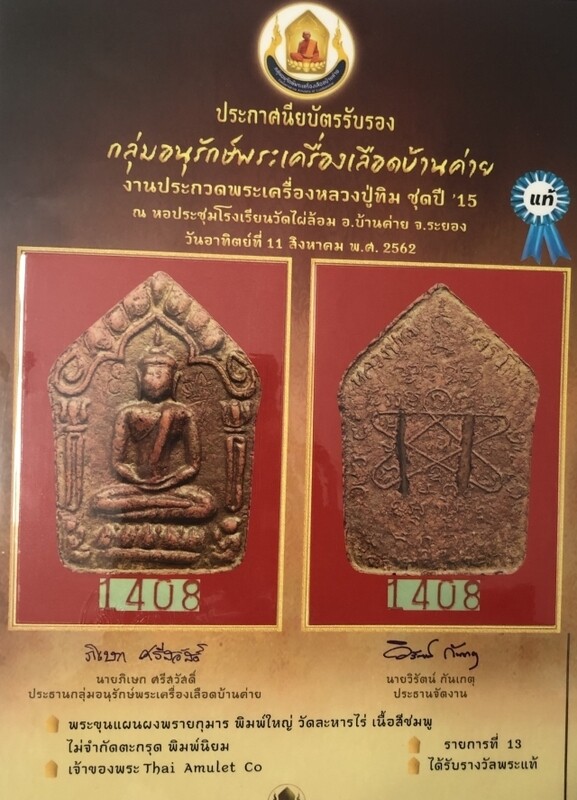
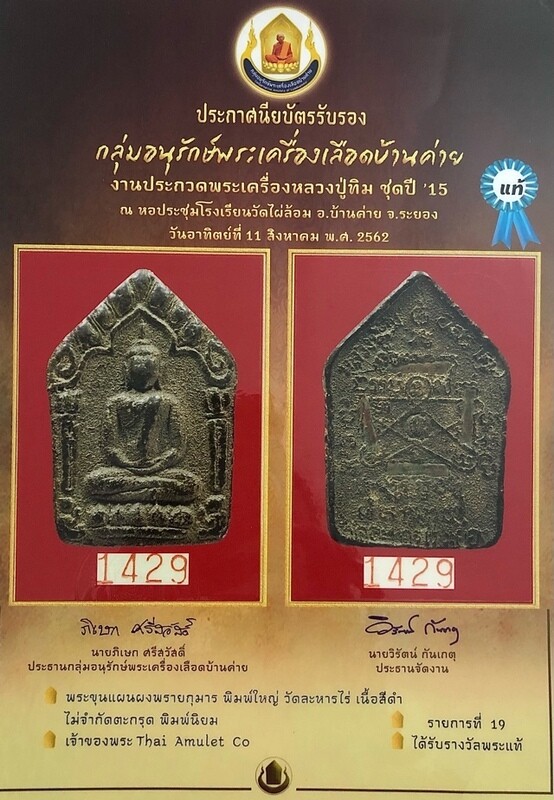
This amulet comes with official authenticity certificate made in the month of August of the 2562 BE Samakom Glum Anuraks Luead Ban Kaay Luang Phu Tim Amulet Preservation Society meeting, with signature of confirmation from its president Ajarn Dr. Phisek. Luang Phu Tim, is Internationally Acclaimed, for his famous Pra Kring Chinabanchorn, his Pra Khun Phaen Pong Prai Kumarn, and Look Om powder balls. As to the classic ‘Rian’ Monk coin Image amulets which have become all time favorites, and eternally, world famous classic amulets of the high end variety.
His Rian Jaroen Porn, and Rian Nakprok Paed Rorp, Rian Huang Chueam, Rian Mae Nam Koo, and Rian Sema are among the most highly sought after coin amulets of all. The Pra Kring Chinabanchorn amulet of Luang Phu Tim is one of his most expensive of all amulets, and extremely rare to find. He has various direct lineage apprentices, Who are continuing to progress and spread his most powerful and world-famous Wicha. Of all of these masters, perhaps the most famous, preferred, is Luang Por Sakorn, of Wat Nong Grub (also now deceased.
The next order of preference, one could possibly estimate the great Luang Phu Sinof Wat Laharn Yai, and equally so Luang Por Rat of Wat Pha Hwaay (Now taking first preference in place of Luang Por Sin, for his adherence to lower prices, and his large repository of Pong Prai Kumarn and See Pheung Khiaw LP Tarb, which is the largest remaining repository of Muan Sarn of all afilliated temples), Luang Por Rat (Wat Pha Hwaay), and Pra Ajarn Somkid, of Wat Beung Tata (Rayong).
KATA LUANG PHU TIM
Below Pic; The rear face of the locket is filled with Sacred Powders, including a large dose of LP Tim’s Pong Prai Kumarn, 2 Chanuan Metallic Blessed Beads, 5 Code Sala stamps with purple ink, met khaw sarn sacred rice grain, and a miniature Blessed photograph of Luang Phu Tim.
Luang Phu Tim made many famous amulets of immense esteem, such as the Pra Kring Chinabanchorn, Rian Semam Rian Jaroen Porn, Pra Sivali, Siarn Dto and Siarn Lek, Carved Krueang Rang (Talismans), Takrut, and other amulets, but was most famous of all for his Pra Khun Phaen Pong Prai Kumarn amulets.
The Lockets were released in the same series as the Khun Phaen 2515 BE edition. The Khun Phaen Luang Phu Tim has been one of the most popular amulets in the whole Pantheon of Thai Buddhist Amulets of the last century, and of all time. The amulets of Luang Phu Tim, are now almost impossible to encounter commonly anywhere in any amulet emporium, except for the most elite showrooms, and at elevated prices.
Below : the rear face of the Locket reveals ftwo Chanuan beads, 5 Code Sala stamps, Met Khaw Sarn, and a small Locket Roop Khai with image of Luang Phu Tim, embedded into the Muan Sarn Sacred Clay.
Below; Met Khaw Sarn Sacred Rice Grain inserted nto the Muan Sarn Sacred Powders
Below; Code Sala Ink Stamp, and Met Chanuan bead inserted nto the Muan Sarn Sacred Powders
Below; A Podcast from the ‘Amulet Talk’ Series, talking about the later, highly discussed and now top hit 2515 BE Edition Block 2 Pra Khun Phaen Pong Prai Kumarn of Luang Phu Tim, another top preferred and now number one amulet of the Muan Sarn Sacred Powders type amulets of Luang Phu Tim, since the “Block 2” 2515 BE series overtook the popularity of the ‘Block Raek’ 2517 BE series
Kata Bucha Luang Phu Tim
Chant to the Triple Gem first (Namo Tassa Bhagavato Arahato Sammaa Sambuddhassa) 3 times before Chanting specific Kata to Buddhist Amulets.
Then Chant :
Arahang Samma Samputto Nachaa Lidti – Anadtaa Agusalaa Tammaa Namoputtaaya Idti Sukadto Arahang Putto Namo Puttaaya – Ma A U Tugkhang Anijjang Anadtaa Putto Putto
(3 times)
Kata Luang Phu Tim, for calling Khun Phaen, Prai Diaw, Prai Koo, and other Prai deities (such as Kuman Tong)
(chant the Refuge to the Triple Gem first (Namo Tassa) 3 times)
Na Maedtaa Ja Mahaa Raachaa Taewiraacha Budtraa Budtree
Samana Prahmchee Taasaa Taasee Gasadtree
Paab Raach-Cha Idthee Naaree
Sappa Aehimuchisappang
Sappa Grotang Winaassandti
Bpiyo Taewamanussaanang
Bpiyo Prahmmaa Namudt-Dtamo
Bpiyo Naaka Subannaanang
Bpinintriyang Namaamihang
(the word ‘Bpinintriyang, is pronounced ‘Bpininsiyang’, because ‘tr’ in Thai becomes an ‘S’)
Be it his Roop Muean, Look Om Pong Prai Kumarn, Pra Khun Phaen, or the many models of Pra Pong Prai Kumarn Pim Boran, the Muan Sarn Sacred Powders of Luang Phu Tim and his empowerments are among the most highly regarded of all.
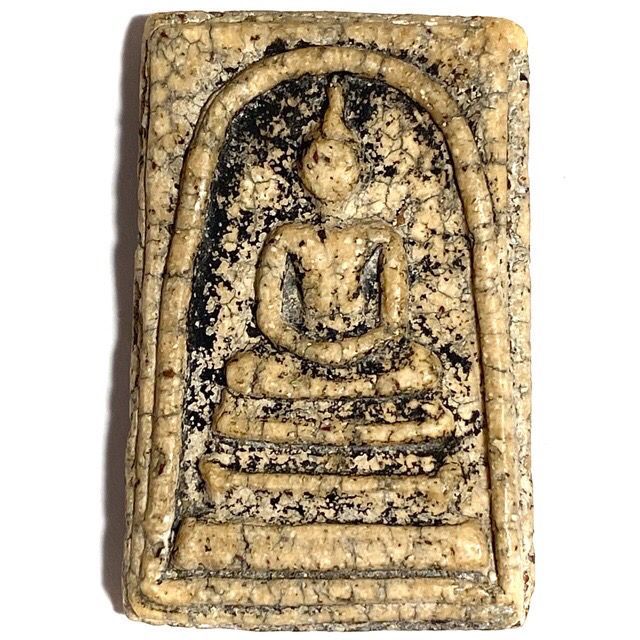
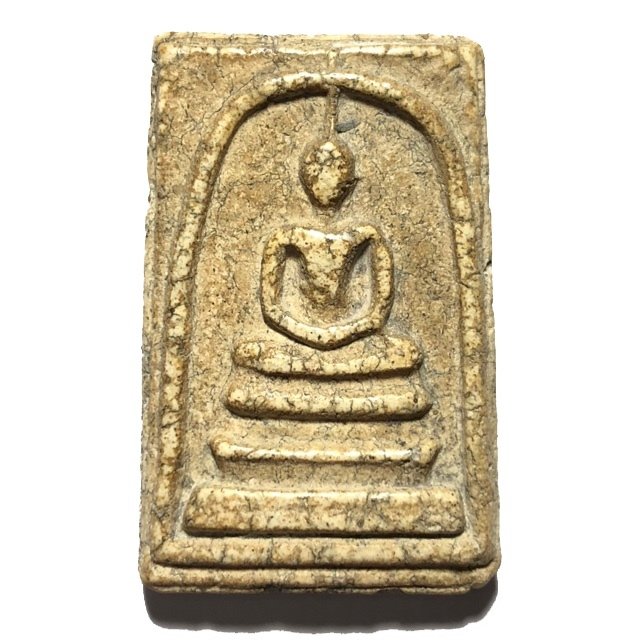
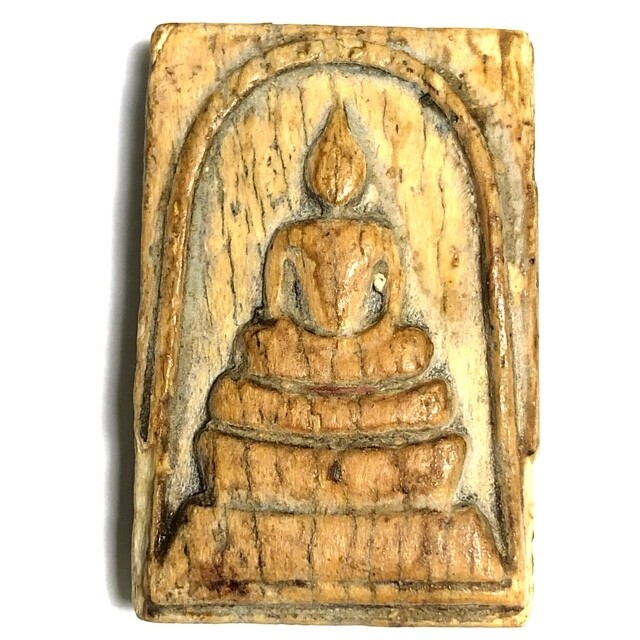
A most Exquisite and Officially Certificated Authentic Pra Somdej Wat Rakang Pim Gae Talu Sum Block Chang Luang Wijarn of Somdej Pra Puttajarn (Khrua Dto) Prohmrangsri, the Great Master of Wat Rakang, with Red Lacquered Surface, and all the classic features of an Ongk Kroo Model of this All Time. This particular exhibit is Extremely attractive to the eye, with its perfect balance of lacquer and open surface. The Pra Somdej Wat Rakang Kositaram of Somdej Pra Puttajarn (Dto) Prohmrangsri is the No. 1 Pra Somdej amulet of all time, and the most eminent member of the five regional top amulets within the Benjapakee Pantheon of Classic Thai Buddhist Amulets. On can also say it is perhaps the most famous of all Thai Amulets.
A Master Class ancient amulet of the Benjapakee Immortal Classic Family, the Pra Somdej Wat Rakang Pim Chang Luang Wijarn, with Rak Chart (ancient red lacquer), of the great Somdej Pra Puttajarn (Dto) Prohmrangsri of Wat Rakang Kositaram, this model is an extremely attractive Pim Niyom model of the ‘Chang Sip Moo’ Artisan Chang Luang Wijarn. This amulet comes with free solid silver casing if desired and selected in the encasement options (Please note; the custom casing can take from 3 – 10 days to custom encase). Bespoke Silver Frame casing is always enhanced with waterproof acrylic sealed windows to protect the amulet from the weather). You can order solid gold casing at extra price if desired too and we will invoice you according to current spot prices.
The Legacy of Somdet Phra Phutthācāriya (Toh) and the Sacred Somdet Amulet: “Kesa Thalu Sum” (Topknot Piercing the Arch)
Among the pantheon of Thai sacred amulets (phra khrueang), none is more revered than the Phra Somdet Wat Rakang—especially the archetype known as “Phim Yai Kesa Thalu Sum” (พิมพ์ใหญ่เกศทะลุซุ้ม), often translated as the Large Mold – Topknot Piercing the Arch. This particular design is believed to be among the most spiritually potent and artistically refined sacred objects created under the auspices of Somdet Phra Phutthācāriya (Toh) Phrommarangsi (Somdet To), the legendary monk of the Rattanakosin era (1788–1872), known as an Arahant-like figure and master of sacred sciences (saiyasāt).
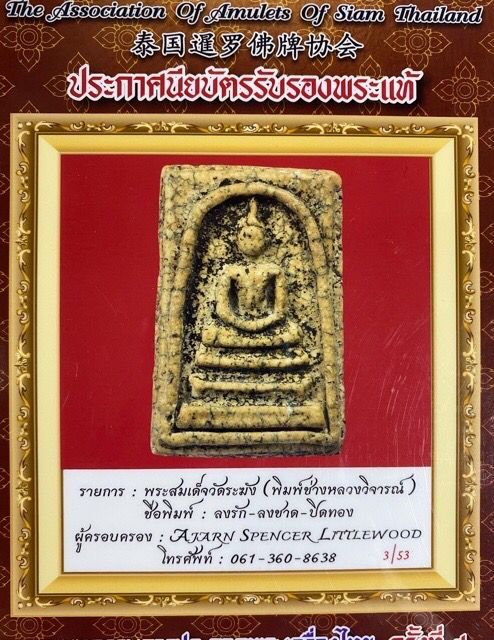
The Pra Somdej Wat Rakang Comes with A4 Size Plasticized Authenticity Certificate issued by the Association of Amulets of Siam Thailand, and comes with Free Express shipping, and Free Solid Silver Casing Included in the price. Please choose the free silver casing option to take advantage of this free offer. Free express registered shipping is worldwide and included automatically.
Below, A4 sized certificate of authenticity of this Pra Somdej Wat Rakang Long Rak Chart Pim Gaes Talu Sum Block Chang Luang Wijarn, The Artisan Chang Luang Wijarn was the Kroo Ba Ajarn (teacher) of all the other artisans of the Chang Sip Moo artisans, including the great Chang Luang Sittigarn and Chang Luang Wijit.
Understanding the Term “Gaes (Kesa) Talu Sum”
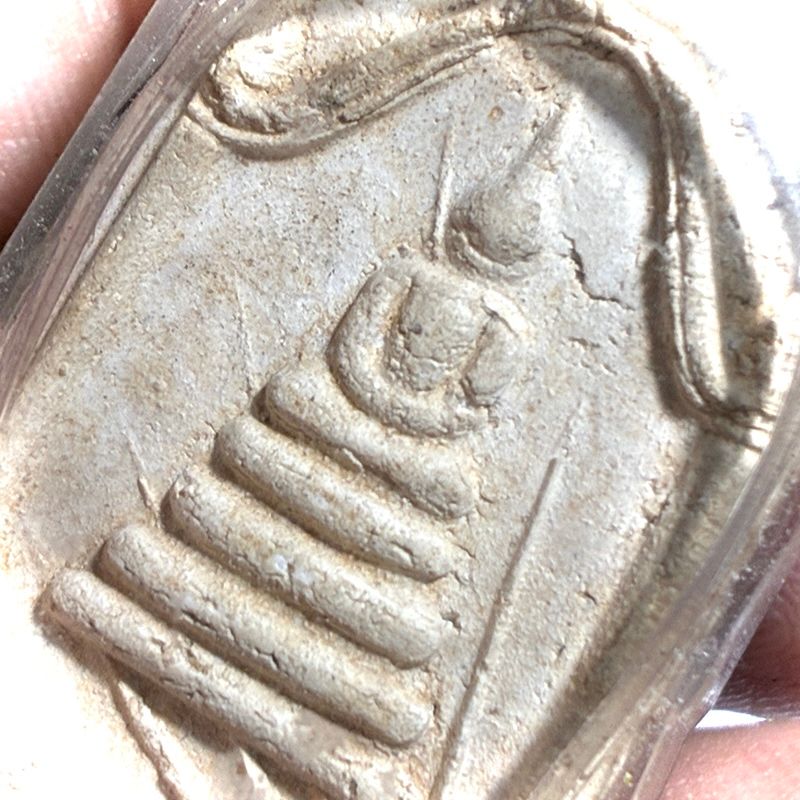
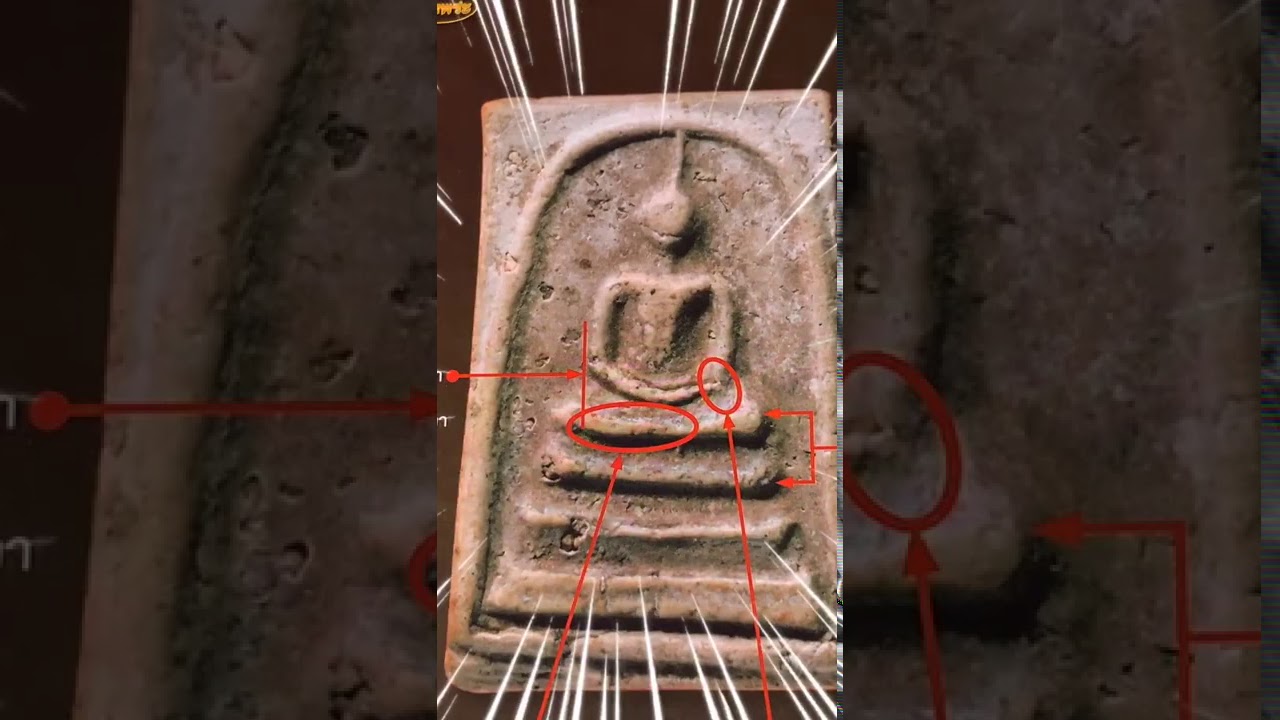
In Thai Buddhist amulet vocabulary, “kesa” (เกศ) refers to the flame-like ushṇīṣa or “topknot” on the head of the Buddha image. “Thalu” (ทะลุ) means “to pierce” or “go through,” and “sum” (ซุ้ม) is the ornate arched frame or halo encasing the Buddha’s seated image. So, Kesa Thalu Sum implies that the topknot reaches upward and pierces through the apex of the arch, a rare and desirable stylistic detail that only appears in a select few authentic master molds (phim ong krū – พิมพ์องค์ครู) from Somdet Toh’s era.
Below, is an 11 minute long video with full views and 12 x Macro closeups of the Muan Sarn Powders, wth Narrative from Ajarn Spencer Littlewood to enlighten the student on the various aspects of authenticity of a different exhibit which was also a lacquered version, and displays similar characteristics to this exhibit, with highly informative narrative by Ajarn Spencer, explaining various aspects of the studt, perusal and inspection of this tyupe of amulet, and some revelatory information about the amulet itself and the history of its making, and the Sacred Muan Sarn Content. This helps the student to understand and increase their expertise in recognising authentic Pra Somdej Wat Rakang Kositaram amulets of this model and type.
Who Was Chāng Luang Wichān (ช่างหลวงวิจารณ์)?
The iconic Kesa Thalu Sum mold is widely attributed to the craftsmanship of Chāng Luang Wichān Wijit Sittikān (ช่างหลวงวิจารณ์ วิจิตร สิทธิการ), a royal artisan of the Chang Sip Mū (ช่างสิบหมู่)—the Ten Royal Craft Guilds of Siam. These were elite artisans directly serving the Chakri dynasty, skilled in sculpture, lacquer work, gold-smithing, and iconography. Wichān was said to have personally carved molds under the commission or guidance of Somdet Toh himself, resulting in highly refined, geometrically perfect, and spiritually resonant Buddhist images.
His mold—known as the Wichān Block—exemplifies regal aesthetics fused with spiritual subtlety. When found on authentic Wat Rakang specimens, it often features:
A perfectly symmetrical arch (sum) enclosing the Buddha image
The kesa (topknot) extending straight upward, piercing the arch
Subtle curvature of the seated Buddha’s silhouette
Triple base lines (samchan) with precise spacing
Signs of aged lacquer (rak chāt chīn) from the original red Chinese lacquer finishing
The Wichān Block vs. Other Blocks
In the study of Somdet amulets, experienced phra sen (พระเซียน – amulet masters) distinguish between various molds (phim) based on micro-details and matrix analysis. Three major molds compared at the elite level are:
Wichān Block (บล็อกช่างหลวงวิจารณ์) – Characterized by its “Kesa Thalu Sum,” fine lines, and sophisticated surface.
Sīao Noi Block (บล็อกเสี่ยวน้อย) – Slightly more primitive in depth but very ancient in clay composition. This block is often less crisp but bears classic signs of age and high energy (sāk sit).
Wang Nā Block (บล็อกวังหน้า) – Possibly produced by artisans from the Front Palace (Wang Nā) under royal patronage, with a broader face and deeper relief.
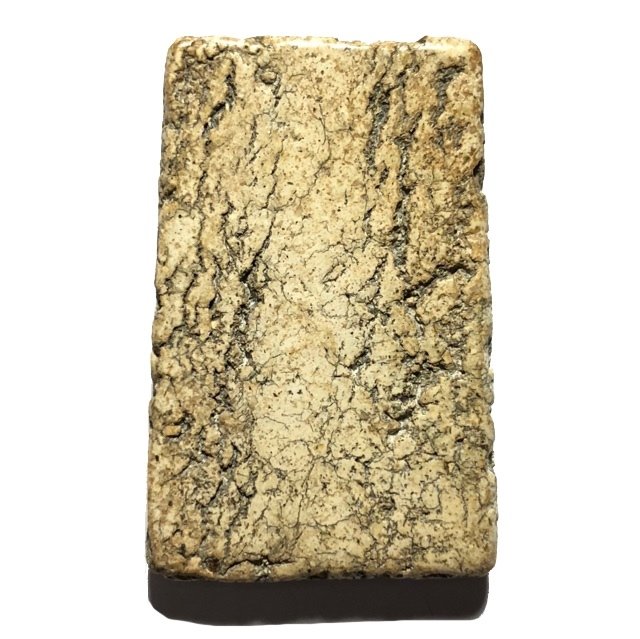
A truly ancient amulet made Circa 2390 – 2396 BE. The rear face of this exhibit is inimitable and has immensely beautiful markings, of a classic Pra Somdej Wat Rakang. Various exhibits display different textures on the rear faces, for they were laid on various surfaces to sun dry, ranging from marble stone, wood, metal, and other surfaces, resulting in textures ranging from stone-like fossilized effect, granular, crackled, to the fine scratches on the rear face of some, which come from laying them to dry on mai gradan wooden boards.
In truth, no two Pra Somdej Wat Rakang are the same, and each amulet has its own individual character, which is of course one of the many aspects which form part of what makes the Pra Somdej Wat Rakang the title holder of the ‘King of Thai Amulets‘.
“Gaes Talu Sum” as One of Many Pīm within Dtamrā
While “Gaes Talu Sum” (เกศทะลุซุ้ม) refers to a distinct style, it is only one recognized Pīm (พิมพ์) among many listed in the classic reference Dtamrā Phra Somdej Wat Rakang. These canonical molds include:
Gaes Talu Sum
Phim Yai (Large block, plain arch)
Phim Sam Chan (Three-base lines)
Phim Paa Singha (Lion-cloth border)
…and others.
The Wichān Block belongs specifically to the Gaes Talu Sum group and is often called a Pīm Ong Krū (พิมพ์องค์ครู – ‘teacher mold’), signifying its canonical status as an original master mold.
The Chang Sip Mū (ช่างสิบหมู่): Ten Royal Artisans of Siam
The Chang Sip Mū (Chāng Sip Mū)—literally “Ten-Craft Guild”—was an elite corps of artisans instituted under King Rama I of Siam. These ten crafts included:
Carving (chāng chākā) – wood and stone
Gilding (chāng phliap) – gold leaf application
Casting (chāng lom) – metals
Engraving (chāng tschāt)
Drawing & Painting (chāng phithāng)
Lacquerwork (chāng rō rät)
Sculpture (chāng chāt)
Manufacture of Buddha images (chāng phra pinyo)
Stucco & inlay (chāng phaeng)
Hidden relief and finishing (chāng lath)
These artisans were established to revive and preserve sacred craftsmanship such as Buddha-image iconography, temple decoration, and monastic utensils. Chāng Luang Wichān—a Chāng Luang rank artisan—expertly blended multiple crafts, especially casting, engraving, and lacquerwork, to produce master molds like the Wichān Block.
Three Eras of Phra Somdej Production at Wat Rakang Kositaram
According to Dtamrā Phra Somdej Wat Rakang (ตำราพระสมเด็จวัดระฆัง), production under Somdet Pra Phutthācāriya (Toh) Phrommarangsi is traditionally divided into three eras:
1. Yuk Ton (ยุคต้น / Early Era, c. 1860s)
Mix: Fine limestone crushed to powder, phong itthi (powerful clay blend)
Pīm: Coarse molds with less defined lines
Ritual: Solo empowerment with Phra Trisaranāgata paritta
Marks: No lacquer finish; rough, sandy texture
2. Yuk Klang (ยุคกลาง / Middle Era, c. 1870s–1880s)
Mix: Addition of phong pārisaṇḍa powders, remnants of old monk’s robes
Pīm: Molds refined by Chang Sip Mū, including the Wichān block
Ritual: Multi-stage consecration with Jinapañjara and Mahā Meṭṭhā chants
Marks: Early signs of Rak Jeen Borān—thin lacquer coat, slight red tint
3. Yuk Plāi (ยุคปลาย / Late Era, c. 1890s until Somdet Toh’s passing in 1872)
Mix: Highly refined batches with small shell inclusions
Pīm: Final mold-state perfected; deep relief, crisp lines
Ritual: Full-scale empowerment ceremonies attended by royal court
Marks: Visible Rak Jeen Borān with Hān (micro-cracks) and color patina
The amulet comes with the A4 size certificate of authenticity as a Pra Somdej Wat Rakang Long Rak Pid Tong of Somdej Pra Puttajarn (Dto) Prohmrangsri, with definition of the preferred artisan as authentic issued from the Pra Tae Mueang Siam Amulet Association.
An Immortal Classic and one of the most famous Thai Buddhist Amulets of all time, as well as being amongst the top preferred amulets of the serious devotee and wealthy collector of the accepted amulets of Somdej Pra Puttajarn (Dto) Prohmrangsri, of Wat Rakang Kositaram, whose Pra Somdej are the number one amulets of all time, be they from Wat Rakang, Wat Bang Khun Prohm,or Wat Gaes Chaiyo.
Made almost 2 centuries ago, the Pra Somdej Wat Rakang can be considered the number one amulet of all time in Thailand for its historical fame and legendary, and thae reputation of its maker to be the number 1 in all Thai History for Pra Somdej Amulets.
Rak Jeen Borān (ลงรักชาดจีนโบราณ): Ancient Red Lacquer
Rak Jeen Borān is a thin red lacquer derived from ancient Chinese formulas. It was popularly applied to selected pīm in the Yok Klang and Yok Plāi eras. Artisans would:
Dip the cured amulet in lacquer bath
Allow it to settle into fine cracks
Let it cure naturally under temple shade
Visually, it leaves a warmreddish hue, especially in recessed areas and seen as a micro hairline cracks (“hān”). The lacquer gave spiritual seal and aesthetic refinement—only a portion of issued amulets received this treatment, based on batch size and ritual occasion.
The Pra Somdej Amulets of Somdej Dto, are officially recognized as coming from one (or all) of four Royal temples Classed as three, because Wat Bang Khun Prohm Nai and Wat Intra Wiharn Bang Khun Prohm, are both located within the same temple boundary). Namely; Wat Intra Wiharn (Bang Khun Prohm Nai), Wat Gaes Chaiyo, Wat Mai Bang Khun Prom, and of course last but not least, Wat Rakang Kositaram. Most of these amulets are given a Puttapisek blessing ceremony in the temple where they were made, but then travel to at least two or three of the other temples to be laid under the ‘Pra Pratan’ (main Buddha statue in the shrine), and absorb the prayers of the Sangha (Monks), for further sacredness and power.
The Pra Somdej amulet, is one of the ‘Benja Pakee’ official set of five national amulets of Thailand seen as the most sacred, desirable and representative of every region of Thailand. In recent decades various Kru hiding place finds have been discovered in temples where Somdej Dto built statues and traveled, such as the Kru Wat Kanlayanamit, and Kru Wat Sadter finds.
This amulet comes with its certificate of authenticity in form of a A4 sized plastified certificate photo of the Chomrom Pra Tae Mueang Siam Amulet Appreciation society of Siam Thailand, and complimentary box with authenticity confirmation sticker. We offer free Solid Silver, Stainless Steel, or Waterproof Casing with this amulet (or gold at extra price), whichever you prefer. Free Express Shipping is also included in the price
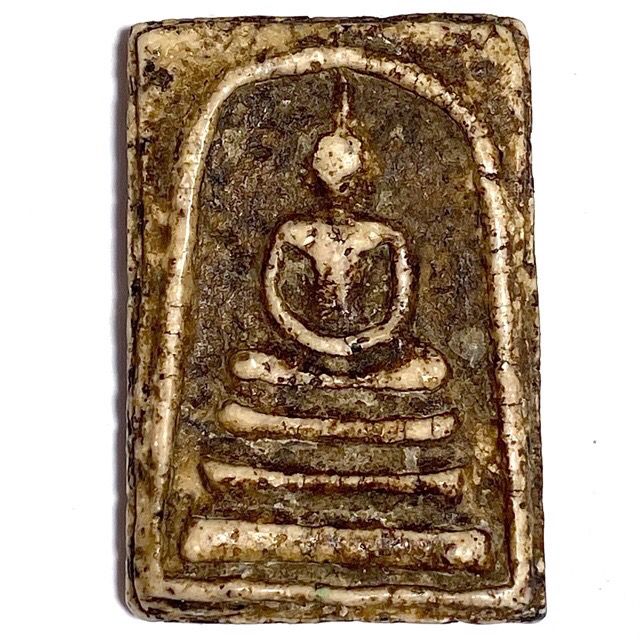
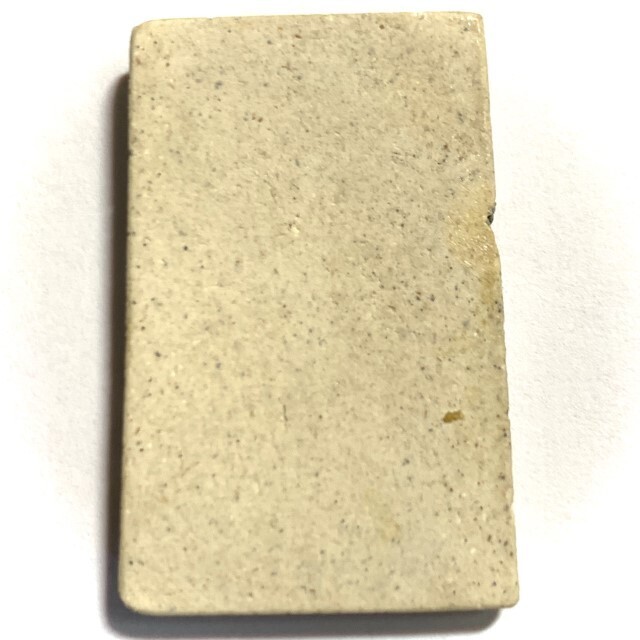
The rear face shows the presence of all the classic features and Muan Sarn ingredients of a true Pra Somdej Wat Rakang of Somdej Dto, with a beautiful lined pattern resulting from shrinkage and drying over almost two centuries of ageing, and which has added to the character and increases the ease of authentication. This kind of rear face pattern is highly preferred among aficionados and serious devotee-collectors, for its classic aged appearance.
The contents of the Muan Sarn Sacred Clay reveal the necessary aspects and content expected from an authentic Pra Somdej Wat Rakang. The design of the front face is exquisite, as were all the block presses carved for Somdej Dto by the artisan Luang Wijarn, one of the royal artisans of the Chang Sip Moo group of artisans.
Pra Somdej Wat Rakang is one of the classic Pra Somdej amulets of Somdej Dto available, along with Pra Somdej Wat Gaes Chaiyo, and the Pra Somdej Wat Bang Khun Prohm amulet as far as popularity, beauty, sacredness of Puttapisek ceremony and price range.
The Pra Somdej Wat Rakang amulet is the Keystone and Master amulet (Ongk Kroo) for all other Pra Somdej amulets. It is an image in the likeness of the Buddha sitting on a Dais, which was essentially created by Somdej Pra Puttajarn (Dto) Prohmrangsri, of Wat Rakang Kositaram. There are various different ‘Pim’ (models) with varying design features.
The Pra Somdej Wat Rakang, are considered to have extremely powerful Buddha magic in them due to the richness of sacred powders and powerful blessings contained within from great master Somdej Dto. Its general appearance is that of an oblong about 2.4 cm wide up to 4 cm high (varies between these sizes), made from white sacred powders mixed together.
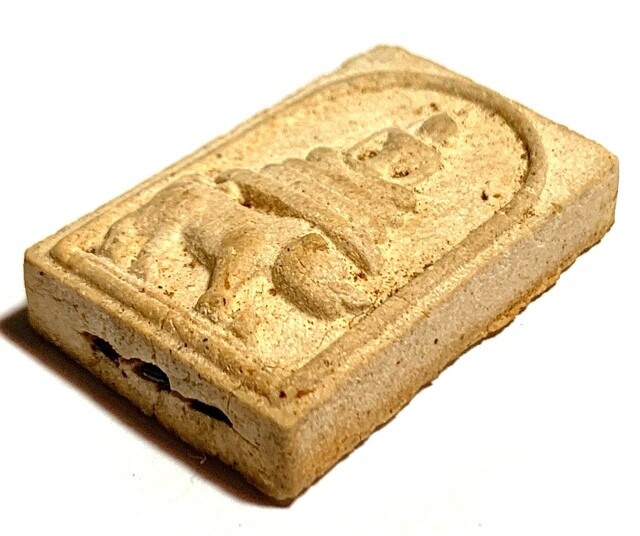
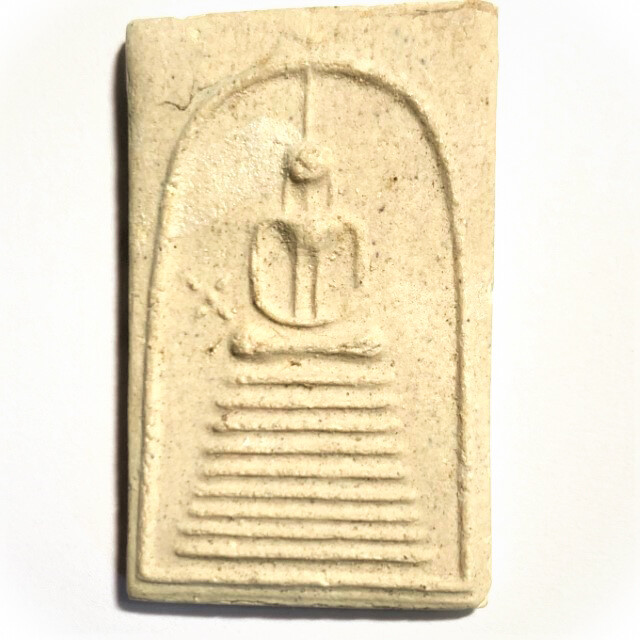
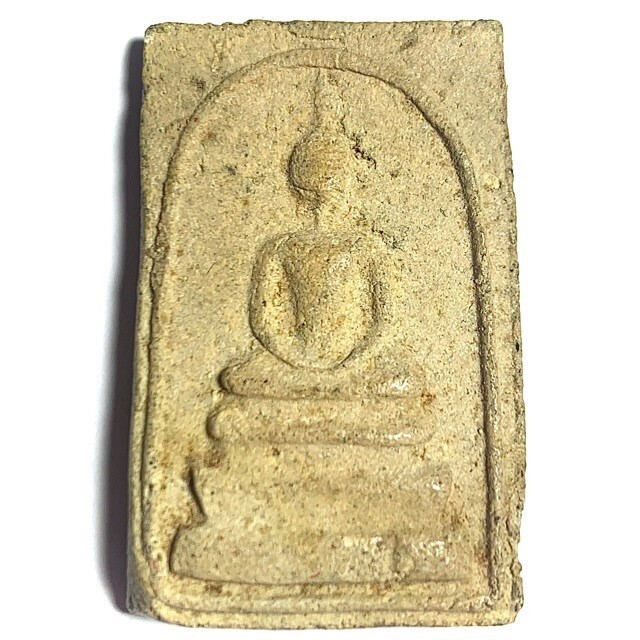
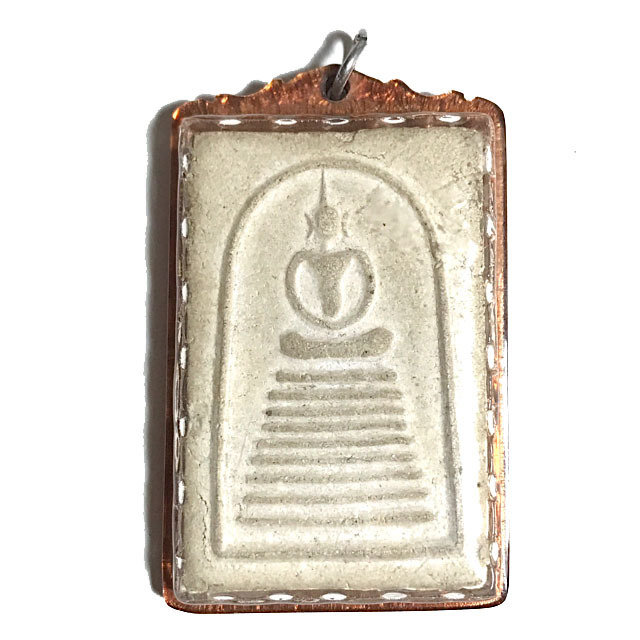
The Pra Somdej Wat Rakang Kositaram Pim Gaes Talu Sum is Similar to the Pra Somdej Pim Pra Pratan, but has the ‘Pra Gaes’ Topknot piercing the arch at the top of the amulet. The Pim Jarod Sum touches the arch or approaches it.
The main Ingredients of the amulets (Muan Sarn Samkan) were made from a base of sea shells, dried rice left from alms round, the five sacred magic powders of Somdej Dto, and ‘Nam Man Dtang Iw’ (special oil for mixing). Nam Man Dtang Iw, or Tung Oil in English, is a preferred oil for mixing and curing amulets with, for it is superior to any other oil as far as water resistance is concerned (one reason why Pra Somdej amulets can be soaked in water without going soft). The oil is much more resistant to mold than its derivatives, such as linseed oil.
The Dtamra must be made by creating exactly 84,000 amulets, equal to the number of Suttas of the Tripitaka. There are different Pim Song (shapes and sizes) of Pra Somdej Wat Rakang, but those which are officially recognized and listed by the ‘wongarn Pra Krueang’ as far as Somdej Wat Rakang amulets are concerned, basically consist of the following officially recognised Pim of Pra Somdej amulets; Pim Pra Pratan, Pim Yai Niyom, Pim Chedi, Pim Prok Po, Pim Gaes Bua Dtum, Pim Gaes Talu Sum, and Pim Thaan Saem.
Somdej Wat Rakang amulets have various surface textures, categorized as ‘Nuea Laiad’ (fine texture cement mixture), ‘Nuea Hyaab” (rough textured cement mixture), ‘Nuea Gae Nam Man Dtang Iw’ (old looking textured cement mixture), otherwise known as ‘Nuea Sangkhayaa’, and ‘Nuea Gae Bpoon’ (old cement mixture).The basic structure of the design of the classic Somdej, (and almost all Somdej amulets from other temples too), is that of the Lord Buddha sitting inside a Bell (the word ‘Rakang’ means ‘Bell’ – ‘Wat Rakang’ means ‘Temple of the Bell’).
This is the primary importance of the Somdej amulet in the sense that Somdej from most temples depict the Buddha sitting within a bell which is represented by the arch. The arched structure in amulets is called a ‘Sum’. Although these rules do not necessarily always apply (there are a lot of Somdej which are in circulation which are most certainly authentic, but which are not preferred in the collector scene)
There are many less preferred editions which do not fulfill these standard rules of recognition, which is of course one of the reasons why some Somdej Wat Rakang amulets are able to sell for high prices and enter competition, get certificated etc, and why some are not, despite their most probable authenticity.
The difference in the various mixtures made for each ‘Pim’ have led to differing textures and appearances in the Pra Somdej collections, which provides for a varied and fascinating niche interest, which one can verily spend a whole lifetime studying and accumulating experience and knowledge about this, the King of all amulets.
The Gaes Talu Sum amulet, especially in its Wichān Block manifestation, is more than a religious token. It is a national archetype—an object that embodies spiritual lineage, royal patronage, and artisanal mastery.
To possess such an amulet is to inherit a sacred narrative written not only in clay and lacquer but also in karmic resonance. It is to hold, in one’s palm, a silent sermon from Somdet Phra Phutthācāriya (Toh)—a sermon of stillness, protection, and profound metaphysical elegance.
In the global context of sacred objects, few artifacts match the complexity, beauty, and theological depth of the Phim Yai Gaes Talu Sum. And none so fully encapsulates the unity of Thai spiritual identity, Buddhist doctrine, and royal craftsmanship as the Somdet amulet of Wat Rakang Kositaram.
Ancient Amulet - Thai Buddhist Pra Niyom Category Amulets
Ancient Amulet. Thai Buddhist Pra Niyom ('Pra Niyom'; meaning 'High End Preferred Class Antique amulets'). Fine Authentic Amulets from the Great Thai Buddhist Sorcerer Monks, Lersi Ascetics, and Lay Masters of Olden Days
Deep Dive into the Sacred “Ya Wasna Jinda Manee” Powder
1. Introduction – The Long‑Lived “Ya Wasna” Tradition Inscribed on Ancient Stelae
The “Ya Wasna Jinda Manee” (Jinda‑Manee Medicine Powder) originates in the Ayutthaya period under King Pra Phanarat (VII) of Wat Pa Kaeo (2360‑2424 BE). The monarch, an early pioneer of spiritual‑medical synthesis, recorded the legend in the treatise “Jinda‑Manee Ottas phra Pilas”, a manuscript scribed on hardened animal hide and embellished with the “Silaanam‑Thad” glyphs—symbols denoting the twelve sacred herbs and the sanctified “Sangasar” (milk‑of‑virtue) derived from intensive monastic austerities.
Through successive custodians—most notably the priest‑scholar “Pra Sangkhika” and the 20th‑century reviver Luang Pu Boon of Wat Klang Bang Kaew (Nakhon Pathom)—the formula has been conserved, adapted, and re‑articulated for contemporary practice.
2. Historical Lineage from the Ayutthaya Court to Luang Pu Boon
2.1. King Pra Phanarat – The Spiritual Sovereign
Educated by the legendary “Professor Trai‑Silp,” a master of dragon‑stone alchemy, the king learned to blend the mystical “Sangasar” essence with the root of the Jinda plant (Jinda). His records were etched on “dragon‑vellum” in three sections: formula (art), incantation (faith), and precept (ethical conduct).
2.2. Transmission Pathway
1. Pra Ajarn Traisin (Pra Trai‑Sri): Court astrologer‑healer who safeguarded the original manuscript from distortion.
2. The “Kru Pokkela” family: Guardians who secularised the recipe, converting it from a strictly monastic preparation to a “global powder.”
3. Luang Pu Boon (born 2462 BE, 1915 CE): Apprenticed under the erudite master Sri Ajarn Saarika at Wat Khalm Jaar, where he systematized the “Ya Wasna” methodology into a reproducible “powder‑craft.”
3. The Sacred Herbarium – “Jinda‑Manee Ottas phra Pilas”
No.
Herb
Description
Principal Property
1
Jinda (Jinda)
Deep‑grey emerald root, thriving in dense forest floor.
The traditional proportion follows the “Four‑Pīs 12‑line” rule: Jinda : Manee : Ottas phra Pilas : Sangasar = 4 : 2 : 1 : 1, finely pulverised after the primary grinding.
4. Ritualistic Grinding and Pellet‑Forming – The Art of “Sily Banchong”
4.1. Auspicious Timing – Full Moon of the Twelfth Lunar Month
The twelfth month is regarded as the “Axis” month, heightening the four‑directional (Chatur) flux. The chief grinder (a senior bhikkhu) occupies the “Sacred Cool Pavilion” flanked by four gilded hammers to safeguard the process.
4. “Sting Vinyan Jit‑Jit, Kanitam” – aligns mind and body into one.
Each mantra is uttered once per breath (inhale‑exhale) for nine cycles, producing a “breath‑syrup” that animates the powder into a luminous “seed of heaven.”
4.3. Physical Parameters
Temperature: 21‑23 °C (the “Cess” zone) to allow blue‑hued atoms to settle into a relaxed state.
Tools: “Crystal Aum Phra‑Phrang” grinder (a marble‑laden mortar) paired with a “Golden Lantern” pestle cast from pure gold.
4.4. Pellet Formation (“Jinda‑Manee” beads)
Technique “Ung‑Yung”: left palm steadies the cold “stone‑clay,” right hand tempers it with the warm “light‑grind,” forging a natural‑cosmic resonance.
Standard mass: 1.6 g per bead (the sacred numeral “one‑point‑six”).
Post‑formation, the master offers a brief dedication, channeling “aura‑stream‑element” into each bead before placing them on an “ancient stone altar” for final energisation.
5. Mythic Correlation – The “Jao Ngo Pa” Narrative Within the Sangkh‑Tong Epic
Side Story – Jao Ngo Pa (the Forest King) and the “Sangkh‑Tong” Legend
In the classical Thai epic “Sangkh Tong” by Si Sunthorn, the hero Jao Ngo Pa, a sea‑captain of the “Lion Ship,” receives a divine boon from the sorceress Phantharat. She commands the “fish‑calling spell” that draws waters from the “Black‑Lake of Heaven,” enabling Jao Ngo Pa to harness the “Jinda‑Manee chant.” The chant, “Jinda‑Ma‑Ni‑O‑Satha,” functions as a mystical summon, compelling aquatic spirits to accompany him eternally. The resulting blessings confer imperishable vigor and a “taste of eternity” upon the user of Jinda‑Manee, symbolic of a life free from corruption.
The narrative intertwines three symbolic elements:
Fish‑calling voice – aligns human consciousness with natural rhythm.
Radiance of the “ghost‑child” – restores chronic ailments.
Night of the forest fruit – amplifies destiny’s brilliance.
Thus Jao Ngo Pa is not a peripheral character but a mythic conduit, embodying the union of celestial “Manee” (heaven) and terrestrial “Jinda” (earth). This synthesis underpins the therapeutic philosophy of Ya Wasna Jinda Manee.
6. Buddhist Merit, Meditation, and Clinical Applications
6.1. Integration with Sīla and Samādhi
The grinding ceremony must be performed under the “Year‑long Vibhanga State 3” meditative posture, allowing the “Jinda‑Manee seed” to attain a “position‑free peace.” Simultaneously, the practitioner’s mind is fixed on the incantation, creating a “state‑of‑readiness” (anu‑bala) that energetically charges the beads.
A field study among Bangkok residents who ingested the powder for three consecutive months reported a 40 % increase in self‑rated “clarity of insight” (measured by the “Sapphira Wellness Index” of the Thai Herbal Society).
7. Conclusion – The Holistic Essence of Ya Wasna Jinda Manee
Ya Wasna Jinda Manee transcends a mere phytochemical formula; it is a “sacred art” that fuses natural potency (Jinda + Manee), Buddhist ethics (sīla‑samādhi‑paññā), occult invocations (chant‑laden pelletisation), and mythic symbolism (Jao Ngo Pa, Phantharat). The resulting micro‑dose operates simultaneously as a physiological tonic, a meditative focal point, and a cultural talisman that nurtures health, mental equanimity, and auspicious destiny.
Ajarn Spencer Littlewood & Sentinel Agent Gemini Unleashed for ancientamulet.com All rights reserved.
Wat Klang Bang Gaew famous mainly with the Public for its great Master Luang Phu Bun, is an Ancient Temple in Nakorn Pathom. It is home to a Lineage History of 4 great Ordained Masters, 3 who have Passed On (Luang Phu Bun, Luang Por Perm & Luang Phu Juea), and the Current Master, Luang Por Kong (Sanya). Luang Por Sanya is proving to continue in the same Trajectory as his Predecessors, and has created a long History of Deeds and released a large Pantheon of Amulets in the Lineage tradition of his Mentors, Luang Phu Bun, Luang Por Perm and Luang Phu Juea.
The Wat Klang Bang Gaew Master Lineage is a fantastic choice for Hunters & Collectors of Fine Master Class Amulets. This is because the Amulets of this Temple, and its Masters, range from the present Day master Luang Por Kong (Sanya), back through Luang Phu Juea, Luang Por Perm, and on, to the Great Luang Phu Bun.
A powerful continued Lineage of Masters have brought Wat Klang Bang Gaew to the Forefront of both the Ancient and the Modern Amulet Scenes, stretching back to the times of Luang Phu Bun, through the Era of Luang Por Perm, and the Great Luang Phu Juea Bpiyasilo, to its present Abbot, Luang Phu Sanya (Kong).